
As-If Transitions
At a Glance
- Time: 30-60 seconds
- Prep: None
- Group: Whole class
- Setting: Any classroom
- Subjects: Universal - works between any activities
- Energy: Medium
Purpose
Transform mundane classroom transitions (moving to seats, lining up, getting materials) into imaginative, energizing moments by having students act "as if" they're in a different scenario, resetting classroom energy while moving efficiently and joyfully from one activity to the next.
How It Works
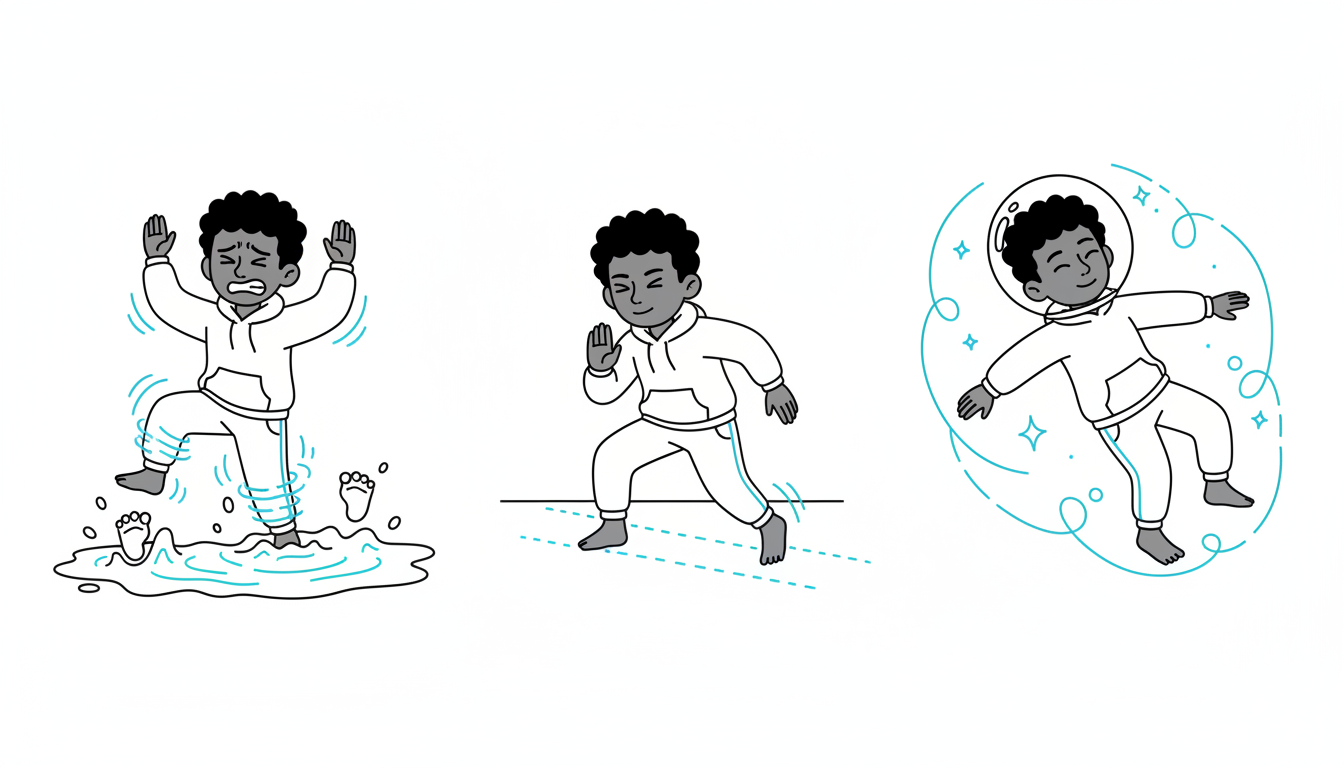
- Give the "as if" prompt (5 sec) - Before a transition, provide an imaginative scenario: "Walk to your desks AS IF you're walking through chocolate pudding"
- Students act out the transition (30-45 sec) - Students physically embody the scenario while completing the actual task (getting to their seats, lining up, etc.)
- Resume regular activity (5 sec) - Once transition is complete, immediately begin next task without extended discussion
What to Say
Opening: "In 30 seconds, we need to be in our seats ready for the next activity. But let's make it fun. Get to your seats AS IF you're astronauts floating in zero gravity. Go!"
Alternative prompts:
- "Return your supplies AS IF you're ninjas on a secret mission"
- "Line up for lunch AS IF you're royalty walking to a throne"
- "Get your notebooks AS IF you're wading through a swamp"
- "Sit in your reading spots AS IF you're cats finding the perfect sunny spot"
Closing: Simply begin the next activity once students are in position.
Why It Works
Imaginative play activates different neural pathways than routine movement, shifting students out of automatic pilot mode and creating a positive emotional reset. The "as if" frame transforms compliance into creativity, making transitions feel like play rather than obedience while maintaining efficiency. This technique also serves as a pattern interrupt, breaking the monotony that can lead to off-task behavior (Csikszentmihalyi's Flow Theory).
Research Foundation: Drama-based pedagogy and embodied cognition research show that physical enactment combined with imagination enhances engagement and memory (Kontra et al., 2015).
Teacher Tip
Match the energy of your "as if" scenario to the energy you need next. If you need students calm and focused, use "AS IF you're tiptoeing past a sleeping dragon." If you need them energized, use "AS IF you're superheroes rushing to save the day." The scenario becomes a mood management tool disguised as fun.
Variations
For Different Subjects
- Math/Science: Content-connected scenarios - "Move AS IF you're molecules heating up" or "Walk AS IF gravity is twice as strong"
- Humanities: Historical/literary contexts - "Enter the room AS IF you're a character from our novel" or "Line up AS IF you're soldiers in formation"
- Universal: Abstract concepts - "Move AS IF you're in slow motion" or "Walk AS IF the floor is ice"
For Different Settings
- Large Class (30+): Use scenarios that create quiet movement to avoid chaos - "AS IF you're sneaking" rather than "AS IF you're running"
- Small Group (5-15): Can use more elaborate scenarios that require interaction - "AS IF you're helping each other through a storm"
For Different Ages
- Elementary (K-5): Highly concrete scenarios with familiar references - animals, weather, food textures
- Middle/High School (6-12): Can be more abstract or ironic; students often enjoy the humor of acting "AS IF" they're enthusiastic about going to their seats
- College/Adult: Frame as a creativity exercise or brain break; lean into the absurdity
Online Adaptation
Tools Needed: Video conferencing platform with cameras enabled
Setup: Works best during short transitions like moving from main room to breakout rooms or switching tabs
Instructions:
- Before transition: "In 10 seconds, you'll open your breakout room. Enter AS IF you're entering a secret hideout."
- Students can add physical gestures on camera during the moment of transition
- Or use for returning from breaks: "Come back from break AS IF you're returning from an adventure"
Pro Tip: Online, this works better with facial expressions and upper-body movements since full-body movement isn't visible.
Troubleshooting
Challenge: Students get too silly or over-the-top, wasting time Solution: Set a timer: "You have exactly 30 seconds. The goal is to get there, not to perform. Move efficiently in character."
Challenge: Some students refuse to participate or feel embarrassed Solution: Make it optional participation with social proof: "If you'd rather walk normally, that's fine. But watch how much more fun it is the other way!" Usually peer modeling works.
Challenge: The transition takes longer than a normal one Solution: This means you've chosen a scenario that's too complex. Switch to simpler prompts like "AS IF you're in slow motion" which actually maintains speed.
Extension Ideas
- Deepen: Let students suggest the "as if" scenarios, rotating who gets to choose
- Connect: Use subject-specific scenarios regularly to reinforce content - "Move AS IF you're showing the water cycle" or "Walk AS IF you're demonstrating different states of matter"
- Follow-up: After a particularly effective "as if" transition, briefly discuss: "How did moving like that make you feel? Did it change your energy for this next task?"
Related Activities: Concept Acting Charades, Environments, Lead with Body Parts