
Simon Says Science
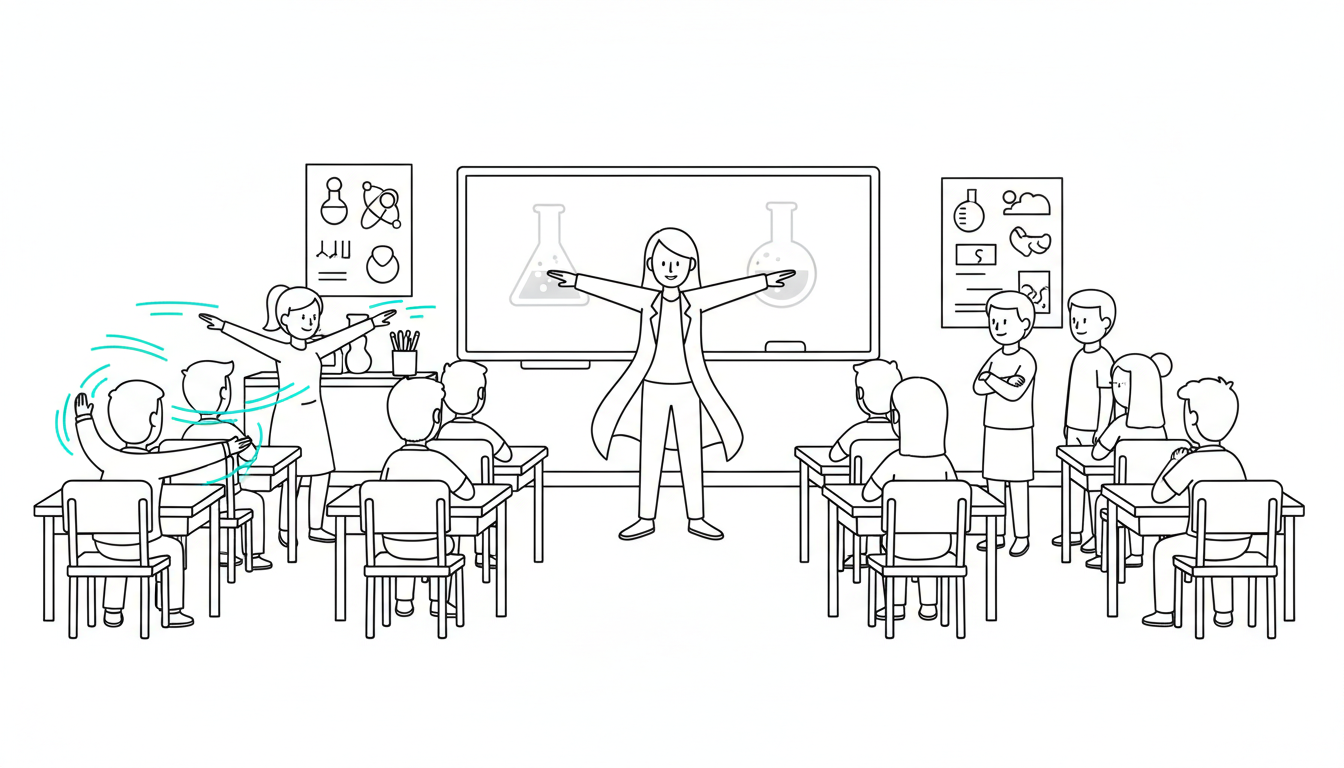
At a Glance
- Time: 3-4 minutes
- Prep: Minimal (10-15 prepared true/false statements)
- Group: Whole class
- Setting: Any classroom with space to stand
- Subjects: Science (adaptable to any factual content)
- Energy: Medium-High
Purpose
Transform fact verification and content review into an active listening game by combining the classic "Simon Says" format with true/false statements, where students only perform actions when statements are scientifically accurate, strengthening both content knowledge and attention to precision while maintaining playful engagement.
How It Works
- Establish the rule (20 sec) - "I'll give you commands with science statements. Only follow the command if the science is TRUE. If it's false, stay still."
- Practice round (30 sec) - "Touch your toes if photosynthesis requires sunlight." (True—students touch toes) "Jump if water boils at 50 degrees Celsius." (False—students stay still)
- Game rounds (2-3 min) - Call out 10-12 statements; students who move on false statements or don't move on true statements sit down (or lose a point)
- Quick review (20 sec) - "Let's correct the false ones we heard. Water actually boils at..."
What to Say
Opening: "Stand up! We're playing Simon Says with a twist. I'll tell you to do an action—BUT only do it if the science statement is TRUE. If I say something false, freeze! Let's practice: Clap your hands if mammals are warm-blooded. [TRUE—students clap] Good! Wave if insects have 8 legs. [FALSE—students freeze]"
During game: "Touch your nose if plants make oxygen... Jump once if the Earth is flat... Pat your head if water is H2O... Spin around if gravity pushes objects apart..."
When students make mistakes: "Uh oh! [Names] moved, but that statement was FALSE. The correct answer is [explanation]. You can stay standing this time, but be more careful!"
Closing: "Great listening and thinking! You had to know the science AND pay attention to every word. That's exactly the focus we need for our next activity."
Why It Works
This activity requires simultaneous processing of command (motor planning), content (factual accuracy), and game rules (only act on true statements), engaging executive function and cognitive flexibility. The split-second decision-making strengthens the speed of conceptual retrieval while the physical component creates embodied memory anchors (Kontra et al., 2015). The game format maintains high attention and motivation while providing immediate implicit feedback—if you move when others don't, you know you made an error.
Research Citation: Embodied cognition in STEM learning (Kontra et al., 2015)
Teacher Tip
Mix obviously true, obviously false, and subtly tricky statements. "Clap if the sun is a star" (obviously true), "Jump if fish breathe air" (obviously false), "Spin if all metals are magnetic" (tricky—false, only some metals). The variety keeps students alert throughout. Also, use varied action commands (stomp, twist, reach up, squat) to maintain physical interest.
Variations
For Different Subjects
- Math: "Touch your toes if 7 × 8 = 56" or "Jump if a triangle has 4 sides" or "Clap if 0.5 = 50%"
- Humanities: "Wave if Shakespeare wrote the Declaration of Independence" or "Sit down if metaphor compares using 'like' or 'as'" (that's simile!)
- Universal: Any content with clear true/false distinctions works—vocabulary definitions, historical facts, grammatical rules
For Different Settings
- Large Class (30+): Use point system rather than elimination so all students stay active; teams compete for accuracy
- Small Group (5-15): Can make it turn-based where students take turns being the caller who creates statements
For Different Ages
- Elementary (K-5): Slower pace; give students 3-5 seconds to think before they must act; use very clear true/false statements
- Middle/High School (6-12): Faster pace with more complex statements; can add requirement to explain why false statements are incorrect
- College/Adult: Highly technical or nuanced statements; can add "defend your answer" element where students explain reasoning
Online Adaptation
Tools Needed: Video platform with cameras enabled
Setup: All students on camera with video showing upper body
Instructions:
- Students perform actions on camera (clap, wave, thumbs up, hands on head)
- Teacher monitors gallery view to see who moved incorrectly
- Use reactions or hand raises instead of full-body movements for simpler version
- Scorekeeping via chat or shared Google Sheet
Pro Tip: Online version benefits from simpler, upper-body movements that are clearly visible on camera (touch nose, wave, clap, pat head).
Troubleshooting
Challenge: Students move too slowly; can't tell if they're responding correctly Solution: Set expectation: "You have 2 seconds to act. If the science is true, move immediately. Delayed movement counts as incorrect."
Challenge: Controversy over whether statements are true/false Solution: Prepare precise statements in advance and have sources ready: "According to our textbook page 47, this is considered true because..." Clear sourcing prevents arguments.
Challenge: Activity becomes too easy; students not challenged Solution: Increase complexity with multi-part statements: "Clap if BOTH photosynthesis produces oxygen AND plants need carbon dioxide"
Extension Ideas
- Deepen: Student-created statements - students write their own true/false commands and take turns being the caller
- Connect: Themed rounds - Round 1: Cell biology, Round 2: Chemistry, Round 3: Physics, tracking which content area students know best
- Follow-up: Students identify which false statements they fell for and write corrected versions: "I moved when you said [false statement], but the truth is..."
Related Activities: Four Corners, Fist to Five, True-False Sorting