
Strategy Inventory
At a Glance
- Time: 4-5 minutes
- Prep: Minimal (optional prepared list of learning strategies)
- Group: Individual reflection
- Setting: Any classroom
- Subjects: Universal
- Energy: Low
Purpose
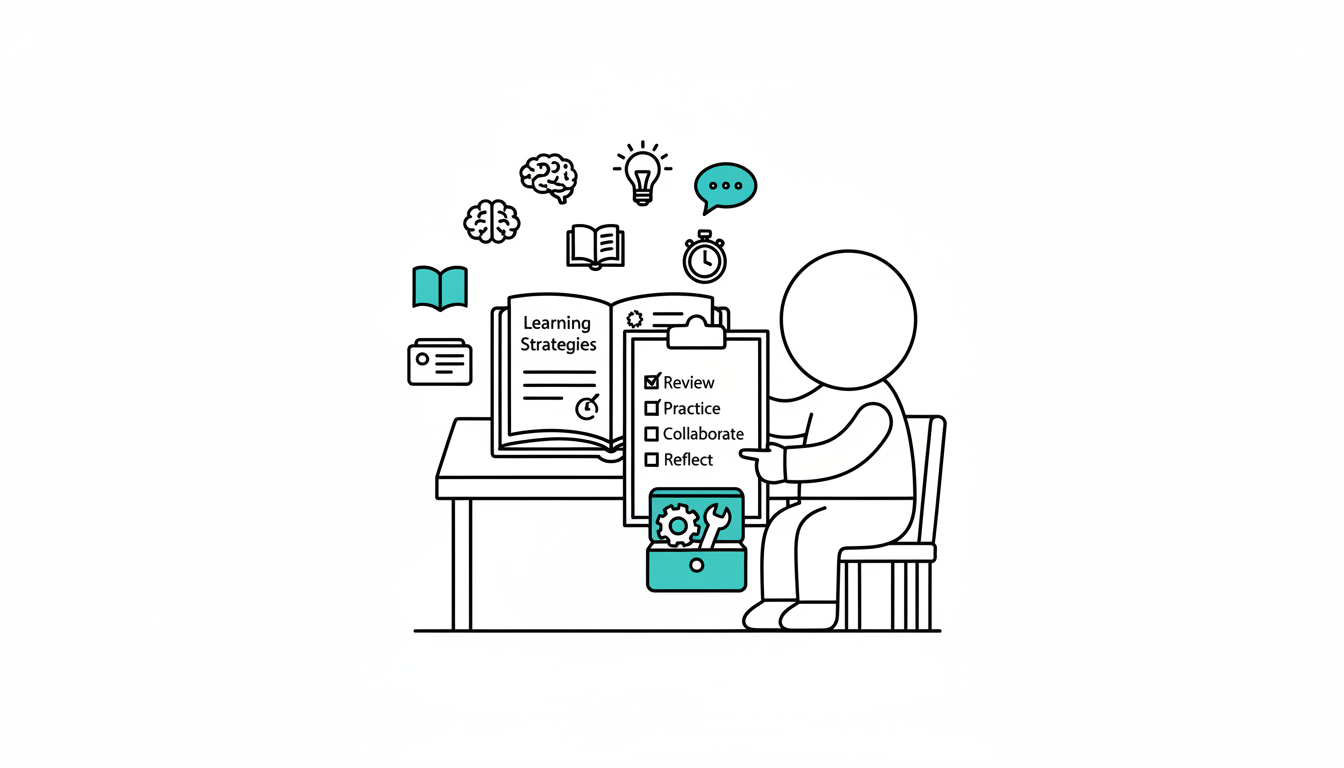
Build metacognitive awareness of the learning strategies students currently use (and don't use) by having them conduct a systematic inventory of their approach to studying, preparing, and processing information, making visible the full range of available strategies while helping students identify which methods they rely on, which they avoid, and which new techniques they might adopt to expand their learning toolkit.
How It Works
- Introduce strategy categories (30 sec) - Present 3-5 categories of learning strategies (e.g., rehearsal, elaboration, organization, monitoring)
- Strategy checklist (3 min) - Students review list of specific strategies and check which ones they regularly use, sometimes use, or never use
- Reflection questions (90 sec) - "Which strategies do you use most? Which have you never tried? Which might be worth experimenting with?"
- Optional goal-setting (30 sec) - "Pick ONE new strategy to try this week"
What to Say
Opening: "Most students use only 2-3 learning strategies over and over—the same methods every time. But there are DOZENS of effective strategies, and different situations call for different approaches. Today we're taking inventory: What's in YOUR learning toolkit? What are you NOT using that might help?"
Presenting checklist (example strategies): "Look at this list. Check the strategies you ACTUALLY USE regularly:
- Highlighting or underlining
- Making flashcards
- Self-quizzing
- Teaching material to someone else
- Drawing diagrams or concept maps
- Summarizing in your own words
- Connecting new material to what you already know
- Taking practice tests
- Spacing out study over multiple days
- Explaining step-by-step to yourself
Be honest. This isn't about what you SHOULD do—it's about what you ACTUALLY do."
Reflection: "Look at your checks. What patterns do you see? Do you rely on one type of strategy? Are there effective strategies you've never tried? That's your opportunity."
Closing: "Experts have BIG toolkits. They match the strategy to the task. Novices have SMALL toolkits and use the same strategy for everything. Your goal: expand your toolkit. Try one new strategy this week."
Why It Works
Research on learning strategies (Dunlosky et al., 2013) reveals that students often rely heavily on low-utility strategies like rereading and highlighting while underutilizing high-utility strategies like retrieval practice and elaborative interrogation. Strategy inventory creates awareness of this mismatch: students discover they're using ineffective methods or ignoring powerful ones. Metacognitive awareness precedes strategic change—students can't adopt new strategies if they don't know those strategies exist or recognize gaps in their current approach. The inventory also validates diverse learning approaches while encouraging strategic flexibility.
Research Citation: Effective learning techniques (Dunlosky et al., 2013)
Teacher Tip
After students complete inventories, share class-level data: "80% of you use highlighting, but only 20% self-quiz. Research shows quizzing beats highlighting every time." Introduce evidence-based strategies students aren't using, but don't shame current methods—frame it as adding tools, not replacing.
Variations
For Different Subjects
- Math/Science: Focus on problem-solving strategies: working backwards, drawing diagrams, checking answers, explaining steps
- Humanities: Focus on reading/writing strategies: annotation, outlining, thesis-first drafting, peer review
- Universal: Include time management and organization strategies alongside cognitive ones
For Different Settings
- Large Class (30+): Use digital form (Google Forms) to collect inventory data; display aggregate results
- Small Group (5-15): After individual inventory, discuss as class: "What strategies work well for you? Which ones do you want to try?"
For Different Ages
- Elementary (K-5): Simplify to 5-7 basic strategies with pictures; "Which ones do you use when you study?"
- Middle/High School (6-12): Standard detailed inventory with self-reflection on patterns
- College/Adult: Add meta-layer: "How do you CHOOSE which strategy to use? What's your decision-making process?"
Online Adaptation
Tools Needed: Google Form with checklist, or shared document
Setup: Create form listing 15-20 learning strategies with checkboxes (Always/Sometimes/Never use)
Instructions:
- Share form link at end of class
- Students complete inventory individually
- Teacher reviews aggregate data and creates summary chart
- Next class, display results: "Here's what our class uses most and least"
- Introduce under-utilized but research-backed strategies
- Students set goal to try one new strategy
Pro Tip: Revisit inventory at semester end—students re-take it and compare to see if their toolkit expanded.
Troubleshooting
Challenge: Students check every strategy to look good, not reflecting honestly Solution: Emphasize: "This isn't graded on HOW MANY you check. An honest inventory with FEW checks is more useful than a dishonest one with ALL checks. The goal is accurate self-awareness."
Challenge: Students don't know if they use a strategy because they don't recognize the terms Solution: Provide examples for each strategy: "Self-quizzing = covering answers and testing yourself, using flashcards, practice problems without looking at solutions"
Challenge: Students use ineffective strategies repeatedly and inventory reveals this Solution: Follow up with evidence: "I notice many of you rely on rereading. Research shows that's one of the LEAST effective strategies for long-term learning. Let me show you alternatives..."
Extension Ideas
- Deepen: "Strategy Experiment"—students try one unfamiliar strategy for a week, then report back on effectiveness for them personally
- Connect: Match strategies to upcoming tasks: "We have a test Friday. Which strategies from your inventory are best for test prep?"
- Follow-up: Strategy reflection after assessment: "Which strategies did you use to prepare? Look at your test results—did those strategies work? What will you adjust?"
Related Activities: Learning Strategy Sharing, Learning Style Recognition, Quiz & Exam Wrappers