
Silent Line-Up
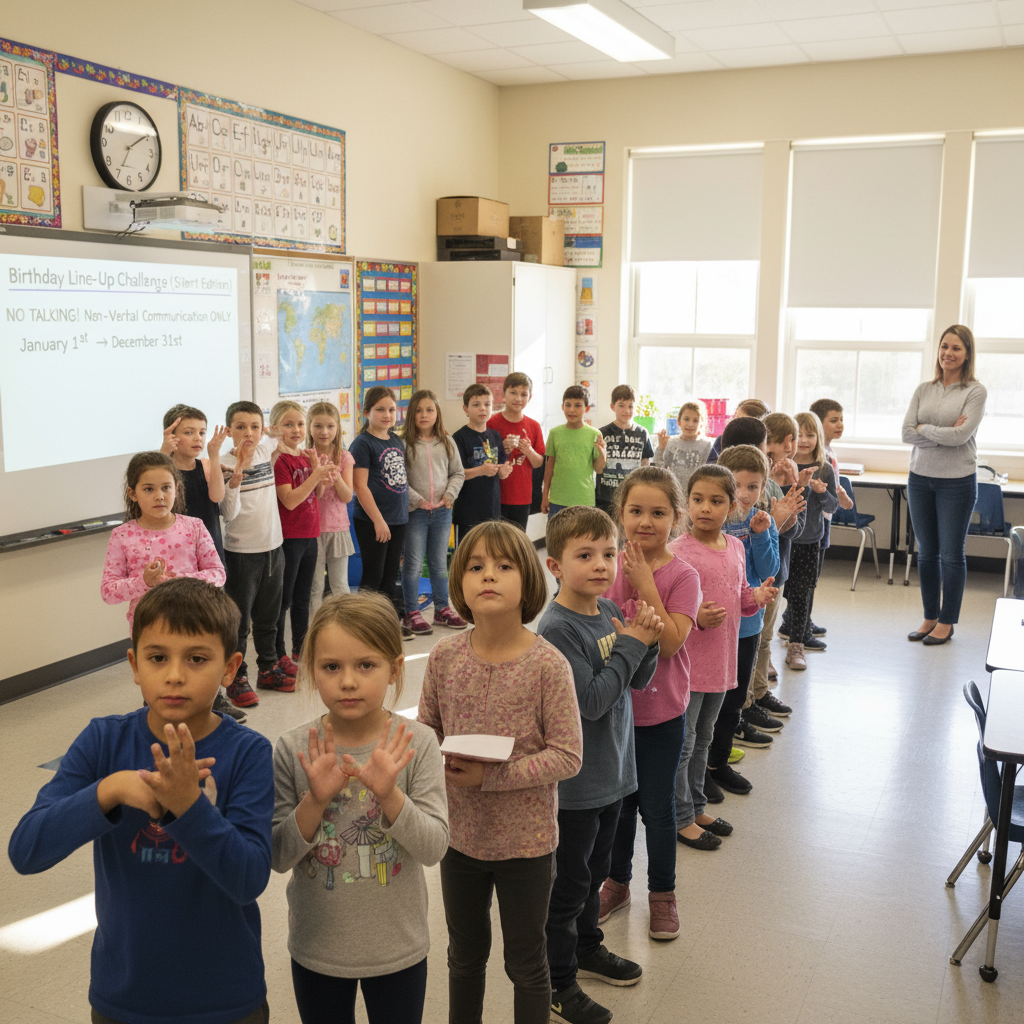
At a Glance
- Time: 1-2 minutes
- Prep: None
- Group: Whole class
- Setting: Any classroom
- Subjects: Universal
- Energy: Low-Medium
Purpose
Create smooth, quiet transitions while building non-verbal communication and sequencing skills by challenging students to line up in a specific order without speaking, reducing noise and chaos during transitions while engaging students in a puzzle-like task that requires cooperation, spatial awareness, and strategic thinking.
How It Works
- Challenge (10 sec) - "Line up by [criteria] WITHOUT talking. You have 90 seconds. Go."
- Silent organization (60-90 sec) - Students use non-verbal communication (gestures, holding up fingers, writing) to figure out correct order and arrange themselves
- Verify (20 sec) - Quickly check accuracy: "Starting at the front, say your [answer]"
- Transition (10 sec) - Proceed to next activity (leaving classroom, forming groups, etc.)
What to Say
Opening: "We need to line up. Here's the challenge: Line up by birthday—January 1st at the front, December 31st at the back. WITHOUT TALKING. You have 90 seconds. Silent communication only. Ready? Go."
During: [Say NOTHING. Let them figure it out. Resist urge to help unless absolutely necessary.]
Verification: "Let's check. Starting at the front, say your birthday." [Students call out dates down the line]
Closing: "Done! You communicated silently and organized yourselves. That's teamwork."
Why It Works
Silent challenges transform mundane transitions into engaging puzzles (gamification). The constraint of silence forces students to problem-solve creatively—they must use gestures, written communication, and spatial reasoning. This cognitive engagement keeps students on-task during what would otherwise be chaotic transition time. The challenge also builds non-verbal communication skills and collaborative problem-solving. Silence itself is the benefit—no shouting, no chaos, just focused cooperation.
Research Citation: Gamification and engagement (Deterding et al., 2011)
Teacher Tip
The first time takes longer as students figure out the process. That's fine—it's a learning investment. By the third time, they'll be efficient. Don't give up after one slow attempt. Also, enforce the silence rule strictly—even one talker ruins the challenge for everyone.
Variations
Different Sequencing Criteria
- Alphabetical: By first name, last name, or middle name
- Numerical: By birthday (month/day), age in months, house number, phone number last 4 digits
- Height: Shortest to tallest
- Random fun: By number of siblings, favorite color alphabetically, hours of sleep last night
Different Difficulty
- Easy: Height (obvious visual sorting)
- Medium: Birthday month only
- Hard: Exact birthdate or numerical sequences requiring communication
Different Ages
- Elementary (K-2): Height or age (simpler visual/numerical sorting)
- Elementary (3-5): Birthday month or alphabetical first name
- Middle/High School (6-12): Complex criteria like birthdate, phone numbers
- College/Adult: Abstract criteria relevant to content (chronological order of historical events discussed)
Online Adaptation
Tools Needed: Breakout rooms or numbered/ordered list
Setup: Create task for students to organize themselves virtually
Instructions:
- "You have 2 minutes to organize your group by [criteria] in the shared doc—WITHOUT using voice or chat"
- Students use collaborative doc to type name/answer and drag into correct order
- Or use breakout room feature: students enter rooms in correct sequence number
- Teacher checks final order
Pro Tip: Use Google Slides where each student controls one slide with their name—they physically move slides into correct order silently.
Troubleshooting
Challenge: Students talk, breaking the silence rule Solution: Pause immediately. "I heard talking. We start over." Restart from beginning. Enforce consequence: if silence isn't maintained, privilege of fun version is lost—just line up normally alphabetically by last name.
Challenge: Some students dominate, take over organizing; others passive Solution: After first round, debrief: "Who did the organizing? Who didn't participate?" Next round, those who were passive must be organizers. Rotate leadership.
Challenge: Line-up takes too long; transition efficiency suffers Solution: Set timer: "If you're not in line by 2 minutes, we lose [privilege]." Time pressure speeds things up. Or simplify criteria to something faster.
Extension Ideas
- Deepen: Reflect: "How did you communicate without words? What strategies worked? What was hard about working silently?"
- Connect: Content-based ordering: line up chronologically by historical events you're studying, by atomic number of elements, by size of fractions
- Follow-up: "Speed record"—track how fast class can complete silent line-up; challenge them to beat their record
Related Activities: Countdown Timer, Human Barometer, Birthday Line-Up