
Robot Walk
At a Glance
- Time: 60-90 seconds
- Prep: None
- Group: Whole class (individual participation)
- Setting: In-person (requires walking space)
- Subjects: Universal (any subject with facts to recite)
- Energy: Medium-High
Purpose
Combine creative movement with content review through silly, stylized walking while reciting facts. Use this to energize students while reinforcing memorized content in a playful, memorable way that reduces the monotony of rote recitation.
How It Works
Step-by-step instructions:
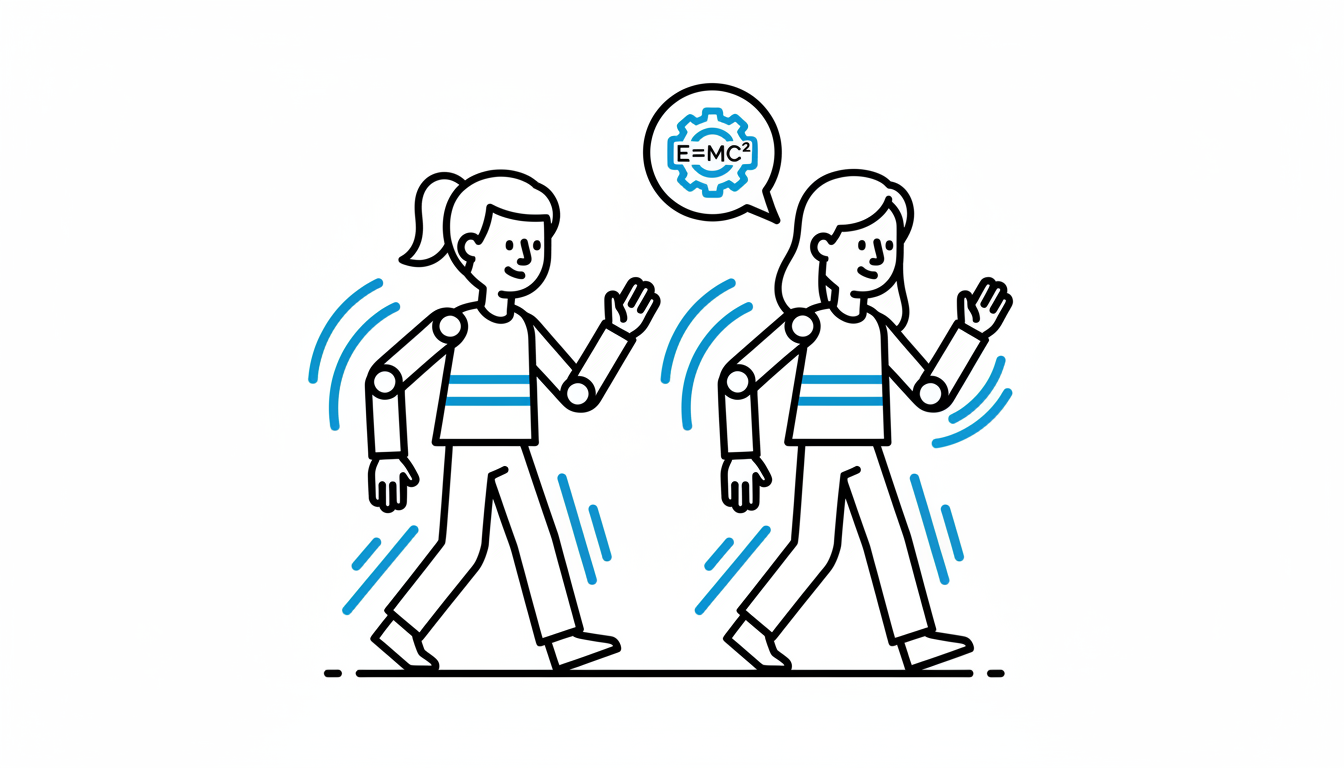
- ANNOUNCE (10 seconds) - "Stand up! We're doing Robot Walk. Walk around the room like a robot—stiff, mechanical movements—while reciting our lesson facts."
- DEMONSTRATE (10 seconds) - Model robot walk: stiff arms, mechanical turning, monotone voice reciting a fact
- WALK & RECITE (60 seconds) - Students walk like robots around the classroom while reciting (e.g., "The. Capital. Of. France. Is. Paris.")
- FINISH (10 seconds) - "Freeze! Power down. Sit back down at your seats."
What to Say
Opening: "Stand up! Push in your chairs. We're going to review our vocabulary by walking around the room like robots. Stiff legs, mechanical arms, turn your head in jerky motions like this (demonstrate). While you walk, recite the definitions in a robot voice: 'Pho-to-syn-the-sis. Is. The. Pro-cess.' Make it robotic! Ready? Robot activate! Go!"
During: Walk with them briefly, narrating: "I see excellent robot movements! Keep reciting! More facts! What else do we know?"
Closing: "Robots, return to your seats! Power down sequence initiated. Sit...down...slow...ly. (Make a powering-down sound.) And we're off. Great work, humans."
Why It Works
Associating content with unusual physical movements creates distinctive episodic memories that are easier to recall later. The novelty and humor of robot walking trigger dopamine release, tagging the information as significant. The physical movement increases blood flow and oxygen to the brain, improving alertness. The stylized, deliberate movements require motor planning and coordination, engaging the cerebellum and prefrontal cortex. Most importantly, it transforms boring rote recitation into a playful, embodied experience, which dramatically improves retention.
Research Citation: Embodied learning through gesture and movement enhances memory encoding and retrieval (Cook et al., 2008).
Teacher Tip
Commit to the bit. Do the robot walk with them, at least for the first 10 seconds. Use a robot voice. Make stiff, mechanical movements. Your enthusiasm and willingness to be silly gives students permission to fully engage. If you stand at the front looking bored while they walk, engagement plummets.
Variations
For Different Subjects
- Science: Recite formulas, periodic table, steps in a process, scientific laws
- Math: Recite multiplication tables, geometric theorems, order of operations
- History: Recite chronological events, dates, important figures
- Language Arts: Recite grammar rules, parts of speech, literary terms
- Foreign Language: Recite vocabulary words and definitions in target language
- Universal: Any facts, sequences, or lists that need memorization
For Different Settings
- Large Class (30+): Have students walk in a large circle or figure-eight pattern to avoid collisions
- Small Class (5-15): Everyone walks freely, weaving around each other
- Limited Space: "Robot pose" instead—students stand and move in place with robot gestures while reciting
- Tight Classroom: Students walk in a small path between desk rows
For Different Ages
- Elementary (K-5): LOVE this. Make it extra silly. Add sound effects: "Beep boop! Reciting fact! Beep boop!"
- Middle/High School (6-12): Frame it as "kinesthetic memory encoding." They'll do it if you keep it quick and purposeful. Can add competition: "Best robot walk wins."
- College/Adult: Use sparingly. Frame as "movement-enhanced learning." Keep it brief (30 seconds). Adults will do it once but may resist repeated use.
Online Adaptation
Tools Needed: Zoom, Teams, any video platform
Setup: Students stand where camera can see them.
Instructions:
- "Stand up and step back from your desk so I can see you."
- "We're doing robot walk in place. Stiff movements, mechanical gestures, while reciting facts."
- "March in place like a robot and recite: 'The. Mi-to-chon-dri-a. Is. The. Power-house.'"
Pro Tip: This is actually hilarious online because you can see everyone doing it simultaneously in gallery view. Screenshot the grid—it makes a great memory of the class.
Troubleshooting
Challenge: Students bump into each other. Solution: Before starting: "Look where you're going. Robots have sensors to avoid collisions. If you get too close to someone, change direction. Safety first, even for robots."
Challenge: Some students are self-conscious. Solution: Start by having them do it at their desks first (robot arms and head movements only). Once they see how silly everyone looks, they'll be more willing to walk around.
Challenge: It gets too loud/chaotic. Solution: Set volume expectations: "Robot voices, but not shouting. I should be able to hear recitation, not yelling." Can also have them recite silently (mouth words only).
Extension Ideas
- Deepen: After the activity: "Why did we recite like robots? Because repetition with movement creates stronger memories than repetition while sitting still. You'll remember this better."
- Connect: "Robots follow programmed instructions exactly. In our next lesson, we're learning about algorithms—which are instructions for computers. What we just did is similar."
- Follow-up: "Tonight, when you study, try walking while reciting. It works at home too. Research shows movement + learning = better retention."
Related Activities: Invisible Jump Rope, Air Writing, Body Letters