
Four Corners
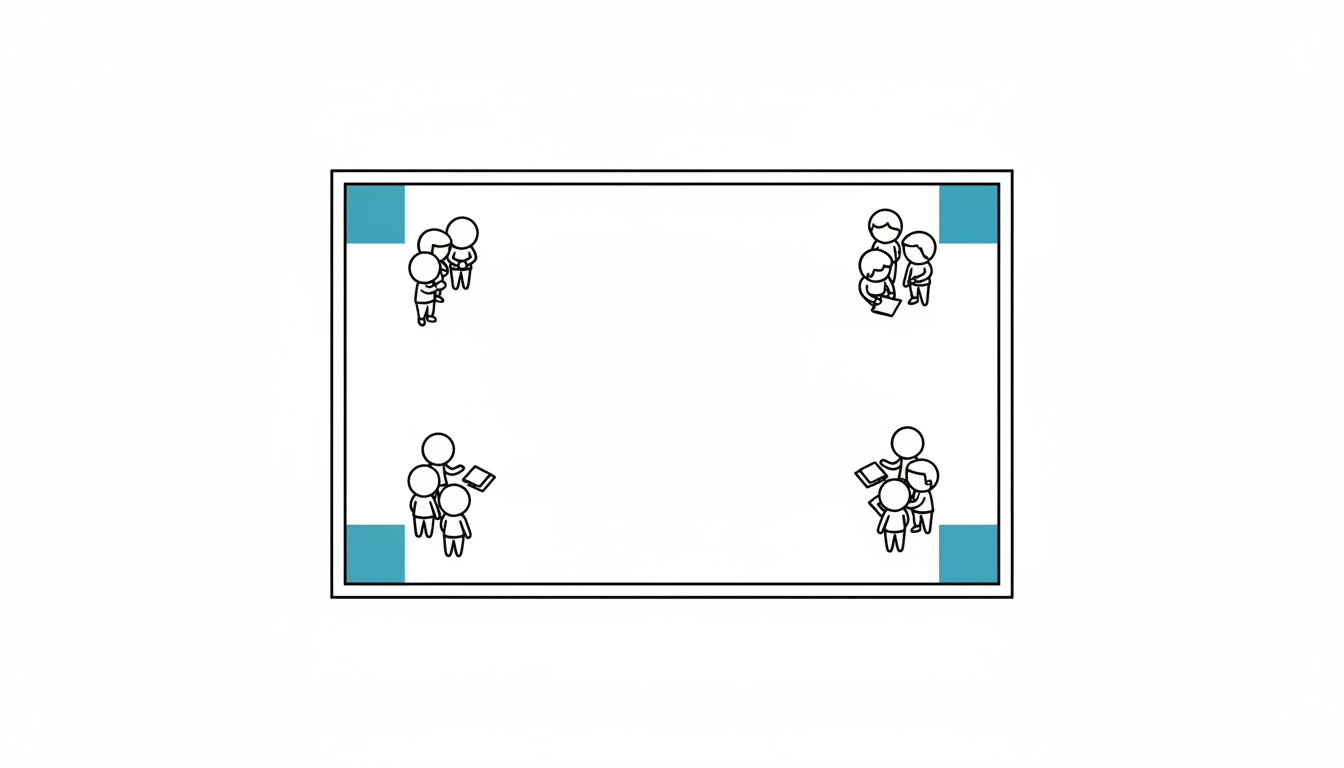
At a Glance
- Time: 3-5 minutes
- Prep: Minimal (corner labels)
- Group: Whole class
- Setting: Classroom with space
- Subjects: Universal
- Energy: High
Purpose
Transform opinion-sharing or content review into physical movement by designating classroom corners to represent different viewpoints or answer choices, requiring students to literally "take a stand" and physically commit to a position before defending it.
How It Works
- Label corners (30 sec) - Assign each corner a position: "Strongly Agree," "Agree," "Disagree," "Strongly Disagree" (or A/B/C/D for questions)
- Pose question/statement (30 sec) - Present controversial statement or multiple-choice question
- Students move and discuss (2-4 min) - Students walk to chosen corner, discuss reasoning with cornermates, optionally share with whole class
What to Say
Opening: "Four corners! This corner is 'Strongly Agree,' this is 'Agree,' 'Disagree,' and 'Strongly Disagree.' Statement: 'Social media does more harm than good to teenagers.' Move to your corner—go!"
During: "Talk with others in your corner about WHY you chose this position... Corner 4, give us your strongest argument... Anyone want to switch corners after hearing that?"
Closing: "Notice how the room divided? That visual distribution shows how complex this issue is. No single 'right' answer—but you all had to commit and defend."
Why It Works
Physical movement to corners creates kinesthetic commitment—harder to remain passive or neutral. Seeing classmates' positions visually represented builds awareness of perspective diversity. Movement energizes engagement while structured corners prevent chaos.
Research Connection: Physical positioning enhances opinion formation and argument articulation (Barsalou, 2008; Glenberg, 2010).
Teacher Tip
After initial corner selection, say: "You can change corners if someone's argument persuades you." Watching students physically switch positions makes persuasion visible and celebrates open-mindedness.
Variations
Content uses: Opinion debates, multiple-choice review (A/B/C/D corners), character perspectives in literature, ranking difficulty levels, stance on historical decisions • Grouping: Large class (30+) works perfectly; small class (8-15) still effective • Ages: K-5: Two corners (Yes/No); 6-12: Four corners standard; College: Five corners for nuance
Online
Annotate shared screen with four quadrants labeled A/B/C/D or positions. Students drag name/icon into chosen quadrant. Breakout rooms by corner for discussion.
Troubleshooting
Everyone clusters in one corner: "Interesting! Let me phrase a more controversial version to spread you out..." or assign roles: "I need 3 volunteers to argue from the least-populated corner."
Extension
Four Corners Debate: After initial positioning, give each corner 90 seconds to prepare their best argument. Each corner sends a representative to present to the whole class.
Related: Human Spectrum, Philosophical Chairs