
Kinesthetic Vocabulary
At a Glance
- Time: 3-5 minutes
- Prep: Minimal (prepared list of vocabulary words)
- Group: Pairs or small groups of 3-4
- Setting: Any classroom
- Subjects: Universal - works for any vocabulary or concept
- Energy: Medium-High
Purpose
Deepen vocabulary understanding and retention through embodied representation by challenging students to act out word meanings without speaking, forcing them to analyze the essence and physical dimensions of abstract concepts while creating memorable multi-sensory anchors for recall.
How It Works
- Assign vocabulary words (20 sec) - Each pair or small group receives 2-3 vocabulary words from current unit on cards
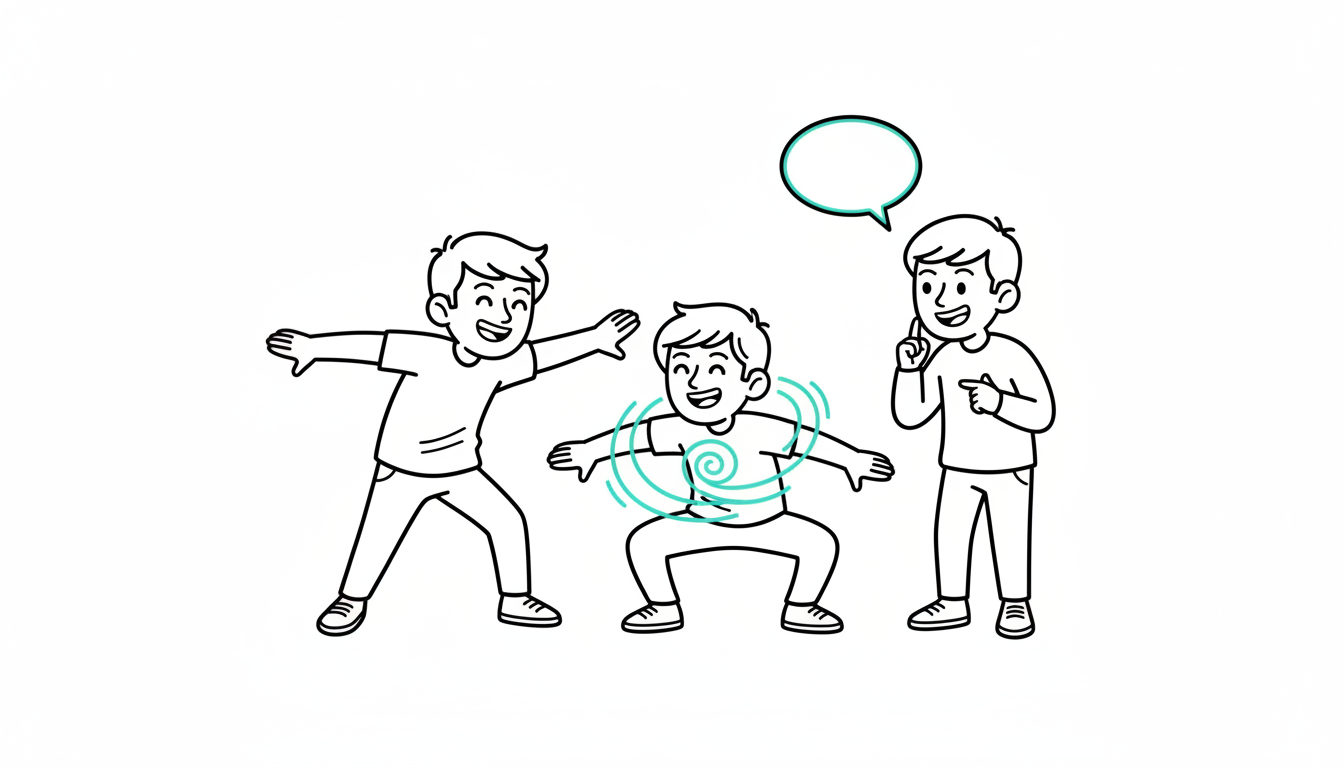
- Silent planning (60 sec) - Groups silently plan how to physically represent each word's meaning using only body movements and gestures (no props, no sounds)
- Performances (2-3 min) - Groups take turns performing their words (15-30 seconds each) while rest of class guesses
- Debrief meaning (30 sec after each) - Once word is guessed, performing group briefly explains why they chose that representation: "We showed 'photosynthesis' by having one person be the sun, one be water, and we demonstrated energy transfer"
What to Say
Opening: "Each group has vocabulary words to act out—no speaking, no props, just your bodies. You have 60 seconds to plan how to show the meaning of your word. Make it clear enough that we can guess it!"
During planning: "Think about the key action or concept in your word. What's the most important thing to show? Can you break it into steps?"
During performances: "Watch carefully! When you think you know the word, raise your hand. Let the action finish before guessing."
After each: "Great! Why did you choose to represent it that way? What part of the definition were you emphasizing?"
Why It Works
The enactment effect (Engelkamp & Zimmer, 1994) demonstrates that physically performing actions related to words significantly improves retention compared to verbal study alone. When students must translate abstract vocabulary into concrete physical movements, they engage in deep semantic processing, analyzing multiple dimensions of meaning (action, emotion, relationship, process). The dual coding of verbal and motor memory creates redundant memory traces, making recall easier during assessments.
Research Citation: Enactment effect in memory (Engelkamp & Zimmer, 1994)
Teacher Tip
For abstract vocabulary (democracy, irony, synthesis), encourage students to think metaphorically or create mini-narratives. "Democracy" might be shown as a group making a decision by counting raised hands. "Synthesis" could be two separate movements combining into one unified movement. The creative interpretation process IS the learning—there's no single "right" way to embody abstract concepts.
Variations
For Different Subjects
- Math/Science: Act out processes (mitosis, photosynthesis, erosion) or demonstrate concepts (acute angle with arms, probability with unpredictable movements)
- Humanities: Embody literary devices (personification, foreshadowing), historical events (cause and effect relationships), or character emotions
- Universal: Any academic vocabulary (analyze, justify, evaluate) by showing what those thinking processes look like physically
For Different Settings
- Large Class (30+): Multiple groups perform simultaneously in different corners; class splits to watch different performances, then groups rotate
- Small Group (5-15): Each group performs for whole class; can do multiple rounds with different vocabulary sets
For Different Ages
- Elementary (K-5): Use concrete vocabulary with clear physical dimensions (melt, evaporate, spin, vibrate); allow sound effects if helpful
- Middle/High School (6-12): Challenge with abstract academic vocabulary; enforce strict silence to increase difficulty
- College/Adult: Highly abstract disciplinary terminology; add requirement to show etymology or word relationships
Online Adaptation
Tools Needed: Video platform with cameras enabled; optional breakout rooms
Setup: Students with cameras on and positioned to show upper body and arms
Instructions:
- Send vocabulary words via chat to specific groups (use breakout rooms for planning if available)
- Groups plan in breakout room (60 seconds)
- Return to main room; each group performs on camera
- Rest of class types guesses in chat or unmutes to share
- Alternative: One student per word; individual performances with 20-second limit
Pro Tip: Online version actually works well because camera framing focuses attention on upper body movements and facial expressions, making gestures more visible than in large classrooms.
Troubleshooting
Challenge: Students make gestures too vague; class can't guess Solution: After one failed round, pause for coaching: "Make your movements bigger and more specific. Show us the VERB in this word. What's the action happening?"
Challenge: Groups want to use sounds or mouth words Solution: Frame as a game constraint: "The challenge is to do this completely silently. If you're tempted to talk, it means you need to make your movements clearer instead."
Challenge: Abstract words seem impossible to act out Solution: Model one first: "Watch me act out 'conflict.' [Two hands pushing against each other] See how I showed opposition? Now you try yours."
Extension Ideas
- Deepen: "Gallery walk" format where multiple groups perform simultaneously; observers rotate between stations trying to identify all words
- Connect: Create a "vocabulary video dictionary" where groups record and save their performances as study tools for later review
- Follow-up: Writing extension: "Describe in words how your group acted out the vocabulary. Use sensory details to capture the movement."
Related Activities: Concept Acting Charades, Vocabulary Fly Swatter, Living Word Wall