
Music Transition
At a Glance
- Time: 30-90 seconds
- Prep: Minimal (speaker and device with music)
- Group: Whole class
- Setting: Any classroom
- Subjects: Universal
- Energy: Low-Medium
Purpose
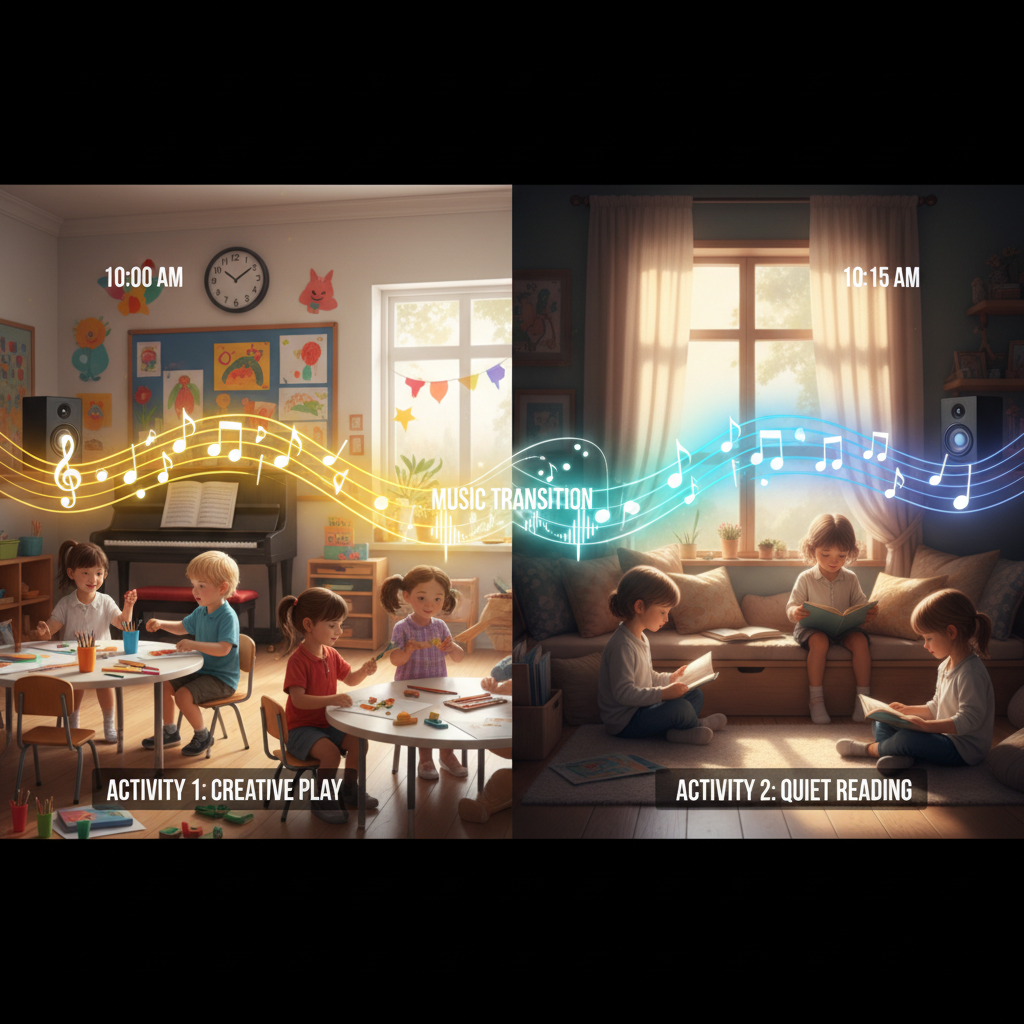
Create smooth, predictable transitions between activities using music as an auditory cue that signals time limits and activity changes, reducing transition chaos while using music's emotional and cognitive effects to set the tone for the next activity, whether calming students down or energizing them up, making transitions feel structured rather than arbitrary.
How It Works
- Play music (30-90 sec) - Start specific song/track when transition begins
- Students transition (during music) - Pack up, move, prepare for next activity while music plays
- Music ends = transition ends (automatic) - When music stops, students must be ready
- Begin next activity (immediate) - Seamlessly start new task once music ends
Music Selection Strategy:
- Calming transitions: Classical, ambient, soft instrumental (preparing for focused work)
- Energizing transitions: Upbeat, rhythmic, pop instrumental (preparing for active task)
- Consistent length: Choose tracks of consistent duration so students learn timing
What to Say
Opening (first time establishing routine): "We're going to use music for transitions. When you hear this song start, you have exactly as long as the song plays to pack up and be ready for the next activity. When the music stops, transition is over—you're seated and ready. Let's try it."
During regular use: [Start music. Say nothing, or minimal direction: "Pack up. You know the routine."]
After music ends: "Music stopped. You're ready. Let's begin [next activity]."
Why It Works
Music creates a dual benefit: it provides both a time marker (concrete endpoint) and a mood regulator (calming or energizing). Unlike verbal instructions, which students can ignore, music fills the auditory space consistently and non-negotiably. Research shows music activates attention networks and emotional regulation systems simultaneously (Thaut et al., 2015). Students also learn timing through repetition—if the same 60-second track plays daily, they internalize how long 60 seconds feels. Music transitions reduce teacher nagging ("Hurry up!") because the music itself creates urgency.
Research Citation: Music and neural processing (Thaut et al., 2015)
Teacher Tip
Use the SAME song for the SAME transition every time for at least 2-3 weeks. Consistency creates automaticity—students will start packing up the moment they hear the first notes. Only vary music once the routine is rock-solid. My go-to: "Clair de Lune" for calming transitions, "Happy" instrumental for energizing ones.
Variations
Different Transition Types
- End of activity → Next activity: Transition song plays while students pack up/prepare
- Entry routine: Song plays while students enter room and settle
- Exit routine: Song plays during end-of-class cleanup
- Brain break to focus: Calming music signals return to work
Different Music Genres
- Classical: Calm, focused (Bach, Mozart, Debussy)
- Jazz: Smooth, sophisticated (for older students)
- Instrumental pop: Upbeat, familiar (recognizable tunes without lyrics)
- World music: Energizing, rhythmic (African drums, Latin beats)
- Ambient/electronic: Modern, neutral (for tech-forward classrooms)
Different Ages
- Elementary (K-5): Fun, recognizable instrumental versions of popular kids' songs
- Middle/High School (6-12): Age-appropriate instrumental tracks (avoid "babyish" music)
- College/Adult: Professional instrumental music or subtle background tracks
Online Adaptation
Tools Needed: Music streaming service or pre-loaded tracks, screen share with audio
Setup: Ensure your video platform transmits audio clearly
Instructions:
- Announce transition: "We're switching activities—listen for the music"
- Share audio/play music through speakers
- Students use music duration to complete transition at home
- When music stops, return to main instruction
Pro Tip: Use YouTube or Spotify links and share screen with audio—students can see progress bar, giving visual + auditory cues for time remaining.
Troubleshooting
Challenge: Students don't finish transition before music ends; still packing up when song stops Solution: Choose longer track for first 2 weeks to allow success. Once routine is established, gradually shorten music duration to increase efficiency.
Challenge: Music is too distracting; students dance, sing along, lose focus Solution: Switch to instrumental-only tracks with no lyrics. Explain: "Music is the timer, not entertainment—stay on task during transitions."
Challenge: Can't play music due to technical issues (no speaker, broken device) Solution: Have backup plan: hum or play music on phone, or use countdown timer instead. Consistency of routine matters more than quality of audio.
Extension Ideas
- Deepen: "Music mood match"—students reflect on how music choice affects their transition speed and focus
- Connect: Student DJ rotation—different student chooses transition music each week (teacher-approved options)
- Follow-up: Genre exploration—introduce students to different music styles through daily transition tracks; discuss cultural contexts
Related Activities: Countdown Timer, Call-and-Response, Dance Break