
Movie Application
At a Glance
- Time: 5-7 minutes
- Prep: None
- Group: Small groups (3-4 students)
- Setting: Any classroom context
- Subjects: Universal - works with any concept
- Energy: Medium to High
Purpose
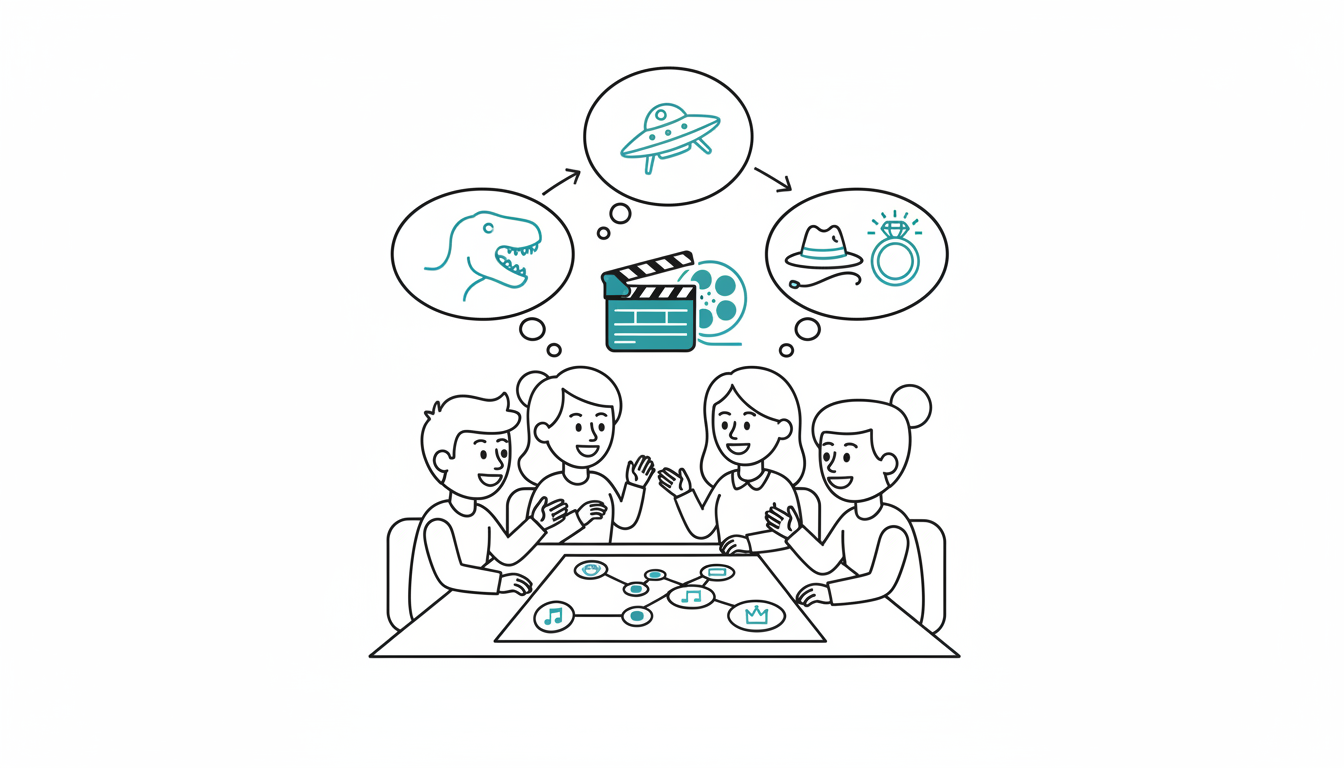
Movie Application connects academic concepts to popular culture by having students identify movies that illustrate course material. Groups brainstorm movie examples, then identify one way the movie got the concept right and one way it got it wrong. Use this when you want to make abstract ideas concrete, tap into students' existing knowledge, and create memorable hooks that aid retention. The activity works because students already have rich mental models from movies—you're just connecting those models to course content.
How It Works
Step-by-step instructions:
-
PRESENT THE CONCEPT (30 seconds) - State the course concept, principle, historical event, or scientific phenomenon you're teaching.
-
FORM GROUPS (15 seconds) - Students form groups of 3-4.
-
BRAINSTORM MOVIES (2 minutes) - Groups list movies that feature or relate to the concept.
-
SELECT ONE MOVIE (30 seconds) - Groups choose their best example.
-
ANALYZE ACCURACY (2-3 minutes) - Groups discuss: What's one way the movie accurately depicted the concept? What's one way the movie got it wrong or oversimplified?
-
SHARE OUT (2 minutes) - Groups share their movie and analysis with the class.
What to Say
Setup: "We've been talking about [CONCEPT]. Now let's connect this to movies you've seen. In groups of three, brainstorm movies that involve or depict [CONCEPT]. Then pick one movie and discuss: How did the movie get this concept RIGHT? How did it get it WRONG? You have 4 minutes."
During: [Circulate and listen. You might hear: "Oh, in that movie..." "Wait, did they actually show...?" "I don't think that's scientifically possible..."]
Sharing: "Let's hear from a few groups. Tell us the movie you chose, and give us one 'right' and one 'wrong.'"
Closing: "Movies shape how we understand the world, but they often sacrifice accuracy for entertainment. Part of your job as a student is to recognize when Hollywood gets it right and when they're bending reality. That critical lens matters."
Why It Works
Movie Application leverages several cognitive and motivational mechanisms:
Schema Activation: Movies provide rich, visual mental schemas. Connecting new learning to these existing schemas aids encoding and retrieval.
Engagement Through Relevance: Students enjoy discussing pop culture, so this activity captures attention in ways that traditional examples might not.
Critical Thinking Through Comparison: Identifying inaccuracies requires students to truly understand the concept well enough to spot deviations from reality.
Memory Enhancement: Information paired with vivid, emotional imagery (movie scenes) is more memorable than information learned in isolation.
Peer Teaching: Students often introduce each other to movies they haven't seen, expanding everyone's reference base.
Research Citation: The "levels of processing" theory suggests that deeper, more elaborative encoding (like connecting concepts to complex movie narratives) leads to better memory retention than shallow processing (Craik & Lockhart, 1972).
Teacher Tip
Keep a running list of the movie examples students generate. Over time, you'll build a database of movies that illustrate each major concept in your course. Share this list with future classes as a resource: "Students in past years said these movies connect to this concept." You might even discover films you haven't seen that become useful teaching examples.
Variations
For Different Subjects
-
Science: Movies featuring physics (gravity in space movies), biology (virus outbreaks), chemistry (explosions). Analyze scientific accuracy.
-
History: Movies depicting historical events. Compare Hollywood version to historical record.
-
Psychology: Movies featuring psychological concepts (memory in Memento, conditioning in A Clockwork Orange). Evaluate accuracy of portrayal.
-
Literature: Movies adapting books. Compare how themes were handled in each medium.
-
Math: Movies using statistics, probability, or code-breaking (Moneyball, 21, The Imitation Game).
For Different Settings
-
Large Class (30+): After small group brainstorming, create a class-wide master list on the board of all movies mentioned. Vote on which example is best.
-
Small Class (8-15): Can share out from every group since there are fewer groups.
-
Online: Use breakout rooms for brainstorming, then use a collaborative doc or Padlet where all groups add their movie examples simultaneously.
For Different Ages
-
Elementary (K-5): Expand to "TV shows, movies, or books" since younger students may have limited movie exposure. Use age-appropriate concepts and media.
-
Middle/High School (6-12): Standard format works well. Students have broad movie knowledge at this age.
-
College/Adult: Can reference more obscure or sophisticated films. Can also expand to include documentaries.
Online Adaptation
Tools Needed: Video conferencing with breakout rooms + shared document (Google Doc, Jamboard)
Setup: Prepare a shared template with sections for each group to add their movie example.
Instructions:
- Send groups to breakout rooms for brainstorming (2 minutes)
- Each group types their chosen movie and analysis into the shared doc
- Return to main room and have groups verbally share their entry
- The shared doc becomes a lasting resource
Pro Tip: After the activity, embed movie clips or trailers in your slide deck for future classes. Seeing a 30-second visual reminder makes the connection even stronger.
Troubleshooting
Challenge: Students can't think of any movies related to the concept.
Solution: Broaden the prompt: "Think about movies featuring robots, doctors, courtrooms, time travel, war, families, schools..." Give genre hints that might jog memory. Or allow TV shows and books.
Challenge: Groups argue about whether a movie really fits the concept.
Solution: That debate IS the learning. Let it happen. Say: "Defend your choice. Convince your group members that this movie connects to the concept. What evidence from the movie supports your claim?"
Challenge: The chosen movie contains inappropriate content for the classroom.
Solution: Set ground rules upfront: "Choose a movie we could show clips from in class—nothing rated R or with content that wouldn't be school-appropriate." Or allow the example but skip detailed discussion.
Extension Ideas
-
Deepen: Have students write a "movie review from an expert's perspective": "As a biologist, here's my review of Jurassic Park..." This combines content knowledge with persuasive writing.
-
Connect: Create a "Movie Madness" tournament where students nominate movies for "Most Accurate" and "Most Ridiculous" depictions of course concepts, then vote.
-
Follow-up: For homework, have students watch a movie from the class-generated list and write a 1-page analysis applying course concepts.
Related Activities: Commonalities and Differences, Real-World Connections, What If Scenarios