
Machines
At a Glance
- Time: 3-5 minutes
- Prep: None
- Group: Whole class or groups of 6-12
- Setting: Any space with room for students to stand together
- Subjects: Universal - excellent for systems thinking and collaboration
- Energy: Medium
Purpose
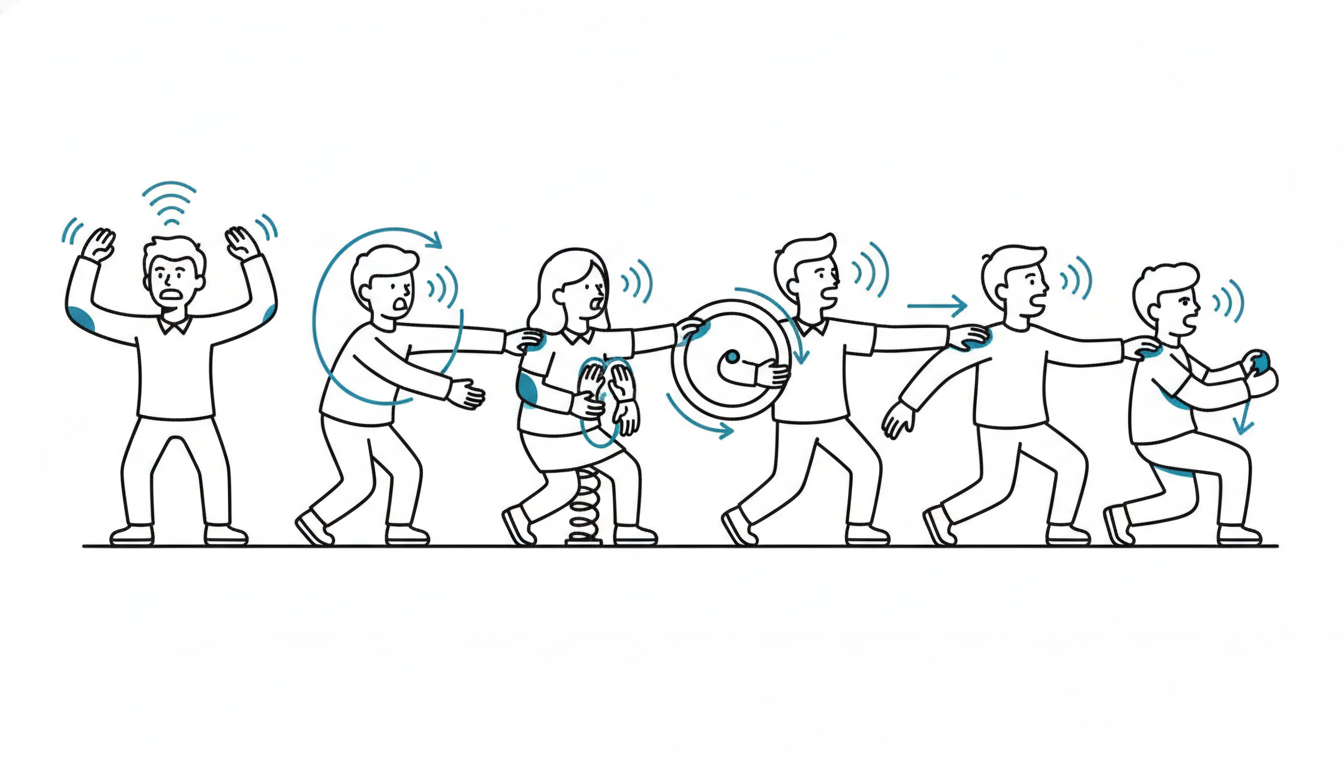
Foster creativity, ensemble awareness, and systems thinking by having students collaboratively build a human "machine" where each person adds a unique repetitive sound and motion that connects to and complements the existing parts, creating a kinesthetic understanding of how individual components function within a larger interconnected whole.
How It Works
- First person starts the machine (10 sec) - One volunteer begins with a simple repetitive motion and sound (e.g., arms pumping up and down with a "whoosh-whoosh" sound)
- Add parts one by one (2-3 min) - One at a time, other students join by physically connecting to the machine (touching shoulder, linking arms, standing nearby) and adding their own unique motion and sound that complements what's already there
- Full machine operating (30 sec) - Once everyone has joined, let the complete machine run for 30 seconds with all parts working together
- "Speed up" and "slow down" (optional, 30 sec) - Teacher calls out tempo changes; machine responds together
- Power down (15 sec) - "The machine is powering down... slower... slower... and stop."
- Brief reflection (30 sec) - "What did you create? How did you decide where to connect and what sound to make?"
What to Say
Opening: "We're going to build a human machine together. One person will start with a repetitive motion and sound. Then one by one, you'll join by connecting to someone already in the machine and adding your own unique motion and sound. Listen and watch before you join - find a way to fit into what's already happening."
During: "Keep your motion and sound consistent... Next person, join when you're ready... Watch for a spot where you can connect... Make your sound different from what's already there..."
When machine is complete: "Everyone's in! Keep it going! Listen to each other... Machine, SPEED UP! SPEED UP! Now SLOW DOWN... slower... even slower..."
Closing: "And power down to a stop. Look at what you created together! Every single person was essential to making this machine work."
Why It Works
This activity develops ensemble awareness (listening and responding to others), creativity within constraints (must fit into existing structure), and systems thinking (understanding how parts relate to create a functioning whole). The combination of sound and movement engages multiple sensory channels, strengthening memory and engagement. The collaborative building process requires each student to observe, analyze, and create simultaneously, activating higher-order thinking while remaining playful and low-stakes (Sawyer's group creativity research, 2003).
Research Citation: Collaborative creativity and flow in groups (Sawyer, 2003)
Teacher Tip
Coach students before starting to make "sustainable" sounds and motions - movements they can repeat for 2-3 minutes without exhausting themselves. This isn't about big, flashy actions; it's about finding simple, repeatable patterns. Also, encourage variety: "We need high sounds and low sounds, fast motions and slow motions, big movements and tiny ones."
Variations
For Different Subjects
- Math/Science: Content-specific machines - "Create a photosynthesis machine" or "Build a cell division machine" or "Construct a water cycle machine" where each person represents a part of the biological/chemical process
- Humanities: Historical or literary machines - "Create a printing press" or "Build the assembly line from our history unit" or "Construct the society from the novel we're reading"
- Universal: Emotional machines - "Build a machine that represents frustration/joy/confusion" with sounds and movements capturing that emotion
For Different Settings
- Large Class (30+): Create multiple simultaneous machines in different areas; have class observe each one and guess what type of machine it is
- Small Group (5-10): Everyone must join faster (every 10 seconds a new person) to maintain momentum
For Different Ages
- Elementary (K-5): Start with a specific type of machine (breakfast-making machine, car wash machine) to provide clearer structure; allow sillier sounds
- Middle/High School (6-12): Standard approach; can add rule that no two sounds can be identical
- College/Adult: Abstract machines representing concepts (innovation, bureaucracy, collaboration) with debriefing on how structure emerged without planning
Online Adaptation
Tools Needed: Video platform with gallery view and good audio
Setup: Works best in breakout rooms of 6-10 students with cameras and mics on
Instructions:
- First person starts with sound and motion visible on camera
- Others join one by one, layering their sounds and visible motions
- All sounds and motions happen simultaneously in gallery view
- Alternative: Use collaborative digital tool (Google Jamboard, Miro) where students add visual representations of their machine part while describing sound verbally
Pro Tip: Online version creates a beautiful cacophony of layered sounds in the audio mix that can actually be MORE interesting than in-person. Record it and play it back!
Troubleshooting
Challenge: Students join too quickly without observing what's already there Solution: Pause after 3-4 people have joined: "Everyone freeze. Let's watch and listen to what we have so far. Next person who joins, think about what's MISSING. What gap can you fill?"
Challenge: All motions are similar or repetitive Solution: Between rounds, expand the vocabulary: "We need different levels - someone low to the ground, someone reaching high. We need different speeds - someone very slow, someone rapid."
Challenge: Machine becomes chaotic; loses cohesion Solution: Call for simplification: "Hold on - some of you simplify your motion and sound. Make it smaller and clearer." Sometimes less is more.
Extension Ideas
- Deepen: Create machines with specific purposes - "Build a machine that helps people learn" or "Build a machine that creates happiness"
- Connect: Use as a metaphor for classroom community: "We're all part of one machine in this class. When one person isn't here, the machine doesn't work the same way."
- Follow-up: Drawing/writing extension - "Draw a blueprint of our machine and label each part" or "Write an instruction manual for our machine"
Related Activities: Environments, Group Juggle, Human Scavenger Hunt