
Fishbowl Discussion
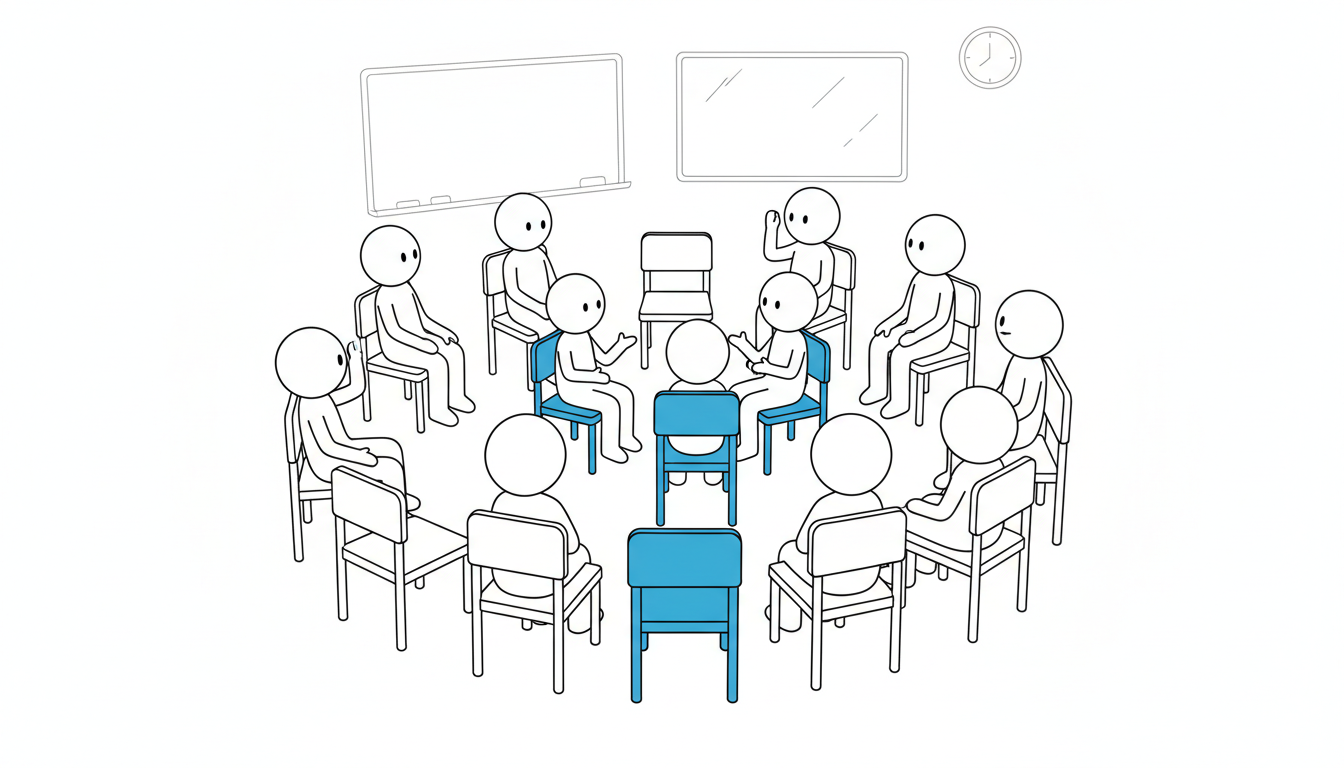
At a Glance
- Time: 10-15 minutes
- Prep: Minimal - arrange chairs in two circles
- Group: Inner circle (4-6 discussants) + outer circle (observers)
- Setting: Requires space for concentric circles of chairs
- Subjects: Universal - especially effective for controversial or complex topics
- Energy: Medium
Purpose
Fishbowl Discussion creates a structured conversation where a small inner circle discusses a topic while a larger outer circle observes and analyzes the discussion itself. Use this when you want to model quality discussion, practice deep listening skills, or have students engage with a complex or controversial topic in a focused way. The fishbowl format slows down conversation, making thinking visible and creating accountability for both speakers and listeners.
How It Works
Step-by-step instructions:
-
ARRANGE SEATING (Before class or 2 minutes during) - Place 4-6 chairs in a tight circle in the center of the room. Arrange remaining chairs in a larger circle around the center (or have students remain at desks if space is limited).
-
SELECT INNER CIRCLE PARTICIPANTS (30 seconds) - Choose 4-6 students for the inner circle. You can select them, ask for volunteers, or use a random method. Remaining students sit in the outer circle.
-
ASSIGN OBSERVATION TASKS (1 minute) - Give outer circle observers specific things to watch for (see examples below).
-
POSE THE DISCUSSION QUESTION (30 seconds) - Present a complex, open-ended question or controversial statement to the inner circle.
-
INNER CIRCLE DISCUSSES (5-7 minutes) - Inner circle students discuss the question. You can participate minimally or just facilitate. Outer circle observes silently and takes notes.
-
PAUSE AND PROCESS (2 minutes) - Stop the inner circle discussion. Outer circle observers share their observations based on their assigned tasks.
-
OPTIONAL: SWITCH CIRCLES (If time allows) - Have inner and outer circles switch roles, either continuing the same topic or discussing a new one.
-
DEBRIEF (2 minutes) - Whole-class reflection on both the content and the process of discussion.
What to Say
Setup: "We're doing a Fishbowl Discussion. [Names 4-6 students], you're in the inner circle—come sit in these center chairs. Everyone else, you're observers in the outer circle. Observers, you have an important job. I want you to track [specific observation task]."
Observation Task Examples:
- "Tally how many times each person speaks. Are all voices balanced?"
- "Note when someone builds on another person's idea vs. introduces a new idea."
- "Write down any assumptions you hear in the discussion."
- "Track what types of evidence people use—personal experience, logic, facts, etc."
Discussion Prompt: "Inner circle, here's your question: [POSE COMPLEX QUESTION]. Discuss this for 5 minutes. You don't need to reach consensus, but push each other's thinking. Outer circle, remember your observation task. Begin."
After Inner Circle Discussion: "Inner circle, pause. Hold your thoughts. Outer circle, let's hear what you observed. Based on your observation task, what did you notice about how the discussion unfolded?"
Debrief: "What did we learn about [CONTENT TOPIC] from the inner circle discussion? And what did we learn about the process of effective discussion from watching and analyzing it?"
Why It Works
Fishbowl Discussion creates a unique learning environment through several mechanisms:
Slowed-Down Thinking: With a small inner circle, conversation is more thoughtful and less chaotic than whole-class discussions. Students have time to think before speaking.
Listening as Active Learning: The outer circle isn't passive—they're engaged in analytical listening, a sophisticated cognitive task. This validates listening as a form of participation.
Meta-Cognitive Awareness: By observing discussion, students become conscious of discussion dynamics they usually don't notice: who speaks, who builds on ideas, what types of evidence are valued, etc.
Reduced Anxiety: Students with discussion anxiety appreciate having a legitimate role (observer) that doesn't require public speaking, while those who speak benefit from a smaller, less intimidating inner circle.
Modeling: The fishbowl lets you publicly model quality discussion moves: "I want to build on Jasmine's point..." "I hear you saying X. Can you elaborate on that?" Students in the outer circle learn by watching.
Research Citation: Fishbowl aligns with Brookfield & Preskill's research on discussion teaching, showing that making discussion processes visible and explicit improves student discussion skills over time (Brookfield & Preskill, 2005).
Teacher Tip
The observation tasks you assign to the outer circle make or break this activity. Generic instructions like "watch the discussion" lead to disengagement. Give specific, analytical observation tasks that require focus: count something, categorize something, identify a pattern. The outer circle should be as cognitively engaged as the inner circle—just in a different way. Pro move: hand out different observation tasks to different segments of the outer circle, then compare findings.
Variations
For Different Subjects
-
Literature: Inner circle discusses themes, symbols, or character motivations while outer circle tracks what evidence from the text is used.
-
Science: Inner circle debates a scientific controversy (climate change, GMOs, etc.) while outer circle tracks types of evidence (data, anecdotes, authority, logic).
-
History: Inner circle analyzes a historical decision from multiple perspectives while outer circle notes which perspectives get airtime and which are missing.
-
Math: Inner circle solves a problem aloud, explaining their thinking, while outer circle notes what strategies are used and where misconceptions emerge.
For Different Settings
-
Large Class (30+): Inner circle of 6, outer circle of 24+. Can rotate multiple inner circles so more students get a turn speaking.
-
Small Class (10-15): Inner circle of 4, outer circle of 6-11. Almost half the class will be speaking, which changes the dynamic but still works.
-
Online: Use one breakout room for inner circle (with shared screen if needed) while outer circle students observe via livestream or after rejoining main room.
For Different Ages
-
Elementary (K-5): Keep inner circle to 3-4 students. Give outer circle very concrete observation tasks: "Count how many times someone says 'I agree.'"
-
Middle/High School (6-12): Standard format works well. Can handle complex observation tasks like tracking argument structure.
-
College/Adult: Can extend discussion to 10-15 minutes and assign sophisticated meta-analysis tasks to outer circle.
Online Adaptation
Tools Needed: Video conferencing with breakout rooms + livestream or recording capability
Setup: Designate inner circle participants in advance.
Instructions:
- Create one breakout room for inner circle participants only
- Outer circle stays in main room OR use Zoom's "Spotlight Video" feature to foreground inner circle speakers
- Inner circle discusses while outer circle watches and takes notes
- After 5-7 minutes, bring inner circle back for observer feedback
Pro Tip: In virtual fishbowls, use the chat for outer circle observations in real-time. This creates a running commentary that enriches the debrief.
Troubleshooting
Challenge: Inner circle discussion stalls—awkward silence persists.
Solution: You can "tap in" like in improv. Tap a student on the shoulder and take their seat temporarily, making a comment or asking a question to restart the flow, then tap out and let them resume.
Challenge: Outer circle observers get bored or distracted.
Solution: Make the observation task harder. Instead of passive watching, give them a chart to complete, data to track, or specific moments to quote. Increase the cognitive demand.
Challenge: Inner circle becomes a debate between two loud voices while others remain silent.
Solution: Interrupt and name it: "I'm noticing that Alex and Jordan are doing most of the talking. Everyone else, jump in—we need your perspectives." Or use a prop: "Whoever is holding this ball speaks. When you're done, pass it to someone who hasn't spoken yet."
Extension Ideas
-
Deepen: Use a "hot seat" variation—one chair in the inner circle is empty. Any outer circle member can tap in by sitting in the empty chair, making one comment, then returning to the outer circle. This creates fluidity between circles.
-
Connect: Follow up with written reflection: "Based on what you observed, what's one discussion skill you want to practice?" or "What did you hear in the discussion that changed your thinking?"
-
Follow-up: The next class, do a second fishbowl on a related topic. Outer circle observers watch for whether the inner circle incorporates any of the improvement suggestions from the previous debrief. Meta-meta-cognition!
Related Activities: Concentric Circles, Philosophical Chairs, Socratic Seminar