
Desk Exercises
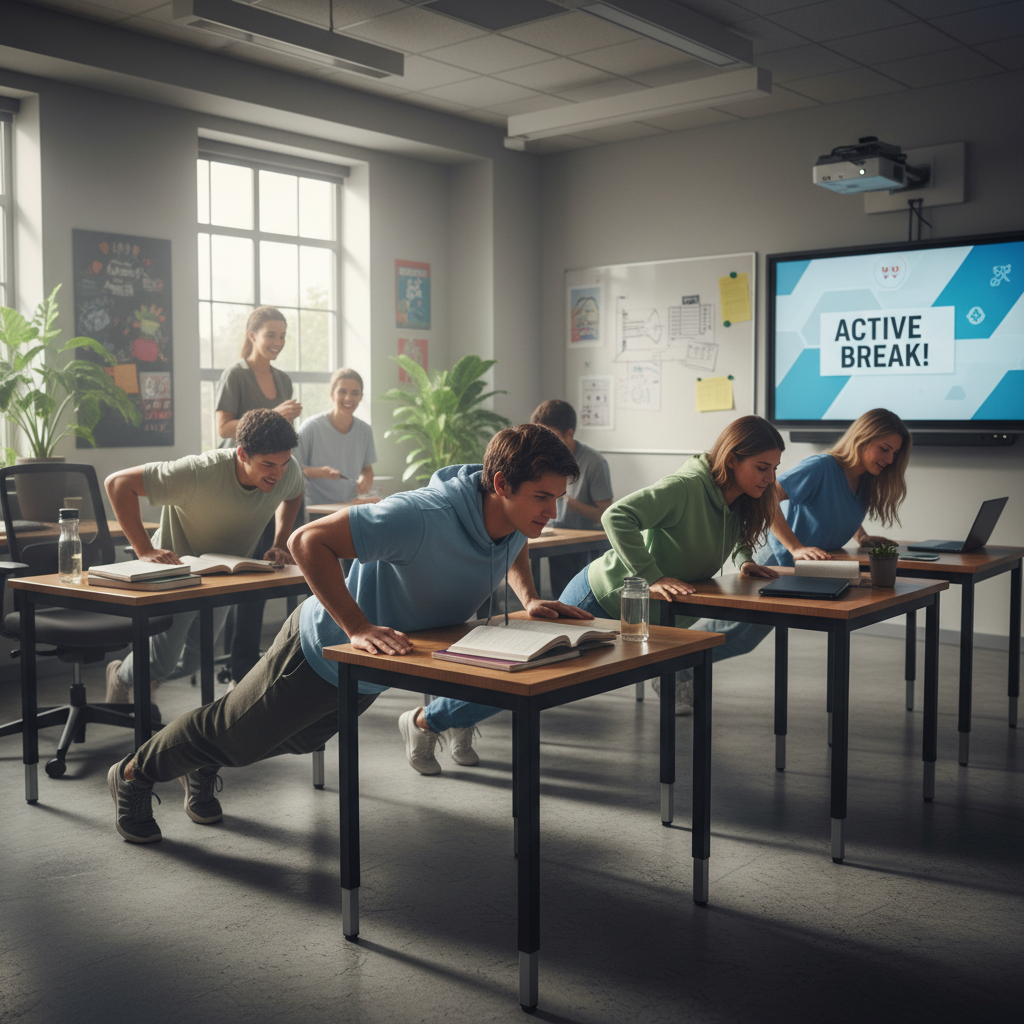
At a Glance
- Time: 1-2 minutes
- Prep: None
- Group: Whole class (individual exercises)
- Setting: Any classroom (at/near desks)
- Subjects: Universal
- Energy: Low-Medium
Purpose
Activate muscles, increase blood flow, and boost alertness through brief exercises that can be performed at or near student desks, providing physical engagement without requiring large movements or space, combating the negative effects of prolonged sitting while building strength and demonstrating that movement and learning are compatible rather than opposed.
How It Works
- Announce exercise (5 sec) - "Stand up. Desk push-ups—10 reps. Go."
- Demonstrate/guide (60-90 sec) - Model the exercise; students perform reps
- Complete (5 sec) - "Sit down. Blood flowing? Good. Back to learning."
Exercise Options:
- Desk push-ups: Hands on desk edge, feet back, lower chest to desk (10 reps)
- Chair dips: Hands on chair edge, lower body (8-10 reps)
- Wall push-ups: Hands on wall, lean in and push (15 reps)
- Calf raises: Rise up on toes, lower (20 reps)
- Squats: Stand, sit, stand without using hands (10 reps)
What to Say
Opening: "Stand up. We're doing desk push-ups. Hands on the edge of your desk, step your feet back, lean forward and lower your chest toward the desk, then push back up. Watch me first."
During: "Ten reps. Down... up... that's one. Down... up... two. Keep going. Breathe. Down... up... eight... nine... ten! Done."
Closing: "Sit down. Muscles activated? Heart rate up a bit? That's what we needed. Let's refocus."
Why It Works
Sedentary behavior impairs glucose metabolism, cardiovascular health, and cognitive function (Tremblay et al., 2010). Brief "exercise snacks"—short bursts of movement—interrupt prolonged sitting and provide many of the benefits of longer exercise: improved circulation, glucose uptake, and alertness. Resistance exercises (push-ups, squats) also activate large muscle groups, triggering neurotransmitter release (dopamine, norepinephrine) that enhances focus. Students return to seats physically energized rather than lethargic.
Research Citation: Exercise snacks and health (Tremblay et al., 2010)
Teacher Tip
Safety first: Demonstrate proper form and watch for students using poor technique that could cause injury. If a student has physical limitations, offer modifications (wall push-ups instead of desk push-ups, partial squats). Never shame students for modifying or doing fewer reps—participation matters more than performance.
Variations
Different Exercise Types
- Upper body: Desk/wall push-ups, chair dips, arm circles
- Lower body: Squats, lunges (if space), calf raises, wall sits
- Core: Seated twists, standing side bends, plank (if space)
- Full body: Burpees (if space/energy), jumping jacks, high knees
Different Intensity
- Low: Wall push-ups, gentle stretches, slow movements
- Medium: Desk push-ups, squats, calf raises
- High: Floor push-ups, jump squats, burpees
Different Ages
- Elementary (K-5): Make it playful: "Pretend you're a robot doing push-ups!" Emphasize fun over form.
- Middle/High School (6-12): Standard exercises; can introduce fitness challenge element
- College/Adult: Frame as wellness/productivity strategy; optional participation
Online Adaptation
Tools Needed: None (students use home furniture)
Setup: Students need space near desk/table
Instructions:
- "Stand up, find a sturdy table or desk"
- Teacher demonstrates exercise on camera
- Students perform exercise at home (cameras optional)
- "Sit back down, we're continuing"
Pro Tip: Create 5-6 different desk exercise routines; rotate through them weekly so students don't get bored.
Troubleshooting
Challenge: Students refuse to participate, claim they "can't" or "won't" do exercises Solution: Make it universal expectation: "This is part of our class routine, like taking notes. You don't have to do 10—do as many as you can." Lower barrier but maintain expectation.
Challenge: Students use poor form or unsafe technique Solution: Stop immediately: "Pause. Watch my form again. Safety first—if you're not sure of proper form, do wall push-ups instead." Demonstrate slowly.
Challenge: Desks aren't sturdy enough for push-ups; furniture tips or wobbles Solution: Switch to wall push-ups only, or squats—no equipment needed. Test desk stability yourself before assigning desk exercises.
Extension Ideas
- Deepen: "Fitness Friday"—every Friday includes 3-5 desk exercise breaks throughout class period
- Connect: Student-led exercises—rotate who chooses/leads the exercise each session
- Follow-up: Track class fitness: "Week 1 we did 5 desk push-ups. Week 8 we did 12. That's progress!"
Related Activities: Stretch Break, Shake It Off, Dance Break