
Rotating Trios
At a Glance
- Time: 6-10 minutes
- Prep: None
- Group: Trios (groups of 3, with one rotating member)
- Setting: Any classroom
- Subjects: Universal - works in any discipline
- Energy: Medium to High
Purpose
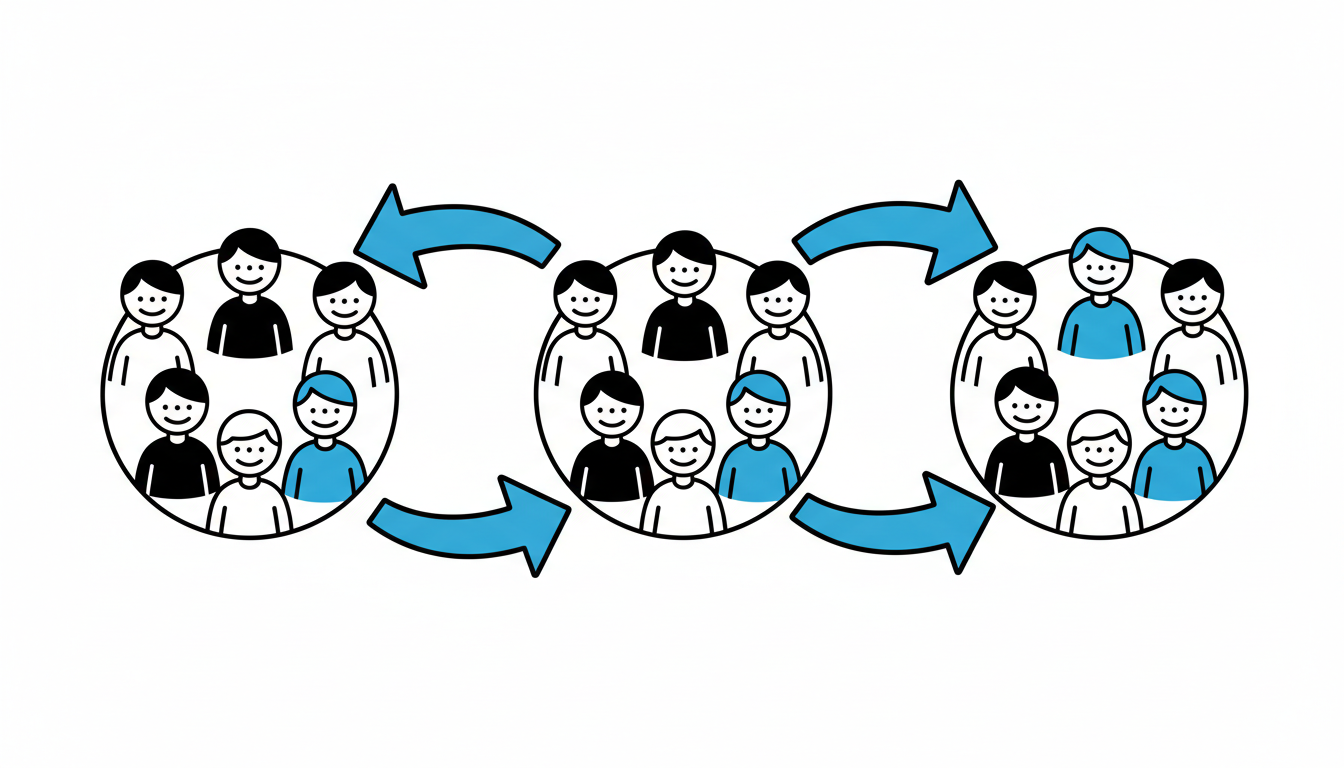
Rotating Trios extends pair work to groups of three and adds dynamic idea circulation by having one member rotate to a new group after each round. Use this when you want students to encounter multiple perspectives while maintaining deeper discussion than pairs allow. The trio format provides the social comfort of having more than one conversation partner while avoiding the diffusion of responsibility that can happen in larger groups.
How It Works
Step-by-step instructions:
-
FORM INITIAL TRIOS (30 seconds) - Divide class into groups of three. If you have remainders, one or two groups can be pairs or quads.
-
ASSIGN ROLES (30 seconds) - Within each trio, designate one person as the "Traveler" (they'll rotate) and two as "Hosts" (they stay put). Simple assignment method: "Person whose birthday is coming up next is the Traveler."
-
FIRST DISCUSSION (2-3 minutes) - Pose a question or task. Trios discuss and develop their ideas together.
-
TRAVELERS ROTATE (20 seconds) - Travelers stand up and move clockwise to the next trio, joining two new Hosts.
-
TRAVELERS SHARE (60 seconds) - The Traveler briefly shares the key ideas from their previous trio's discussion.
-
SECOND DISCUSSION (2-3 minutes) - The new trio discusses the same question or a follow-up question, building on ideas the Traveler brought.
-
REPEAT IF TIME ALLOWS - Travelers can rotate 2-3 times total, bringing new ideas to each trio they join.
What to Say
Setup: "Form groups of three. Within your trio, decide who will be the 'Traveler'—that person will rotate to new groups. The other two are 'Hosts' and will stay put. Quick way to decide: whoever's birthday is coming up next is the Traveler."
First Round: "Here's your question: [POSE QUESTION]. Discuss it in your trio for 2 minutes. Travelers, pay attention to your trio's best ideas—you'll be sharing them with your next group. Begin."
Rotation: "Travelers, stand up. Rotate clockwise to the next trio. Hosts, raise your hand so Travelers can see you. Travelers, join the nearest Hosts."
After Rotation: "Travelers, start by briefly sharing the most interesting idea from your previous trio. Then, Hosts and Traveler, discuss together: How is that idea similar to or different from what you were discussing? You have 2 minutes."
Closing: "Travelers, return to your original trio. Share what you learned from the other groups. Hosts, share what the Travelers who visited you brought. What patterns do you notice?"
Why It Works
Rotating Trios combine the benefits of stable groups with the idea exchange of rotation structures:
Balanced Group Size: Trios avoid the potential awkwardness of pairs (when one person dominates) and the diffusion of responsibility in larger groups (where people hide). Three is often called the "sweet spot" of group work.
Structured Idea Circulation: Travelers carry ideas from group to group like pollinators, cross-fertilizing thinking throughout the classroom without everyone needing to move.
Dual Perspectives: Travelers get to hear multiple groups' thinking. Hosts get to hear ideas from multiple Travelers who visit. Everyone benefits from expanded perspectives.
Stability Plus Novelty: The Host pair provides continuity and allows relationship-building, while the rotating Traveler adds novelty and fresh thinking.
Role Clarity: Clear roles (Traveler vs. Host) reduce confusion and create natural structure for idea-sharing.
Research Citation: Research on jigsaw-style cooperative learning shows that structures requiring students to both contribute to and learn from multiple groups lead to deeper understanding than static groups (Aronson & Bridgeman, 1979).
Teacher Tip
Travelers often feel pressure to perfectly summarize their previous trio's ideas, which can create anxiety. Lower the stakes by framing it differently: "Travelers, you're not giving a formal report. Just say, 'One thing that came up in my last group was...' That's it. You're starting a conversation, not delivering a presentation."
Variations
For Different Subjects
-
Math: First round solves a problem. Travelers rotate and share their solution method. New trios evaluate the method and look for flaws or alternative approaches.
-
Literature: First round analyzes a character. Travelers rotate and share their analysis. New trios compare the character to a different character.
-
Science: First round explores one variable in an experiment. Travelers rotate and share findings. New trios discuss how multiple variables interact.
-
Social Studies: First round examines one historical perspective. Travelers rotate and share. New trios compare multiple perspectives.
For Different Settings
-
Large Class (30+): Works beautifully. You'll have 10+ trios, so Travelers encounter many different ideas as they rotate.
-
Small Class (9-15): Still effective. With 3-5 trios, Travelers can visit every group.
-
Fixed Seating (Auditorium): Hosts can stay in their seats. Travelers move to open seats in other rows, temporarily forming trios with students in that area.
For Different Ages
-
Elementary (K-5): Give Travelers a concrete task: "When you move to your new group, tell them one word your old group said about this topic."
-
Middle/High School (6-12): Standard format works well. Students handle the abstract task of summarizing and comparing ideas.
-
College/Adult: Can add meta-cognitive layer: "Travelers, don't just report ideas—report how your previous trio discussed the ideas. What process did they use?"
Online Adaptation
Tools Needed: Video conferencing with breakout rooms (Zoom, Google Meet)
Setup: Pre-designate Travelers before creating breakout rooms.
Instructions:
- Create initial trio breakout rooms for 2 minutes
- Bring everyone back to main room
- Manually reassign Travelers to new breakout rooms while keeping Host pairs intact
- Send groups to breakout rooms for 2 minutes
- Repeat if desired
Pro Tip: In Zoom, rename Travelers with a prefix (e.g., "T-Alice," "T-Bob") so you can easily identify and reassign them when recreating breakout rooms.
Troubleshooting
Challenge: Travelers forget what their previous trio discussed and struggle to report out.
Solution: Give Travelers a concrete note-taking task during the first discussion: "Travelers, jot down 2-3 keywords from your trio's discussion. You'll use these notes when you rotate."
Challenge: When Travelers leave, the two Hosts sit silently waiting for a new Traveler to arrive.
Solution: Give Hosts a specific task during transitions: "While you're waiting for your new Traveler, Hosts should summarize your trio's main idea in one sentence. You'll share this with your incoming Traveler first, then hear what they bring."
Challenge: Some Travelers rotate to the wrong group, creating chaos.
Solution: Use a clear movement pattern: "Travelers, stand and walk clockwise. Join the trio immediately to your right." You can also direct traffic: "Travelers, freeze. Now I'm going to point to where each of you goes."
Extension Ideas
-
Deepen: After 2-3 rotations, have all Travelers gather in one group and all Hosts form groups. Each group synthesizes the range of ideas they encountered.
-
Connect: Assign different questions to different rounds: Round 1 = brainstorm causes. Travelers rotate. Round 2 = brainstorm solutions. This builds complexity.
-
Follow-up: Written reflection: "What idea did you encounter through rotation that you wouldn't have thought of in your original trio?"
Related Activities: Concentric Circles, Jigsaw, Snowball Groups