
Human Barometer
At a Glance
- Time: 60-90 seconds
- Prep: None
- Group: Whole class (individual participation)
- Setting: In-person (requires movement space)
- Subjects: Universal
- Energy: Medium
Purpose
Physically visualize opinion distribution by having students move to different areas of the classroom based on their stance on a question. Use this to activate prior opinions, start debates, or make abstract concepts concrete through spatial positioning.
How It Works
Step-by-step instructions:
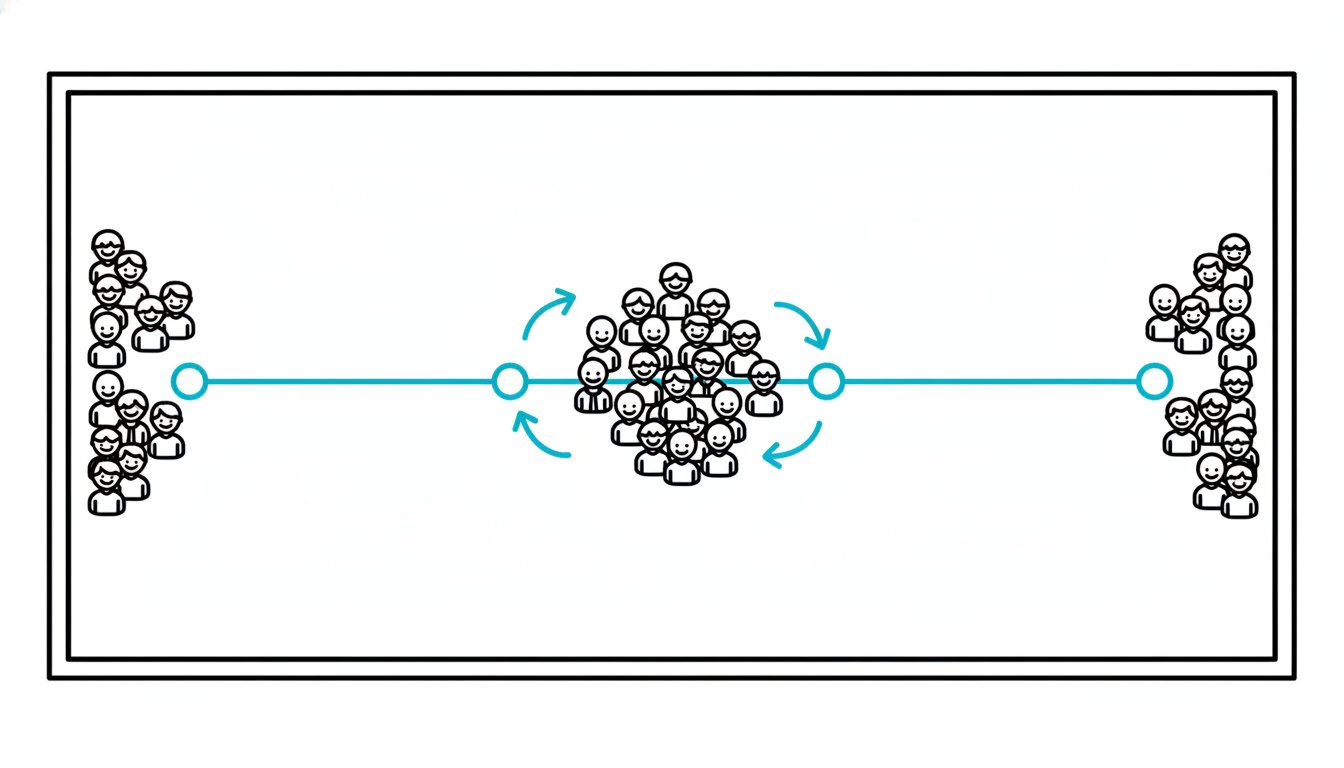
- ESTABLISH SCALE (15 seconds) - "This side of the room is 'Strongly Agree,' that side is 'Strongly Disagree,' middle is 'Neutral.' You can stand anywhere along the spectrum."
- POSE STATEMENT (10 seconds) - "Statement: 'Social media does more harm than good.' Move to where you stand on that spectrum."
- MOVE (30 seconds) - Students physically move to positions
- OBSERVE (15 seconds) - "Look around. Notice the distribution. Interesting!"
- OPTIONAL SHARE (20 seconds) - Call on 2-3 students from different positions: "Why are you standing there?"
- TRANSITION (10 seconds) - "Return to your seats. Let's explore this topic."
What to Say
Opening: "Stand up! This wall is 'Strongly Agree.' That wall is 'Strongly Disagree.' The middle of the room is 'Neutral/Unsure.' I'm going to read a statement. Move to wherever you stand on that opinion spectrum. Ready? Statement: 'Technology makes us less social.' Move!"
After movement: "Look at this! We have a wide distribution. Some strongly agree, some strongly disagree, many in between. This tells us today's topic is complex and worth discussing."
Optional callouts: "Sarah, you're way over at 'Strongly Agree.' Why?" (Brief answer.) "Marcus, you're at 'Strongly Disagree.' Different perspective?" (Brief answer.)
Closing: "Thank you! Back to your seats. We just visualized the range of opinions in this room. Let's dig deeper."
Why It Works
Physical movement engages the body, increasing alertness and attention. Seeing the spatial distribution of opinions makes abstract concepts concrete—students can literally see "Most people are in the middle" or "We're divided on this." This builds intellectual safety by showing diverse perspectives are normal and expected. The movement also gets students out of their seats, increasing blood flow. The public commitment (standing in a position) primes students to engage more deeply with the upcoming discussion because they've already taken a stance.
Research Citation: Kinesthetic learning activities improve engagement and memory by connecting physical experience with cognitive content (Barsalou, 2008).
Teacher Tip
Choose provocative statements that genuinely divide opinions. If everyone ends up on the same side, the activity loses its power. Test your statement beforehand: "Will this create a range of responses?" Good statements are debatable, relevant, and connect to the lesson content.
Variations
For Different Subjects
- Any Debate Topic: "The death penalty should be abolished." "Climate change is the most urgent global issue."
- Content Opinions: "Romeo and Juliet is a love story." (Lit) / "Math is more important than art." / "The Revolutionary War was justified."
- Self-Assessment: "I understand photosynthesis." (One end = totally understand, other = confused)
- Preference Poll: "I prefer working alone vs. in groups."
- Confidence Check: "I'm ready for this test." (One end = ready, other = not ready)
For Different Settings
- Large Class (30+): Works great. The physical distribution is very visible.
- Small Class (5-15): Still effective. Even with fewer people, the spatial positioning matters.
- Limited Space: Use a line instead of full room. "Front of the class = agree, back = disagree, line up in between."
- Online: Use a digital poll or number line: "Type a number 1-10 in chat. 1 = strongly disagree, 10 = strongly agree."
For Different Ages
- Elementary (K-5): Use simpler statements: "Pizza is better than tacos." "Reading is more fun than math." Keep it lighthearted.
- Middle/High School (6-12): Can handle complex, nuanced topics. Great for controversial discussions.
- College/Adult: Use sophisticated topics relevant to course content. Adults appreciate seeing the diversity of perspectives.
Online Adaptation
Tools Needed: Zoom, Teams, polling tool, or chat
Option 1: Poll
- Use built-in polling: "Rate 1-5: 1 = Strongly Disagree, 5 = Strongly Agree"
- Display results
Option 2: Chat Scale
- "Type a number 1-10 in chat. 1 = Strongly Disagree, 10 = Strongly Agree. Go!"
- Scroll through responses: "I see lots of 7-9s, a few 2-3s. Wide range!"
Option 3: Visual Scale
- Share screen with a horizontal line graphic
- "Annotate where you stand on this line using the annotation tools"
Pro Tip: Digital polls work well but lose the powerful visual of physical distribution. If possible, have students hold up fingers (1-5) on camera for a visual approximation.
Troubleshooting
Challenge: Everyone clumps in the middle (neutral) to avoid commitment. Solution: Encourage spread: "I need more diversity! If you're even slightly leaning one way, move in that direction. The middle should only be genuine 'I don't know.'"
Challenge: Students look around to see where others go before moving. Solution: "Close your eyes, think about where you stand, then move quickly when I say 'go.' Don't follow your friends—go where YOU stand. Open eyes, GO!"
Challenge: A controversial statement creates discomfort or tension. Solution: Frame it: "We're exploring different perspectives, not attacking each other. All positions are valid starting points for discussion. Respect the range."
Extension Ideas
- Deepen: After they've moved, do a brief pair-share: "Find someone near you. Explain why you're standing where you are. 60 seconds."
- Connect: Allow movement during discussion: "As you hear arguments, you can physically move if your opinion shifts. Let's see if anyone changes position."
- Follow-up: End the lesson with the same statement: "Has your position changed? Move to where you stand NOW." Compare before/after distributions.
Related Activities: Four Corners, Fist to Five, Thumbs Compass