
Difficulty Ranking
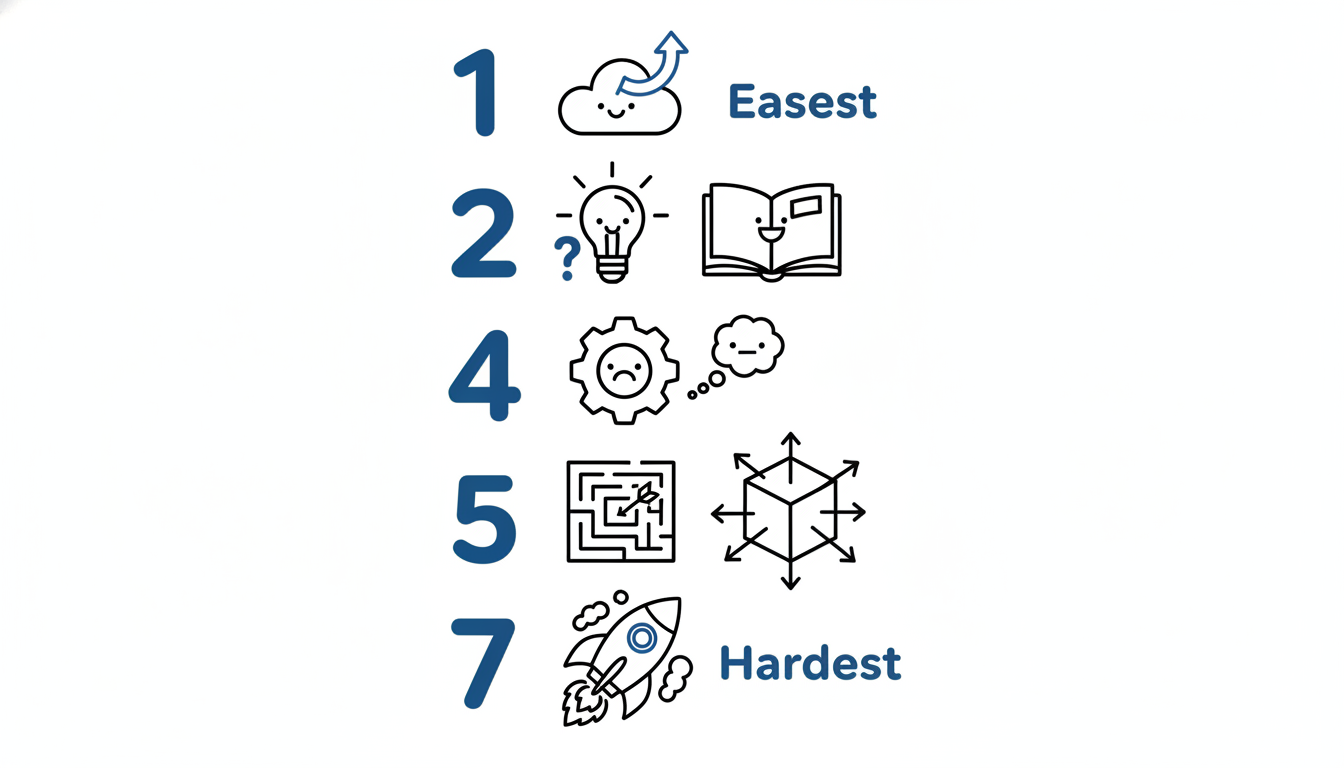
At a Glance
- Time: 2-3 minutes
- Prep: None (or list of concepts on board)
- Group: Individual reflection
- Setting: Any classroom
- Subjects: Universal
- Energy: Low
Purpose
Develop accurate self-assessment and comprehension monitoring by having students rank today's concepts, skills, or topics from easiest to hardest, making their understanding explicit and providing both students and teachers with diagnostic information about where additional support is needed and where students feel confident.
How It Works
- List the concepts (30 sec) - Write 3-5 key concepts/skills from today's lesson on board
- Individual ranking (90 sec) - Students copy the list and number them 1-5, with 1 = easiest for me, 5 = hardest for me
- Optional tally (30 sec) - Quick poll: "How many ranked [concept A] as hardest? How many as easiest?" Identify class-wide patterns
- Metacognitive prompt (30 sec) - "Why did you rank [concept] as hardest? What specifically is confusing?"
What to Say
Opening: "Look at these five concepts we covered today: [list them]. In your notes, rank them from 1 to 5. Number 1 is the concept you found easiest—you've got it. Number 5 is the hardest—you're still working on it. Be honest; this is for YOU, not for a grade."
During: "Think about what makes something 'easy' versus 'hard' for you. Is it confusing? Unfamiliar? Lots of steps? Identify what specifically makes your #5 challenging."
After poll: "Interesting! Most of you ranked [X] as hardest. That tells me where we need to spend more time tomorrow."
Closing: "Your ranking is your study plan. Tonight, focus on your #4 and #5. Your #1 and #2? You've got those—brief review is enough."
Why It Works
Accurate self-assessment is a hallmark of expert learners but a struggle for novices (Dunning-Kruger effect). Difficulty ranking forces students to evaluate their own comprehension rather than passively assuming understanding. The comparative format (ranking rather than absolute rating) is easier and more reliable—students can usually determine which of two concepts they understand better, even if they can't assign accurate percentage scores. Aggregated rankings give teachers real-time feedback about which concepts need re-teaching.
Research Citation: Metacognitive monitoring accuracy (Dunlosky & Rawson, 2012)
Teacher Tip
Use the class data strategically. If most students rank the same concept as hardest, start tomorrow's lesson by re-teaching it from a different angle. If rankings are scattered—everyone finds something different challenging—plan differentiated practice or small-group work targeting different concepts.
Variations
For Different Subjects
- Math/Science: Rank problem types, formulas, or processes by difficulty
- Humanities: Rank themes, characters, events, or essay skills
- Universal: Rank steps in a process, vocabulary terms, or skills practiced today
For Different Settings
- Large Class (30+): Use digital polling tool (Mentimeter, Poll Everywhere) to instantly visualize class rankings
- Small Group (5-15): Share rankings aloud and discuss why certain concepts felt harder
For Different Ages
- Elementary (K-5): Use emoji scale ( easy, medium, hard) instead of numbers; 3 concepts maximum
- Middle/High School (6-12): Standard 1-5 ranking; can add written explanation for hardest-ranked item
- College/Adult: Include self-efficacy component: "Rate difficulty AND your confidence you can master it with practice"
Online Adaptation
Tools Needed: Poll tool (Google Forms, Mentimeter, Zoom poll) or shared spreadsheet
Setup: Create quick poll with concepts listed
Instructions:
- Display concepts on screen
- Students rank independently using poll tool
- Share aggregate results instantly via chart/graph
- Discuss in chat: "If you ranked X as hardest, what specifically is confusing?"
- Use breakout rooms to group students by their #5 (hardest concept) for targeted peer support
Pro Tip: Use Google Forms with dropdown ranking; results auto-generate charts showing class patterns.
Troubleshooting
Challenge: Students rank everything as "hard" or everything as "easy" Solution: Emphasize forced choice: "You MUST use each number 1-5 only once. Even if they all feel similar, which is relatively easiest?"
Challenge: Students rank strategically to avoid practice ("I'll say it's all easy so I don't have homework") Solution: Frame as diagnostic, not punitive: "This isn't about assigning more work. It's about focusing your OWN study time wisely and helping me teach better."
Challenge: Rankings don't match actual performance (over-confident or under-confident students) Solution: Compare rankings to quiz results later: "You ranked X as easy, but several people missed it on the quiz. Let's talk about what you thought you knew versus what the assessment showed."
Extension Ideas
- Deepen: "Difficulty + Strategy Ranking"—for each item, note difficulty AND which study strategy would help most
- Connect: Track rankings over time: "Last week you ranked this as #5 hardest. Where is it now? That's progress!"
- Follow-up: Peer tutoring based on rankings: students who ranked something as #1 can teach students who ranked it #5
Related Activities: Traffic Light Self-Assessment, Learning Ladder, Progress Tracking