
Brainwriting 6-3-5
At a Glance
- Time: 5 minutes
- Prep: Minimal (paper for each student)
- Group: Groups of 6 (adapt for other sizes)
- Setting: Any classroom
- Subjects: Universal (especially effective for collaborative ideation)
- Energy: Low-Medium
Purpose
Generate a high volume of diverse ideas quickly through silent, written brainstorming that ensures equal participation and builds on peers' thinking. Use this when you need many varied perspectives on a problem, want to include introverted students fully, or need to prevent dominant voices from monopolizing the conversation.
How It Works
Step-by-step instructions:
-
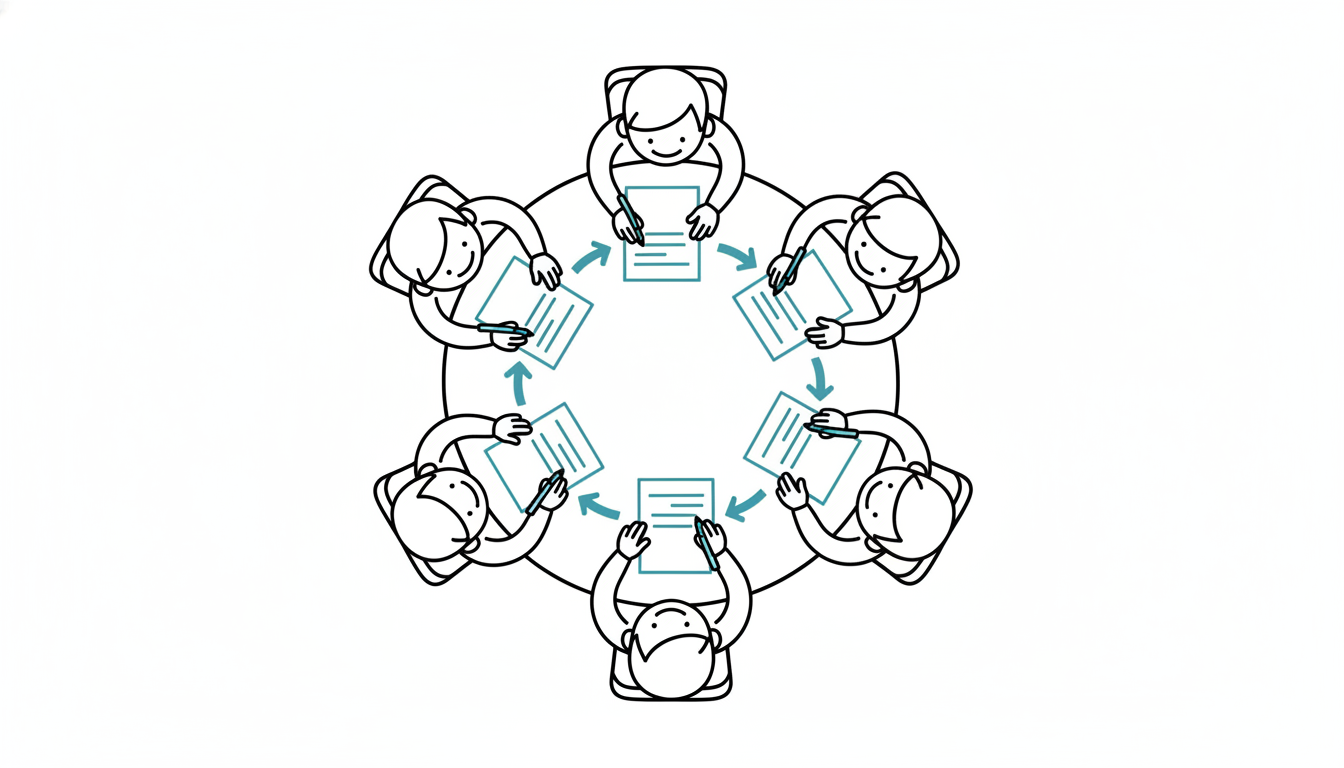
Set up groups and pose the challenge (30 seconds) - Arrange students in groups of 6. Give each student paper divided into three columns. Present the brainstorming challenge clearly
-
Conduct writing rounds (4 minutes) - Each student writes 3 ideas in 50 seconds, then passes their paper to the right. Students read what their neighbor wrote and add three new or expanded ideas. Continue for 6 rounds until papers return to original owners
-
Harvest best ideas (1 minute) - Each student identifies the strongest idea from their returned sheet and shares it with the group or class
What to Say
Opening: "This is brainstorming without talking. You'll write 3 ideas in 50 seconds, then pass your paper to the right. When you get a new paper, read the ideas and add 3 more—build on what's there, combine ideas, or add something completely new. Ready? Your challenge is: 'How could we make our school more sustainable?' Write 3 ideas now. Go!"
During: "Pass to the right... Read quickly and add 3 more ideas... You can build on what's there or add something fresh... Pass again... Keep the ideas flowing... Two more rounds!"
Closing: "Your original paper is back. Read through all the ideas that accumulated—that's 18 ideas generated in 5 minutes! Circle the one you think is strongest... Who wants to share the best idea from their sheet?"
Why It Works
Brainwriting equalizes participation by removing the advantages that quick thinkers and extroverted students have in verbal brainstorming. Silent generation prevents groupthink and the tendency to converge too quickly on the first good idea. The serial building on others' ideas creates unexpected connections and refinements that wouldn't emerge in parallel individual brainstorming. The time pressure and structure keep energy high and prevent overthinking.
Research Connection: Brainwriting techniques consistently outperform traditional verbal brainstorming in both quantity and quality of ideas generated, particularly because they reduce production blocking and evaluation apprehension (Paulus & Yang, 2000).
Teacher Tip
The first round is always the hardest—students worry about writing "good" ideas. Emphasize that quantity matters more than quality in the initial rounds. Say: "Even silly ideas count! Sometimes the best final solutions come from combining a good idea with a silly one." This permission to be imperfect unlocks creativity.
Variations
For Different Subjects
- Math/Science: "Generate different strategies for solving this problem type... What experiments could test this hypothesis?... How could we apply this formula to real-world situations?"
- Humanities: "Different interpretations of this character's motivation... Alternative endings for this historical event... Ways to organize this essay argument"
- Universal: Innovation challenges, problem-solving scenarios, process improvement ideas
For Different Settings
- Large Class (30+): Adapt to 6-2-4: groups of 6, write 2 ideas in 40 seconds, 4 rounds
- Small Group (fewer than 6): Modify to 4-3-4 (4 students, 3 ideas, 4 rounds) or 3-3-3 (3 students, 3 ideas, 3 rounds)
For Different Ages
- Elementary (K-5): Use 3-2-3 format (3 students, 2 ideas, 3 rounds). Provide sentence starters: "One idea is... Another way is... We could also..."
- Middle/High School (6-12): Standard 6-3-5 format
- College/Adult: Add evaluation round: after generating, groups use dot voting to identify top 3 ideas, then develop one in detail
Online Adaptation
Tools Needed: Google Docs with editing permissions or Padlet
Setup: Create 6 separate Google Docs (one per student), each shared with edit access to all group members
Instructions:
- Students open their assigned doc and write 3 ideas
- On teacher signal, everyone switches to the next numbered doc (Doc 1→2, 2→3, etc.)
- Read previous ideas, add 3 new ones
- Continue rotating until back to original doc
- Debrief via breakout rooms or chat
Pro Tip: Use a shared Jamboard instead—each student gets a frame, adds sticky notes, then "passes" by moving to the next frame
Troubleshooting
Challenge: Students can't think of 3 ideas in 50 seconds Solution: Allow "half-ideas" or questions: "What if we...?" or "Could we try...?" counts as an idea. Lower the requirement: "Write as many as you can, minimum of 2"
Challenge: Ideas become repetitive after a few rounds Solution: Introduce a "twist" prompt after round 3: "Now make your ideas more unusual... combine two existing ideas... think about the opposite approach"
Extension Ideas
- Deepen: After generating, have groups categorize ideas (feasible vs. innovative, short-term vs. long-term) and select one from each category to develop further
- Connect: Compare with verbal brainstorming: "Did you generate more ideas silently or out loud? Which felt more comfortable? Why might written brainstorming produce different results?"
- Follow-up: Create a "greatest hits" compilation of the best ideas from all groups, then vote democratically on which to implement
Related Activities: Divergent Thinking Prompts, Silent Collaboration, Reverse Brainstorming