
Hula Hoop Venn Diagrams
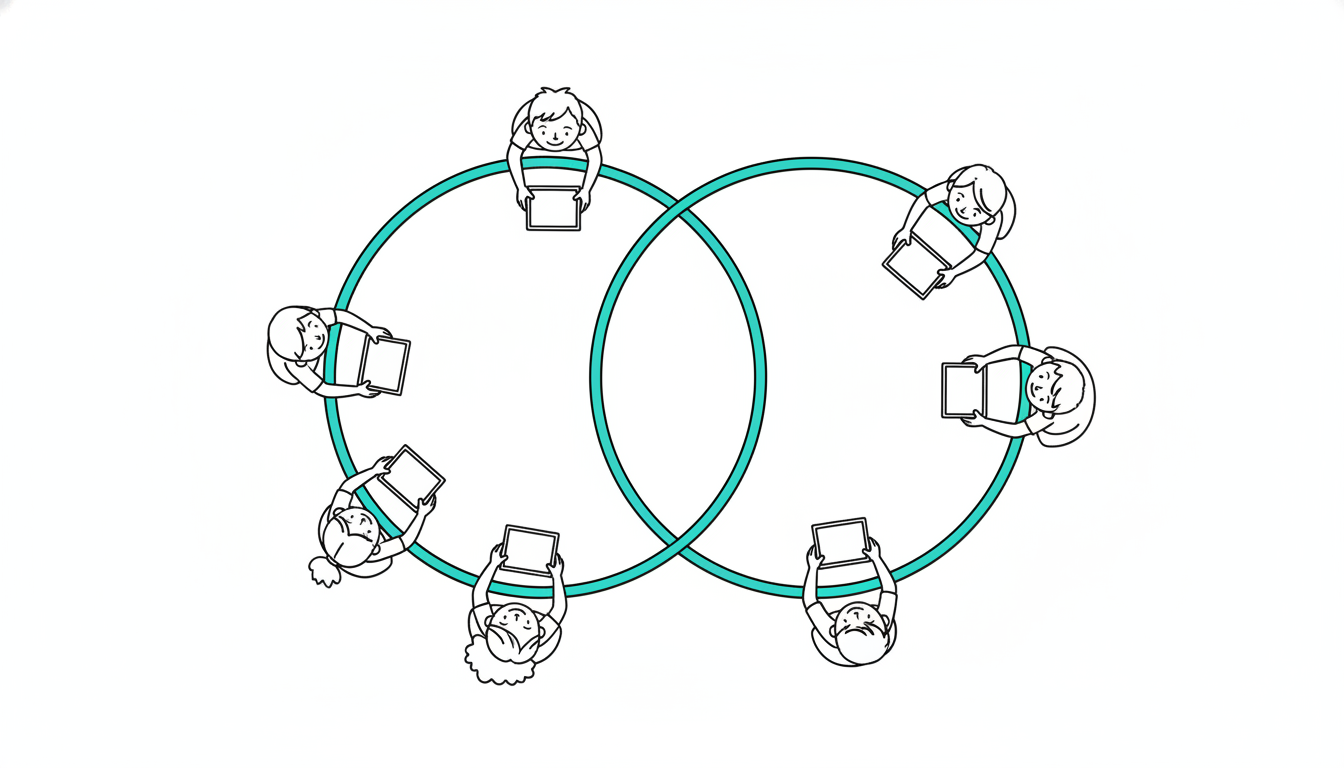
At a Glance
- Time: 4-5 minutes
- Prep: Minimal (hula hoops, cards)
- Group: Small groups
- Setting: Classroom with floor space
- Subjects: Science, Language, Math, Universal
- Energy: Medium
Purpose
Transform abstract Venn diagram into large-scale, collaborative sorting activity by using overlapping hula hoops on the floor where students physically place cards into appropriate categories, making set relationships spatially concrete.
How It Works
- Set up hoops (30 sec) - Place 2-3 hula hoops on floor with overlaps; label each circle
- Distribute cards (30 sec) - Give students index cards with facts, terms, or characteristics to sort
- Collaborative sorting (3-4 min) - Students discuss and physically place cards in correct regions of Venn diagram
What to Say
Opening: "This hoop = 'Plant Cell characteristics,' this hoop = 'Animal Cell characteristics.' The overlap = 'Both.' Each card has a cellular feature. Work together to sort them into the right spots. Discuss before placing!"
During: "Does mitochondria go in both? ... Where does cell wall belong? ... Justify your placement to your team..."
Closing: "You physically saw the overlap—the shared characteristics in the middle. That spatial representation helps you remember which features are unique versus shared."
Why It Works
Large-scale physical sorting makes abstract set theory concrete. Collaborative placement requires articulation and negotiation. Visual-spatial organization enhances categorical memory. Physical movement to place cards adds embodied engagement.
Research Connection: Physical manipulation of learning materials improves conceptual understanding (Glenberg et al., 2004).
Teacher Tip
After sorting, take a photo of the completed Venn diagram. Project it later: "Remember where you placed 'chloroplast'? Why was it only in the plant cell circle?" Photos provide visual retrieval cues.
Variations
Content: Compare/contrast characters, classify organisms, sort numbers (prime vs. composite vs. both), categorize literary devices, compare historical events, sort geometric shapes • Complexity: 2-circle Venn, 3-circle Venn, 4-set Venn • Ages: K-5: Simple 2-circle sorting; 6-12: Complex 3-circle; College: Multi-set logic problems
Online
Digital Venn diagram (Google Jamboard, Miro). Students drag digital cards into regions. Collaborative in real-time.
Troubleshooting
Disagreement on placement: "Great—that debate means you're thinking critically. Look it up together, then decide as a team."
Extension
Human Venn: Skip cards—students themselves stand in hoop regions. "If you play sports, stand in this hoop. If you play music, stand in this hoop..." See who's in overlap!
Related: Speed Sort, Four Corners