
Body Letters
At a Glance
- Time: 2-3 minutes
- Prep: None
- Group: Whole class (individual or pairs)
- Setting: In-person (requires space for movement)
- Subjects: Universal (especially effective for vocabulary, spelling, language arts)
- Energy: High
Purpose
Engage kinesthetic learners by using the body to physically form letters of key vocabulary words. This combines movement, creativity, and content review while activating embodied cognition—the brain remembers information better when it's connected to physical experience.
How It Works
Step-by-step instructions:
- ANNOUNCE (10 seconds) - "We're going to spell our vocabulary word using our bodies. The word is 'PHOTOSYNTHESIS.' You can work alone or with a partner to form each letter."
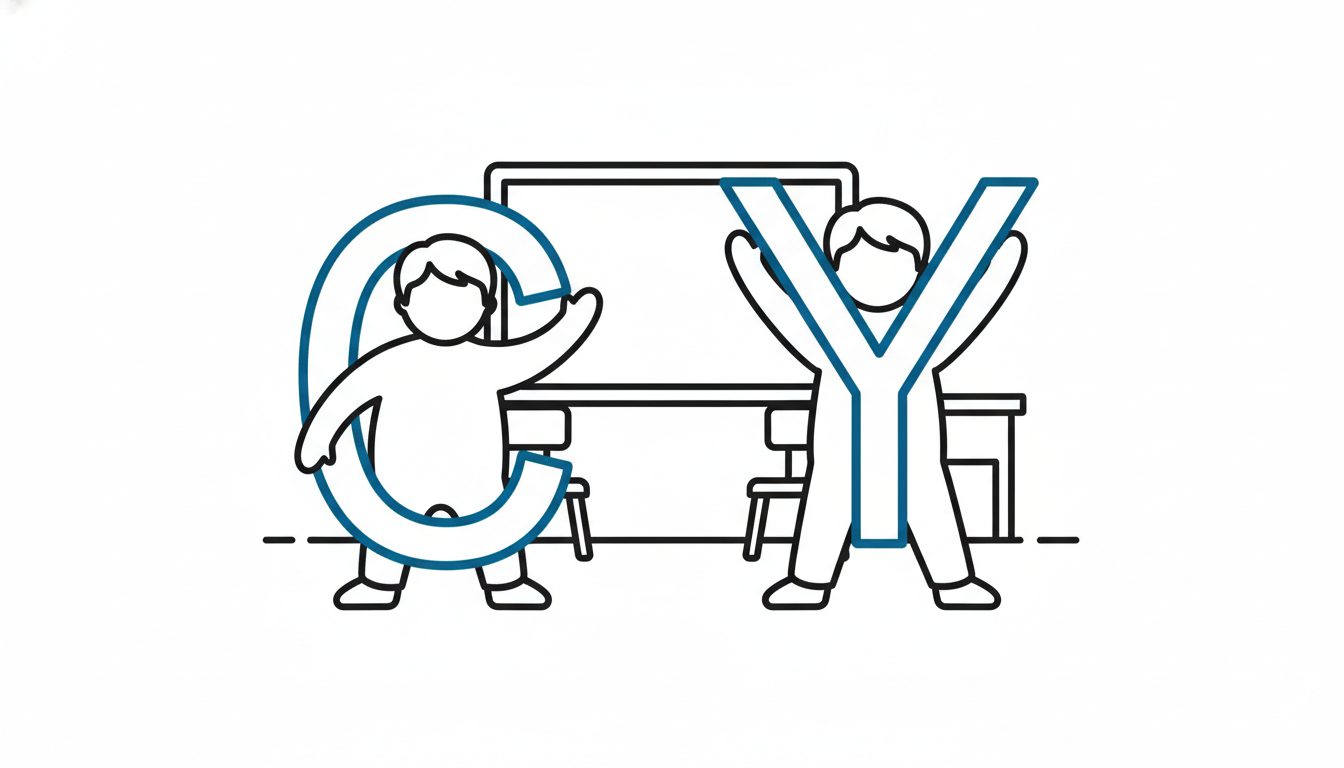
- DEMONSTRATE (15 seconds) - Show an example: stand with arms above head in a "Y" shape or bend to form a "C"
- CREATE (90 seconds) - Students form letters of the word one at a time or collaborate to spell the whole word
- SHARE (30 seconds) - Call on 2-3 students/pairs to show creative letters
- TRANSITION (5 seconds) - "Great! Now let's define photosynthesis."
What to Say
Opening: "Stand up! Our key word today is 'HABITAT.' Your challenge: use your body to form the letters H-A-B-I-T-A-T. You can do this alone—one letter at a time—or partner up and each person makes a letter. Get creative. You have 90 seconds. Go!"
During: Walk around, narrate what you see: "I see someone making an amazing 'H' with arms and legs! That's an interesting 'B'—nice work!"
Closing: "Show me your best letter! Hold it! Perfect. Now let's use these bodies-and-brains to learn what habitat actually means. Sit down."
Why It Works
Embodied cognition research shows that learning involving physical movement creates stronger memory traces than passive learning. When students physically form letters, they're encoding the word through motor memory, visual memory, and spatial awareness simultaneously. This multi-modal encoding makes recall easier. Additionally, the novelty and creativity involved activate dopamine release, tagging the experience as memorable.
Research Citation: Studies on embodied cognition demonstrate improved vocabulary retention when learning involves physical gesture and movement (Barsalou, 2008).
Teacher Tip
Let them be creative and silly. The "best" body letters are often unconventional. Celebrate creativity rather than perfect letter formation. The goal is engagement and memory, not art class precision.
Variations
For Different Subjects
- Language Arts: Spelling words, vocabulary terms, parts of speech (form the letters in "VERB")
- Science: Key terms (DNA, ATOM, CELL), chemical symbols (H2O—three people!)
- Math: Spell out math vocabulary (PRIME, RATIO, ANGLE)
- History: Important names (LINCOLN, CAESAR), key terms (EMPIRE, TREATY)
- Foreign Language: New vocabulary words, greetings, numbers
For Different Settings
- Large Class (30+): Everyone does it simultaneously. Controlled chaos is fine!
- Small Class (5-15): Can do it as a group, with each person forming one letter to spell the whole word together
- Limited Space: Use seated body letters—form letters with arms, hands, or upper body only
For Different Ages
- Elementary (K-5): Use short, simple words (CAT, SUN, FUN). Make it a game: "Who can make the best 'S'?"
- Middle/High School (6-12): Use content-specific vocabulary. Can make it competitive: "Fastest group to spell the word wins."
- College/Adult: Frame it as "kinesthetic encoding" rather than a game. Adults still engage if you explain the neuroscience.
Online Adaptation
Tools Needed: Zoom, Teams, or any video platform with camera
Setup: Students turn cameras on and stand back so their full body is visible in frame.
Instructions:
- "Stand up and back up so I can see your whole body on camera."
- "We're spelling 'DEMOCRACY' using body letters. Show me one letter at a time."
- Call on students to demonstrate their letters: "Sarah, show us your 'D'!"
Pro Tip: Use gallery view so everyone can see each other's creative letters. Screenshot the best ones and share in the chat or use them in slides later.
Troubleshooting
Challenge: Students are self-conscious or hesitant to participate. Solution: Start by forming a letter yourself with exaggerated enthusiasm. "Check out my letter 'T'!" Make it silly and fun. Lower the stakes by saying, "No wrong answers—any shape works!"
Challenge: The word is too long and takes forever. Solution: Shorten it. Instead of spelling "PHOTOSYNTHESIS," just do "PHOTO" or the first few letters. Or assign pairs—each pair does 2-3 letters.
Challenge: Some students are shy about moving their bodies. Solution: Offer "arm letters only" as an option. They can sit and form letters with their arms/hands. Still kinesthetic, just less exposed.
Extension Ideas
- Deepen: After forming the word, ask students to create a frozen tableau (body sculpture) that represents the meaning of the word, not just the letters.
- Connect: Create a photo gallery. Take photos of their best body letters and create a class "Body Alphabet" poster.
- Follow-up: Challenge them to teach a younger student or sibling the word using body letters. Report back tomorrow.
Related Activities: Air Writing, Superhero Poses, Statue Freeze