
Quick STEM Challenges
At a Glance
- Time: 5-7 minutes
- Prep: Minimal (simple materials: paper, tape, straws, marshmallows, cardboard, string)
- Group: Small groups (3-4 students)
- Setting: Any classroom
- Subjects: STEM (adaptable to any subject needing hands-on problem-solving)
- Energy: High
Purpose
Engage students in rapid engineering design challenges that require hands-on problem-solving, prototyping, and iteration—compressing the full design process into just a few minutes. Use this to energize the room, build teamwork, or introduce concepts like constraints, optimization, and the iterative nature of engineering.
How It Works
Step-by-step instructions:
-
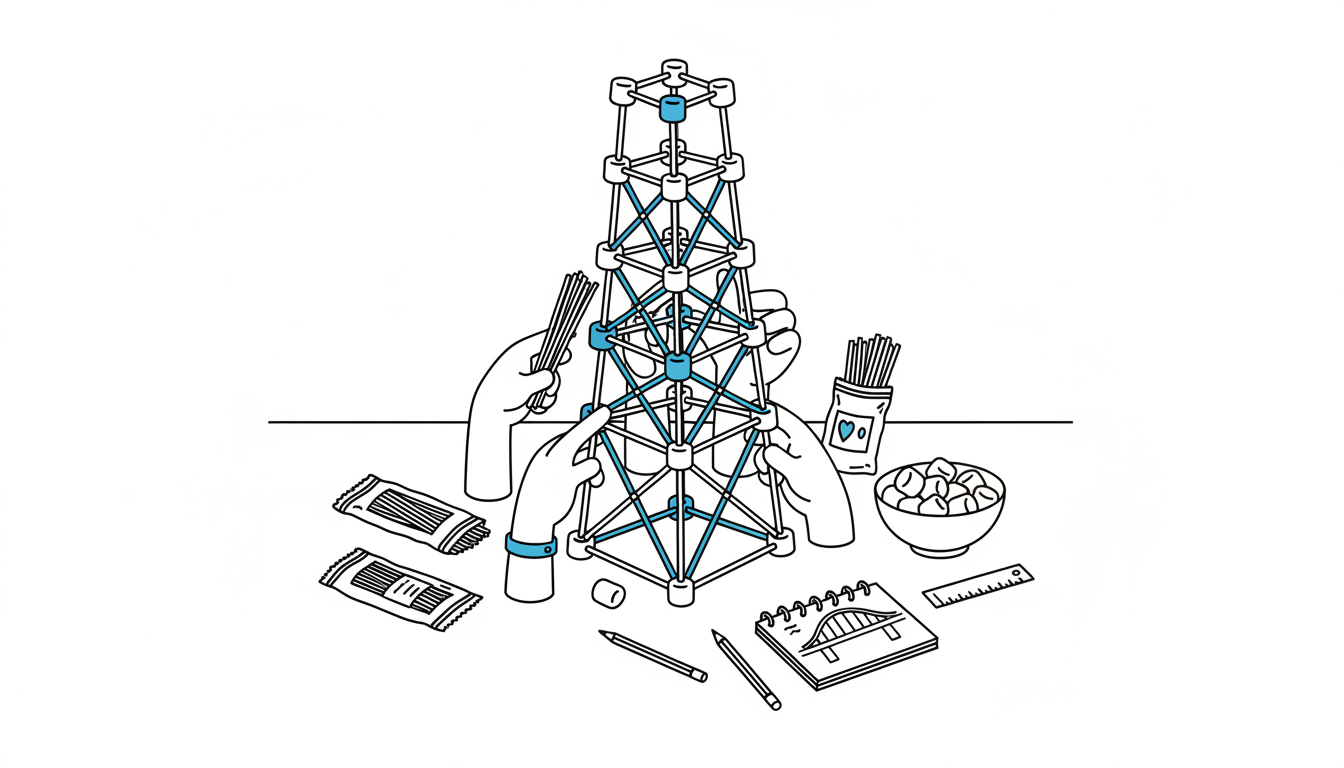
Present the challenge and materials (1 minute) - Explain the challenge: build the tallest free-standing tower, create a boat that floats, protect an egg from a drop, etc. Show the limited materials available and time constraint
-
Build and iterate (4-5 minutes) - Groups work rapidly to design, build, and test their solutions. Encourage quick prototyping and revision rather than extensive planning. If something fails, they adapt immediately
-
Test and reflect (1-2 minutes) - Test all designs simultaneously (measure heights, test flotation, drop eggs). Briefly discuss: What strategies worked? What would you do differently with more time?
What to Say
Opening: "Your challenge: build the tallest free-standing tower that can hold a marshmallow on top. You have exactly 20 spaghetti sticks, 1 yard of tape, and 1 yard of string. Your tower must stand for 10 seconds without support. You have 5 minutes. Go!"
During: "Test as you build... Don't aim for perfection—aim for functional... If it falls, that's data! Revise quickly... 2 minutes left... Think about weight distribution... stability matters more than height!"
Closing: "Let's measure! Stand back... Wow, 18 inches, 14 inches, collapsed at 20—what happened?... What design principle did the tallest tower use? What would you do differently next time? This is exactly how engineers work: build, test, learn, revise, repeat."
Why It Works
Hands-on challenges activate learning in ways that abstract instruction cannot. The time pressure prevents perfectionism and over-planning, forcing students into the messiness of real problem-solving. The tangible feedback—does it stand? Does it float? Does the egg break?—is immediate and undeniable, teaching iteration faster than any lecture. The collaborative element distributes cognitive load and mirrors real-world engineering teams. Most importantly, students experience that failure is information, not defeat.
Research Connection: Project-based and challenge-based learning improve retention, engagement, and development of problem-solving skills (Kolodner et al., 2003; Barron et al., 1998). The engineering design process develops systems thinking and resilience.
Teacher Tip
Don't give solutions or hints—let them struggle productively. The learning happens in the struggle, the failed attempts, and the rapid iterations. Your role is cheerleader and timekeeper, not engineer. Some groups will fail spectacularly—celebrate that: "You just learned three things that don't work, which is more valuable than lucky success on the first try."
Variations
For Different Subjects
- Math/Science: "Build a bridge to hold maximum weight... Create a container to keep ice from melting... Design a parachute to slow a falling object... Build a catapult to launch farthest"
- Humanities: "Create a visual representation of this character's journey using only these materials... Build a structure that represents the structure of this government"
- Universal: Tower challenges, boat-building, egg drops, paper airplanes for distance/accuracy
For Different Settings
- Large Class (30+): Prepare material kits in advance; each group gets identical supplies. Stagger start times if materials are limited
- Small Group (5-15): All groups work simultaneously; compare and discuss strategies
For Different Ages
- Elementary (K-5): Use simpler challenges: "Build a house for this toy... Make a boat from aluminum foil... Create the longest chain from paper strips"
- Middle/High School (6-12): Standard challenges with engineering vocabulary: prototype, iterate, constraints, optimization
- College/Adult: Add complexity: "Solve this while optimizing for both height AND stability... You have a budget—materials cost money"
Online Adaptation
Tools Needed: Household items students have at home
Setup: Send materials list in advance or specify "use only items on your desk right now"
Instructions:
- Present challenge via screen share with clear visual/demo
- Students work independently or in virtual breakout groups coordinating via video
- Set timer visible on screen
- Students hold up final creations to camera for "testing" (subjective measurement)
- Screenshot and share designs in chat for comparison
Pro Tip: Assign a "household STEM challenge of the week" where students compete asynchronously—build, photograph, submit
Troubleshooting
Challenge: Students spend too much time planning and not enough building Solution: "30-second planning maximum, then you must start building. You'll learn more from building than from planning."
Challenge: One group finishes very quickly while others are still building Solution: "Challenge complete? Great! Now optimize: can you make it taller? Lighter? More stable? Use fewer materials?"
Extension Ideas
- Deepen: After the challenge, have groups sketch their design and label the engineering principles or scientific concepts they used (leverage, center of gravity, surface area, etc.)
- Connect: Introduce formal design thinking language: empathize, define, ideate, prototype, test. "You just did all five steps in 5 minutes!"
- Follow-up: "If you had unlimited time and any materials, how would you improve your design? Sketch version 2.0"
Related Activities: One-Minute Problem Solving, Reverse Brainstorming, Paperclip Challenge