
Fist to Five
At a Glance
- Time: 15-30 seconds
- Prep: None
- Group: Whole class (individual participation)
- Setting: Any (works in-person or online)
- Subjects: Universal
- Energy: Low-Medium
Purpose
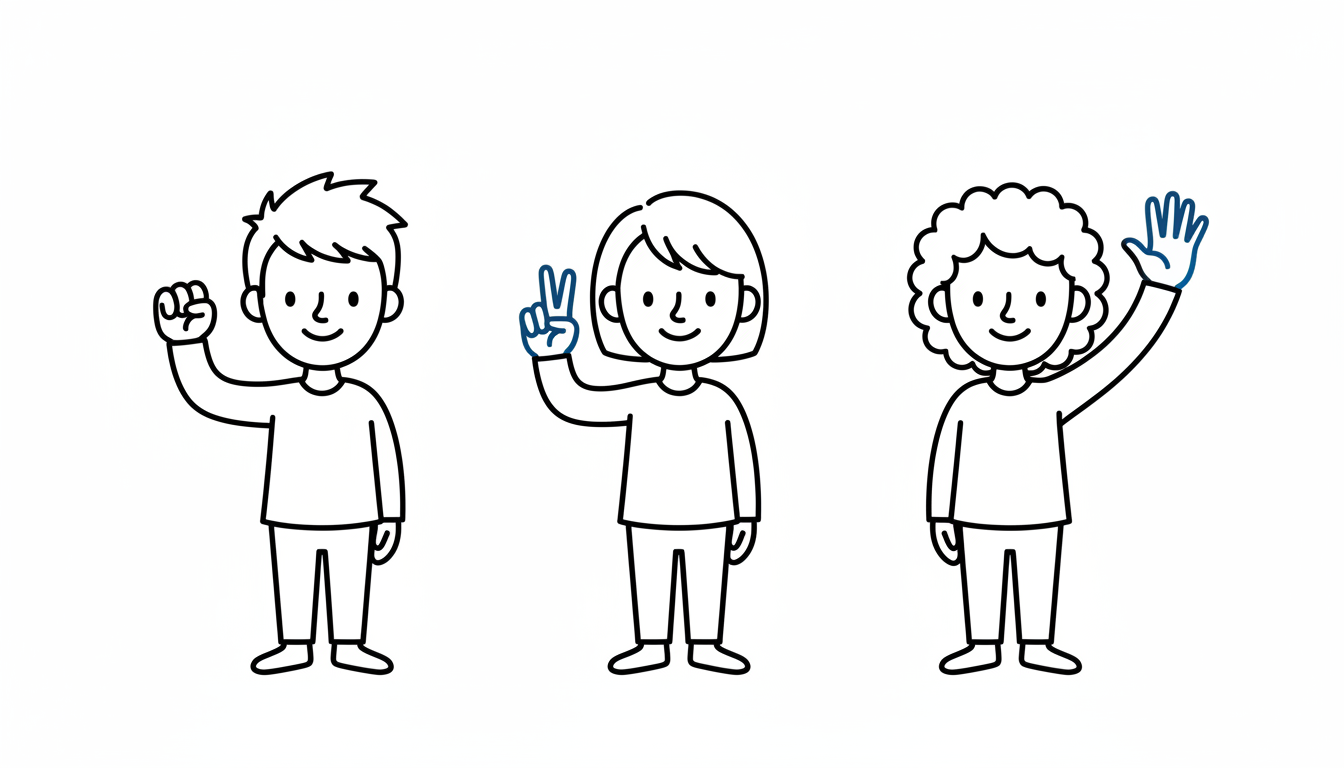
Instantly assess student confidence, understanding, or readiness using a silent hand signal (fist = 0, five fingers = 5). Use this before starting new content, before assessments, or to quickly gauge comprehension. It's faster than polling software and provides immediate visual feedback.
How It Works
Step-by-step instructions:
- EXPLAIN SCALE (10 seconds) - "Fist means 'no confidence/don't understand.' Five fingers means 'totally confident/completely understand.'"
- ASK QUESTION (5 seconds) - "How confident are you about solving quadratic equations?"
- SIGNAL (3 seconds) - "Show me on your fingers. Hold them up where I can see. Three, two, one, show!"
- SCAN & RESPOND (10 seconds) - Quickly scan the room, note the range
- ADJUST (5 seconds) - "I see mostly 3s and 4s. Let's do one practice problem together before the quiz."
What to Say
Opening: "Before we move on, I want to check: how confident do you feel about photosynthesis? Fist means 'I'm lost,' five fingers means 'I could teach this.' On three, show me your confidence level with your fingers. One, two, three, show!"
(After seeing responses): "I see a lot of 2s and 3s—that tells me we need more practice. I see a few 5s—you all will be our experts. Let's review the key steps one more time."
Why It Works
Fist to Five provides instant, visual, formative assessment data without technology or time-consuming polling. The simultaneous reveal (everyone shows at once) reduces social pressure—students aren't as self-conscious when everyone is participating simultaneously. The teacher gains immediate insight into class-wide understanding or confidence levels and can adjust instruction accordingly. This responsive teaching—adjusting based on student feedback—significantly improves learning outcomes. The silent nature means it doesn't disrupt flow.
Research Citation: Formative assessment techniques like Fist to Five improve student outcomes by allowing real-time instructional adjustments (Black & Wiliam, 1998).
Teacher Tip
Emphasize "everyone show at the same time" by counting down: "Three, two, one, show!" This prevents students from looking around to see what others are showing before deciding. You want their honest, immediate response, not a social consensus.
Variations
For Different Subjects
- Confidence Check: "How confident are you about [topic/skill]?"
- Comprehension Check: "How well do you understand this concept?"
- Agreement Scale: "How much do you agree with this statement?"
- Difficulty Rating: "How challenging was that assignment? (fist = easy, five = very hard)"
- Readiness Check: "How ready are you for the test?"
- Energy Level: "What's your energy level right now?"
For Different Settings
- Large Class (30+): Works perfectly. Scan sections of the room to get a sense of overall distribution.
- Small Class (5-15): Can see every hand clearly and respond individually if needed.
- Online: "Hold up your fingers to your camera" or use Zoom reactions (thumbs up/down) or type number in chat.
- Anonymous Option: "Close your eyes and show your fingers so only I can see, not your classmates."
For Different Ages
- Elementary (K-5): May need to practice what each number means first. Use simpler language: "How good do you feel about this?"
- Middle/High School (6-12): Works seamlessly. They understand the scale immediately.
- College/Adult: Appreciate the efficiency. Explain once, then use repeatedly throughout semester.
Online Adaptation
Tools Needed: Zoom, Teams, any video platform
Option 1: Physical Fingers
- "Hold up your fingers to your camera. Show me your confidence level. Three, two, one, show!"
Option 2: Chat Numbers
- "Type a number 0-5 in the chat. All at once when I say go. GO!"
- Numbers flood the chat.
Option 3: Reaction Buttons
- Use Zoom reactions or polls if available
Pro Tip: Chat numbers work best for large online classes—you can quickly scan and even calculate an average if needed.
Troubleshooting
Challenge: Students show different numbers at different times, looking at each other first. Solution: Use a countdown: "Don't look at your neighbors! I'm counting to three, then everyone shows at exactly the same time. One, two, three, SHOW!"
Challenge: Everyone shows 5 (overconfident or not honest). Solution: Test it: "Great! Since everyone's at 5, let's do a quick check. [Ask a question.] Hmm, I'm seeing confusion. Let's be honest so I can help. Try again—real confidence levels."
Challenge: Everyone shows 0 or 1 (under-confident or anxious). Solution: Reassure: "That's okay! That's exactly why we're practicing today. By the end of class, I want everyone at a 3 or higher. Let's work on this together."
Extension Ideas
- Deepen: After checking, pair students: "If you're a 4 or 5, pair with someone who's a 1 or 2. Explain the concept to each other for 2 minutes."
- Connect: Track growth: "Show me your confidence before we start. [Teach.] Now show me again. Look at that growth!"
- Follow-up: "Tonight, before you study, check your own confidence level. Which topics are 2 or lower? Focus your study time there."
Related Activities: Energy Check, Thumbs Compass, Human Barometer