
Board Rotation
At a Glance
- Time: 8-12 minutes
- Prep: Moderate - set up multiple boards/chart papers with different prompts
- Group: Small groups (3-5 students)
- Setting: Requires wall space or multiple whiteboards
- Subjects: Universal - especially effective for brainstorming
- Energy: High
Purpose
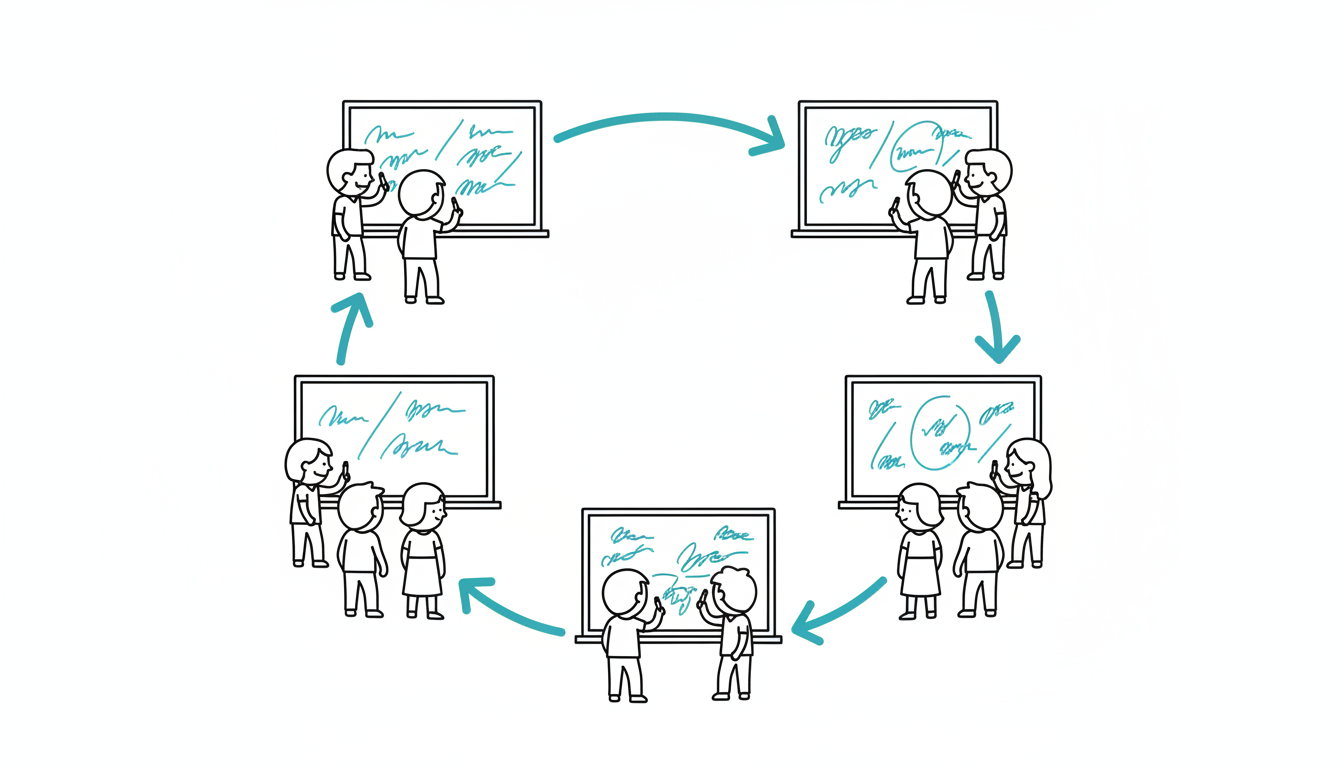
Board Rotation is a kinesthetic brainstorming strategy where groups move from board to board, reading what previous groups wrote and adding their own ideas. Use this when you want to generate many ideas quickly, build on others' thinking visibly, and energize the room through movement. It's ideal for generating multiple perspectives on related questions or exploring different aspects of a complex topic.
How It Works
Step-by-step instructions:
-
SET UP STATIONS (Before class: 10 min) - Post 4-6 large sheets of chart paper or designate whiteboard sections around the room. Write a different prompt/question at the top of each.
-
FORM GROUPS (30 seconds) - Divide class into small groups. Ideally, number of groups = number of stations.
-
ASSIGN STARTING STATIONS (30 seconds) - Send each group to a different starting station. Give each group a different colored marker.
-
FIRST ROTATION: BRAINSTORM (2 minutes) - Groups brainstorm responses to the prompt at their station and write ideas on the chart paper.
-
ROTATE (15 seconds) - Signal groups to rotate clockwise to the next station.
-
SUBSEQUENT ROTATIONS: READ AND ADD (90 seconds each) - At each new station, groups first READ what previous groups wrote, then ADD new ideas that haven't been mentioned yet.
-
CONTINUE ROTATING (Repeat until groups visit all or most stations)
-
GALLERY VIEW (1-2 minutes) - Groups walk around to view all completed boards.
-
DEBRIEF (2 minutes) - Discuss patterns, surprises, or themes across the boards.
What to Say
Setup: "We're going to do Board Rotation. I've posted [number] different questions around the room. Count off by [number] to form groups. Each group gets a marker and will start at a different board."
First Station: "At your first station, read the prompt and brainstorm as many ideas as you can. Write them all on the chart paper. You have 2 minutes. The goal is quantity—get ideas flowing. Begin."
Rotation Signal: "Time! Rotate clockwise to the next station. Bring your marker with you."
Subsequent Stations: "At each new station, first READ what the previous groups wrote. Then ADD ideas they haven't mentioned yet. Don't just repeat what's there—add something new. You have 90 seconds. Go."
Debrief: "Take a moment to walk around and look at all the boards. What patterns do you notice? Which board generated the most ideas? Where do you see disagreement or contrasting perspectives?"
Why It Works
Board Rotation activates multiple learning processes:
Visible Thinking: Writing ideas publicly on large sheets makes thinking concrete and communal. Abstract discussions become tangible artifacts.
Kinesthetic Engagement: Movement between stations resets attention and adds physical energy to cognitive work.
Building on Others: Each group benefits from seeing previous groups' ideas, which sparks new connections and prevents duplication.
Collaborative Knowledge Construction: By the end, each board contains contributions from multiple groups, creating a richer response than any single group could generate.
Equity of Voice: All groups contribute to all topics, ensuring diverse perspectives are represented.
Research Citation: Board Rotation draws on research showing that brainwriting (written brainstorming with idea exchange) often generates more ideas than verbal brainstorming because it prevents dominant voices from overshadowing quieter contributors (Paulus & Yang, 2000).
Teacher Tip
Use different colored markers for each group. This serves two purposes: (1) You can track which group contributed which ideas, useful for accountability or follow-up discussions. (2) Students can see at a glance how many different groups have contributed to each board—more colors = more diversity of thought. The visual variety also makes the boards more engaging to read during gallery viewing.
Variations
For Different Subjects
-
Literature: Each board has a different character. Groups rotate and add observations about each character's traits, motivations, or development.
-
Science: Each board explores a different variable in an experiment or a different organ system.
-
Math: Each board shows a different problem-solving strategy. Groups rotate and add examples of when that strategy is useful.
-
Social Studies: Each board represents a different historical perspective on an event. Groups add evidence supporting that perspective.
For Different Settings
-
Large Class (30+): Create 6-8 stations so groups are smaller (4-5 students). More stations mean more focused questions and faster rotations.
-
Small Class (12-15): Create 3-4 stations. Allow longer time at each station (3 minutes initially).
-
Limited Wall Space: Use clipboards or large sheets of paper on desks instead of wall-mounted stations. Groups still rotate, just to different desks.
For Different Ages
-
Elementary (K-5): Use images or very simple prompts. Allow students to draw responses in addition to writing.
-
Middle/High School (6-12): Standard format works well. Can handle abstract prompts.
-
College/Adult: Can use dense, complex prompts requiring synthesis of course materials.
Online Adaptation
Tools Needed: Collaborative digital whiteboard (Google Jamboard, Miro, Padlet)
Setup: Create multiple "boards" or "frames" in the digital tool, each with a different prompt.
Instructions:
- Assign each breakout room group a starting board number
- Groups work on their assigned board for 2 minutes (they can work simultaneously in the same digital space)
- After 2 minutes, announce in each breakout room to move to the next board number
- Continue rotations
- After all rotations, bring everyone back to main room to view all boards
Pro Tip: In Padlet, create multiple columns (one per prompt). Assign each group a starting column. They add sticky notes, then shift to the next column every 2 minutes. All work is visible in real-time.
Troubleshooting
Challenge: Later groups at a station can't think of anything new to add because "everything is already written."
Solution: Change the task for later rotations: "If you think all the important ideas are there, put a star next to the THREE most important ones. Or add a 'Why does this matter?' note next to one of the ideas."
Challenge: Some groups write illegibly or so small that later groups can't read it.
Solution: Set expectations upfront: "Write large enough that someone across the room could read it. Use bullet points, not paragraphs. Print don't script."
Challenge: Groups spend too much time reading previous responses and don't add anything new.
Solution: Set a specific split: "You have 90 seconds total. Spend 30 seconds reading, then 60 seconds adding new ideas. I'll call out when 30 seconds is up so you know to start writing."
Extension Ideas
-
Deepen: After the gallery walk, assign each group to return to one board as "synthesizers." They read all the responses on that board and create a 1-2 sentence summary capturing the key themes.
-
Connect: Use Board Rotation at the start of a unit as a pre-assessment to activate prior knowledge, then return to the same boards at the end of the unit and add ideas in a different color to show learning growth.
-
Follow-up: Have students individually select one idea from any board that surprised them or changed their thinking, and write a reflection explaining why.
Related Activities: Gallery Walk, Graffiti Wall, Carousel Brainstorming