
Environments
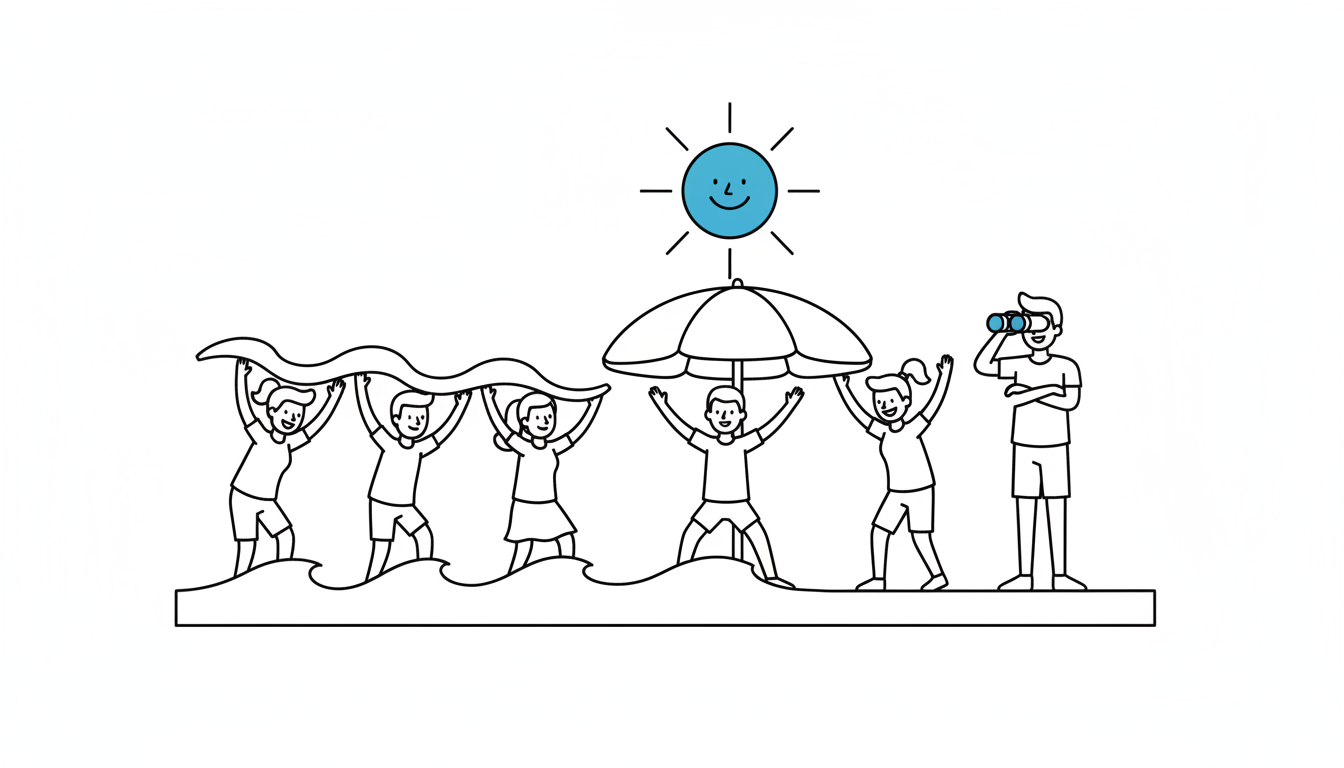
At a Glance
- Time: 2-3 minutes
- Prep: None
- Group: Whole class or small groups
- Setting: Any classroom with space to move and freeze
- Subjects: Universal - highly adaptable to any content
- Energy: Medium-High
Purpose
Stimulate rapid creative thinking and collaborative problem-solving by challenging students to quickly use their bodies to collectively create a tableau representing a specific environment, encouraging non-verbal teamwork and spatial awareness while providing an energizing mental reset.
How It Works
- Call out an environment (5 sec) - Teacher announces a setting: "The beach!" or "The moon!" or "A busy kitchen!"
- Students create the scene (45-60 sec) - Without speaking, students quickly position themselves as objects, weather, people, or creatures that belong in that environment, forming a frozen tableau
- Hold and observe (10 sec) - "Freeze! Look around at what we created together."
- Quick reflection (20 sec) - "What did you see? What were people representing?"
- Optional second round (repeat with new environment)
What to Say
Opening: "When I call out an environment, you have 30 seconds to use your body to become part of that scene. You might be an object, a person, weather, or anything that belongs there. No talking - just create! Ready? THE BEACH!"
During: "Keep building! Think about what's missing. What else belongs at the beach?"
Freeze moment: "Freeze! Hold your position. Look around without moving. I see waves, I see a lifeguard, I see a beach ball!"
Closing: "Release! What creative thinking! That's the kind of imagination I want to see in our next activity."
Why It Works
This activity requires rapid divergent thinking as students must quickly identify elements of an environment and embody them physically. The non-verbal collaboration element engages spatial reasoning and social cognition, while the creative constraint (must fit the environment) provides structure that makes the open-endedness less overwhelming. The collective creation builds ensemble awareness and demonstrates how individual contributions create a meaningful whole (Csikszentmihalyi's Flow Theory in group contexts).
Research Foundation: Drama pedagogy and embodied learning research show that physical representation of concepts deepens understanding and memory (Nicholson, 2005).
Teacher Tip
Start with concrete, familiar environments (beach, forest, classroom) before moving to abstract or academic ones (inside a cell, during a chemical reaction, a historical battle). The progression from concrete to abstract allows students to master the format before adding cognitive challenge. Also, resist the urge to give hints - the joy is in seeing what students create independently.
Variations
For Different Subjects
- Math/Science: Content-specific environments - "Inside a human cell!" "During photosynthesis!" "On the periodic table!" "Inside a geometric proof!"
- Humanities: Historical/literary settings - "Ancient Rome!" "The setting of Chapter 3!" "During the signing of the Declaration!" "In Shakespeare's Globe Theatre!"
- Universal: Emotional or conceptual environments - "A peaceful place!" "A moment of tension!" "Success!"
For Different Settings
- Large Class (30+): Create multiple simultaneous tableaux in different corners; each group represents the same environment and then compare interpretations
- Small Group (5-15): One environment per person - each student creates their own version, then combine into collaborative scene
For Different Ages
- Elementary (K-5): Use highly concrete environments; allow 60-90 seconds; celebrate specific creative choices afterward
- Middle/High School (6-12): Can include abstract concepts; add challenge by restricting movements (no standing, only use arms, etc.)
- College/Adult: Complex academic or philosophical concepts; can add rule requiring interconnection between all participants
Online Adaptation
Tools Needed: Video platform with gallery view enabled
Setup: Students need cameras on with full upper body visible; optional: ability to use virtual backgrounds
Instructions:
- Call out environment: "A jungle!"
- Students have 20 seconds to create a pose representing something from that environment
- All freeze on camera in gallery view
- Teacher and students observe the collective "scene" in gallery view
- Optional: Use breakout rooms where smaller groups create coordinated scenes together
Pro Tip: Virtual backgrounds can enhance this - students can add an appropriate background image and then pose as a character/object within that environment.
Troubleshooting
Challenge: Students all choose the same obvious elements (everyone is a tree in "forest") Solution: After first round, say: "This time, think about what's NOT represented yet. Make choices that fill in the gaps."
Challenge: Students start talking and negotiating instead of creating Solution: Enforce silence strictly: "The challenge is to create this WITHOUT words. Use your eyes and your body to collaborate."
Challenge: Some students stand frozen unsure what to be Solution: Provide categories as hints: "You could be an object, a person, a creature, weather, or a sound that scene would have"
Extension Ideas
- Deepen: Add layers - "Now add the WEATHER to this environment!" or "Now show what happens NEXT in this place!"
- Connect: Use as a review tool - "Create the environment of the chapter we just read" or "Show me the setting where this historical event occurred"
- Follow-up: Have students write from the perspective of the element they embodied: "I was a wave at the beach, and I felt..."
Related Activities: Concept Acting Charades, Machines, As-If Transitions