
Give and Take
At a Glance
- Time: 2-3 minutes
- Prep: None
- Group: Whole class
- Setting: Any space with room to move freely
- Subjects: Universal - excellent for developing ensemble awareness
- Energy: Medium
Purpose
Develop spatial awareness, quick decision-making, and seamless transitions between individual and collaborative states by having students alternate between solo movement and partner poses on command, building the ability to shift focus and adapt quickly to changing social contexts.
How It Works
- Establish movement space (15 sec) - Students spread out in available space, ensuring personal space around each person
- Individual movement (30 sec) - "Students, begin moving around the space at a comfortable pace. No talking, just walking."
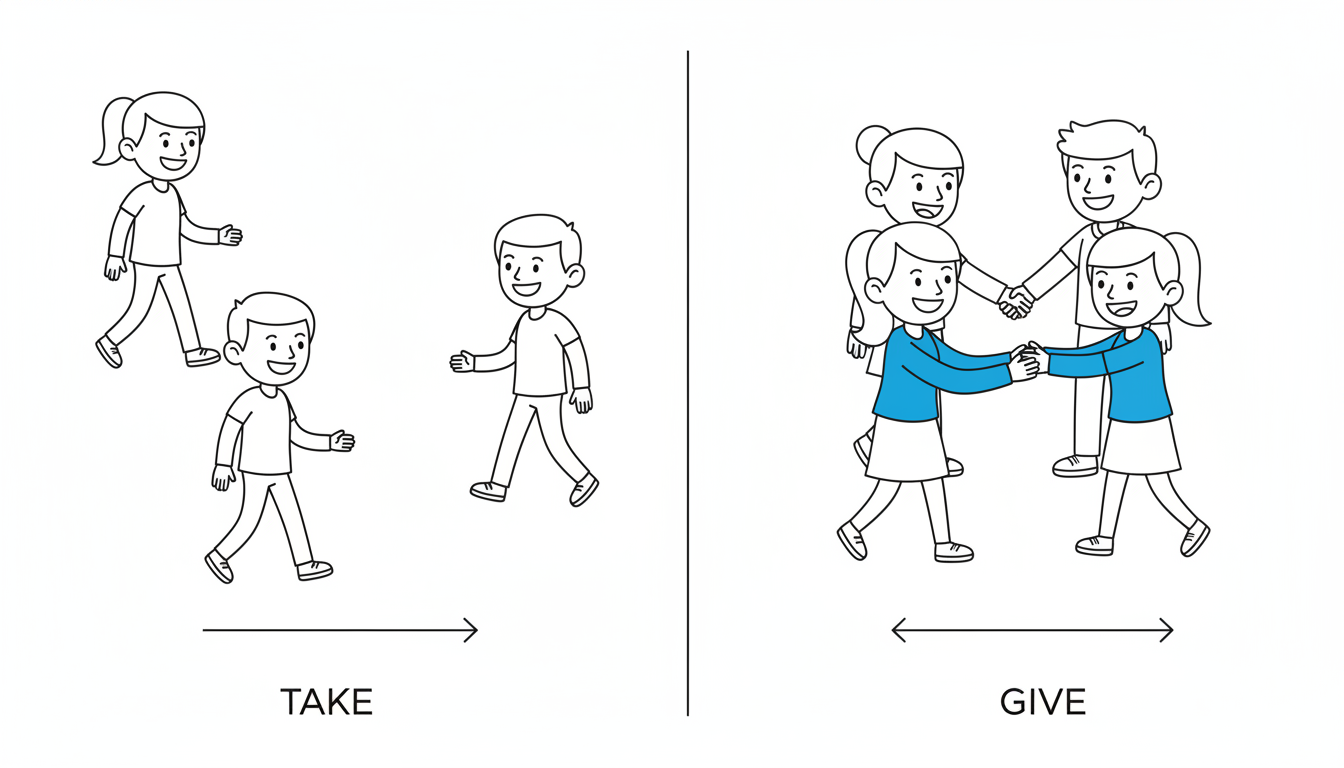
- "GIVE!" command (30 sec) - Teacher calls "Give!" Students quickly find nearest partner and create a connected shape or pose together (high-five position, back-to-back, mirroring arms, etc.)
- "TAKE!" command (30 sec) - Teacher calls "Take!" Students break apart and resume individual movement
- Repeat cycle (60 sec) - Continue alternating "Give!" and "Take!" calls 3-4 more times with varying intervals
- Final freeze (10 sec) - End with everyone frozen independently: "Take! And freeze where you are."
What to Say
Opening: "Spread out in our space. When I say GO, start moving around the room. When I call GIVE, find the nearest person and create a connected shape together. When I call TAKE, break apart and move individually again. Ready? GO!"
During: "Keep moving... GIVE! Find someone and connect! Hold your shape... TAKE! Move individually... keep your own path... GIVE! New partner, new shape!"
Closing: "TAKE! And freeze. Notice how quickly you shifted between solo and collaborative movement. That's the kind of flexibility we need in today's lesson."
Why It Works
This activity trains the brain to toggle between individual and collaborative modes rapidly, a crucial metacognitive skill. The physical movement activates the vestibular system and spatial reasoning, while the social element engages theory of mind and responsiveness to others. The unpredictability of when "Give!" or "Take!" will be called maintains high attention and presence, similar to mindfulness practices (Kabat-Zinn's mindfulness principles adapted for movement).
Research Foundation: Improvisational theater pedagogy demonstrates that "yes, and" acceptance training improves cognitive flexibility and social responsiveness (Sawyer, 2011).
Teacher Tip
Vary the duration between calls strategically. Start with longer intervals (20-30 seconds) so students understand the pattern, then make calls more rapid-fire to increase challenge and attention. End with a longer "Take" interval to bring energy back down if you need students calm for the next task.
Variations
For Different Subjects
- Math/Science: During "Give!" moments, partners must form a shape that represents a concept (parallel lines, acute angle, molecule structure, stages of mitosis)
- Humanities: "Give!" creates tableau of a scene from literature or history; "Take!" represents individual characters moving through time
- Universal: Add levels - "Give HIGH!" (standing connected shape), "Give MIDDLE!" (seated/kneeling), "Give LOW!" (floor level)
For Different Settings
- Large Class (30+): Define clear pathways for movement to avoid collisions; allow trios for "Give!" when needed
- Small Group (5-15): Can make all "Give!" moments whole-group sculptures where everyone connects into one shape
For Different Ages
- Elementary (K-5): Simplify to just two calls with longer intervals; demonstrate examples of safe connected shapes; add playful music
- Middle/High School (6-12): Standard approach; can add complexity like "silent Give!" where partners create shapes without any verbal negotiation
- College/Adult: Add conceptual layer - "Give!" represents agreement/collaboration; "Take!" represents independent thought; discuss application to group work dynamics
Online Adaptation
Tools Needed: Video platform with gallery view enabled
Setup: Students need cameras on with upper body visible; adequate physical space off-camera
Instructions:
- "Take!" = students move off-camera in their own space
- "Give!" = students return on-camera with a partner (if multiple students in same location) OR create a connected gesture with their hands visible in frame
- Alternative: "Give!" means creating a synchronized pose visible on camera (all students do same pose simultaneously); "Take!" means individual poses
Pro Tip: Works best in hybrid settings where some students are physically together; purely remote adaptations lose the partner connection element but can still practice individual/group transitions.
Troubleshooting
Challenge: Students bump into each other during movement Solution: Pause and reset: "During Take, your eyes should be scanning the whole space. Move with awareness of everyone around you. Let's try again with even more spatial awareness."
Challenge: Students always pair with the same partner Solution: Add rule: "Each time I call Give, you must find a DIFFERENT partner. Challenge yourself to connect with someone new every time."
Challenge: "Give!" poses become repetitive (everyone just high-fives) Solution: Between rounds, suggest specific types of connections: "This time, create a shape at LOW level" or "Connect without using your hands"
Extension Ideas
- Deepen: Add a third command - "Share!" where 3-4 people create a connected group shape
- Connect: Use this as a metaphor for collaborative work: "Sometimes you work alone (Take), sometimes you partner up (Give). Both are valuable. Know when each is needed."
- Follow-up: After activity, transition directly into think-pair-share using the same "Give!" and "Take!" language: "Take a moment to think individually... Give! Share your thinking with a partner."
Related Activities: Mirror Movements, Concentric Circles, Environments