
Six Degrees
At a Glance
- Time: 3-4 minutes
- Prep: None
- Group: Pairs or small groups (3-4)
- Setting: Any classroom
- Subjects: Universal
- Energy: Medium
Purpose
Build synthesis skills and reveal conceptual connections by challenging students to link today's topic to yesterday's (or any two seemingly unrelated concepts) in six steps or fewer. Use this to help students see the interconnectedness of learning, activate prior knowledge, or bridge between units.
How It Works
Step-by-step instructions:
-
Set the challenge (30 seconds) - Name two concepts: today's topic and yesterday's, or two seemingly unrelated ideas. Challenge: "Connect these in 6 steps or less. Each step must be a logical connection"
-
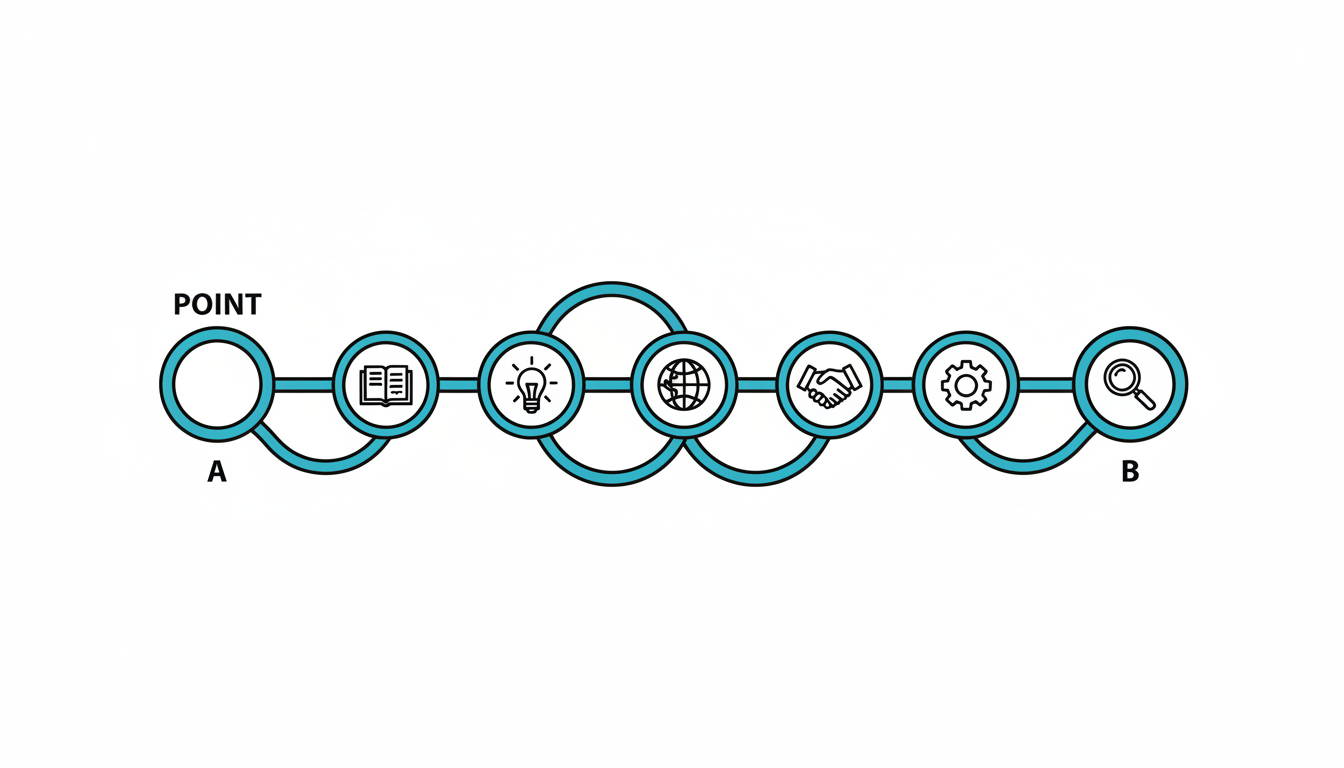
Build the chain (2-3 minutes) - Groups create a chain of connections: Concept A → connects to → Concept B → connects to → Concept C... → connects to Target Concept. Each link must be justified with a clear relationship
-
Share pathways (1 minute) - Groups share their connection chains. Compare: Did groups take different paths? Which chain is most direct? Most creative? Most insightful?
What to Say
Opening: "Yesterday we studied photosynthesis. Today we're starting the Civil War. Your challenge: connect photosynthesis to the Civil War in 6 steps or fewer. Each connection must be logical. For example: Photosynthesis → produces cotton → cotton economy → slavery → sectional tensions → Civil War. That's 5 steps. Can you find a shorter path? Or a totally different one? Go!"
During: "Make each link clear—HOW does A connect to B?... Don't just list random words—show the relationship... Can you find a shorter path?... What's the most creative connection?"
Closing: "Let's hear your chains. [Groups share.] Group 1 went through economics, Group 2 through geography, Group 3 through human needs—three different pathways, all valid! This shows that knowledge isn't isolated facts—it's a web of connections. The more connections you can make, the deeper your understanding."
Why It Works
This activity combats siloed learning by forcing students to find bridges between apparently disconnected topics. Making connections strengthens memory and comprehension—concepts that connect to multiple other concepts are remembered better and understood more deeply. The constraint (6 steps maximum) forces creative, non-obvious connections rather than long, meandering chains. Students discover that everything they learn can connect to everything else, building integrative thinking and revealing that disciplines aren't truly separate—boundaries between subjects are artificial.
Research Connection: Connection-making and integration of knowledge across domains are hallmarks of expertise and deep understanding (Bransford et al., 2000; National Research Council, 2000).
Teacher Tip
The best connections reveal genuine conceptual relationships, not superficial word associations. "Photosynthesis → green → uniforms → soldiers → Civil War" is weak—each step is arbitrary. "Photosynthesis → agricultural economy → regional dependence → political conflict" is strong—each step has causal or conceptual significance. Teach students the difference.
Variations
For Different Subjects
- Cross-Unit Connections: "Link this week's topic to last month's unit"
- Cross-Disciplinary: "Connect this math concept to something in your English class... this science concept to history"
- Concept to Real-World: "Connect this abstract concept to something in current events in 6 steps"
For Different Settings
- Large Class (30+): Pairs create chains, then combine with another pair to compare and improve
- Small Group (5-15): Whole-class collaborative challenge—each student contributes one link in the chain
For Different Ages
- Elementary (K-5): Allow more steps (8-10) and use concrete, familiar concepts
- Middle/High School (6-12): Standard 6-step format
- College/Adult: Reduce to 4 steps for increased challenge; require one connection to be cross-disciplinary
Online Adaptation
Tools Needed: Shared document or digital whiteboard
Setup: Display two concepts on screen
Instructions:
- Present the two concepts to connect
- Breakout rooms for group chain-building (2-3 minutes)
- Groups type their connection chains in chat using arrows: A → B → C → D
- Return to main room; discuss which path is most direct, most creative
- Use annotation to visually connect concepts on shared whiteboard
Pro Tip: Use a mind-mapping tool like Coggle—groups can visually build and share their connection pathways
Troubleshooting
Challenge: Students create long, rambling chains of weak connections Solution: "Shorter is better! Can you cut out middle steps? Each connection should be meaningful, not just word association. Why does A genuinely relate to B?"
Challenge: Students say "these can't be connected!" Solution: "Everything connects to everything if you go deep enough. Try thinking about: causes and effects, examples and categories, part-whole relationships, historical sequences, shared properties..."
Extension Ideas
- Deepen: After creating chains, analyze: "Which connection in your chain is strongest? Weakest? If you had to defend this chain, where's the vulnerability?"
- Connect: Link to Six Degrees of Kevin Bacon or network theory: "In a knowledge network, concepts are nodes and connections are edges. The more connections, the more robust the network"
- Follow-up: "Create a visual concept map showing multiple pathways between the two concepts—not just one linear chain"
Related Activities: Concept Mapping, Chain Reactions, Connection Web