
SWOT Analysis
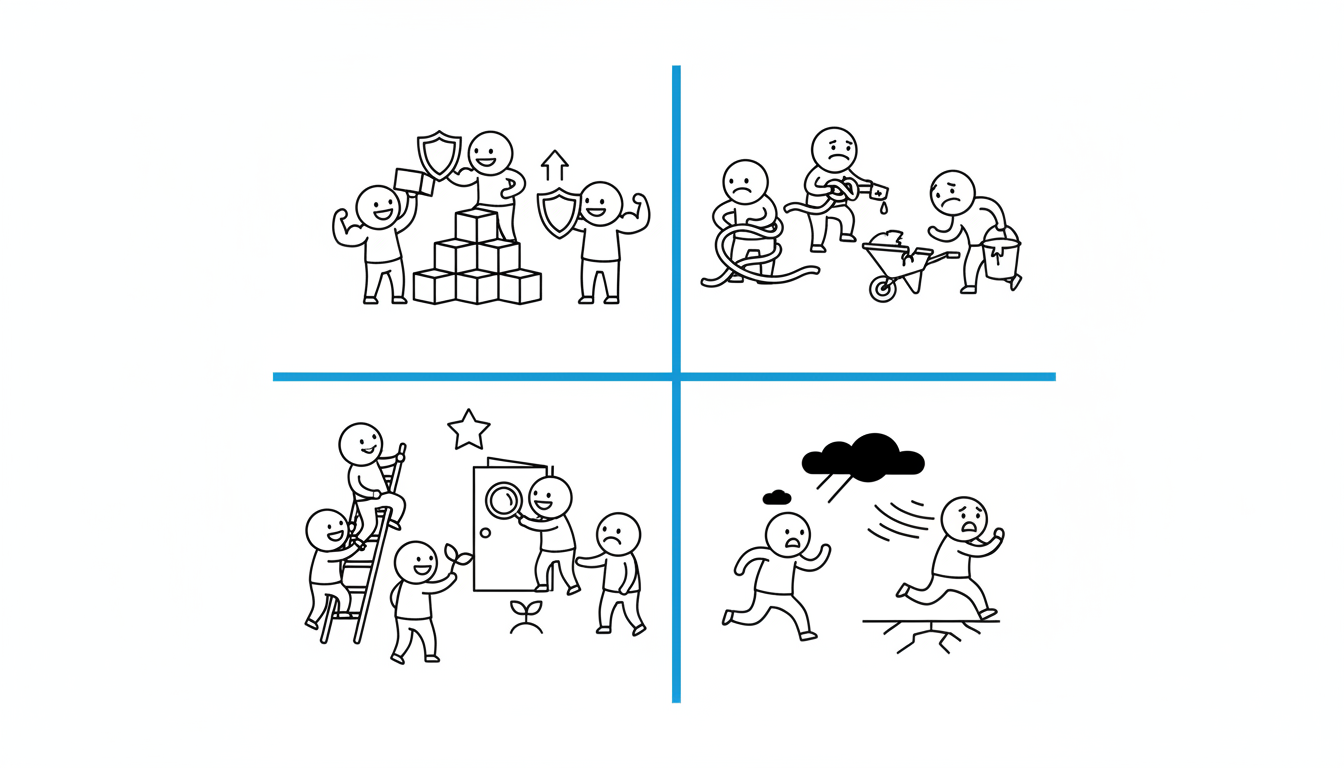
At a Glance
- Time: 4-5 minutes
- Prep: None
- Group: Small groups (3-4 students)
- Setting: Any classroom
- Subjects: Universal (business, history, literature, science)
- Energy: Medium
Purpose
Analyze a topic, decision, or situation comprehensively by systematically evaluating its Strengths, Weaknesses, Opportunities, and Threats. Use this to teach strategic thinking, evaluate historical decisions, analyze character choices, or assess proposed solutions to problems.
How It Works
Step-by-step instructions:
-
Set up the framework (30 seconds) - Draw a four-quadrant grid on paper or whiteboard. Label quadrants: Strengths (internal positives), Weaknesses (internal negatives), Opportunities (external positives), Threats (external risks)
-
Conduct analysis (3-4 minutes) - Groups analyze the assigned topic, filling each quadrant with specific factors. Push for at least 2-3 items per quadrant. Strengths/Weaknesses focus on internal factors; Opportunities/Threats focus on external factors
-
Share key insights (1 minute) - Groups share their most significant finding from each quadrant: "The biggest strength is... The greatest threat is..." Discuss how this analysis would inform decision-making
What to Say
Opening: "We just read about Westward Expansion. Now let's analyze it using a SWOT framework. Divide your paper into four boxes: Strengths—what advantages did settlers have? Weaknesses—what challenges did they face internally? Opportunities—what external possibilities existed? Threats—what external dangers threatened success? Fill all four quadrants. Go!"
During: "Strengths and weaknesses are INTERNAL—things within the control of the people or organization... Opportunities and threats are EXTERNAL—things in the environment they must respond to... Be specific! Not just 'lack of resources' but 'insufficient water for crops in arid regions'"
Closing: "Looking at all four quadrants together, would you have recommended proceeding with this decision? Why or why not? This is exactly how businesses, governments, and organizations make strategic decisions—by seeing the full picture, not just the positives."
Why It Works
SWOT provides a structured framework that prevents narrow thinking. By forcing consideration of both internal and external factors, both positive and negative dimensions, it creates comprehensive analysis that reveals blind spots. The four-quadrant structure makes complex analysis manageable and visible. Distinguishing between controllable internal factors and environmental external factors develops systems thinking and strategic awareness. The simplicity of the framework makes it accessible while the depth of thinking it prompts makes it rigorous.
Research Connection: SWOT analysis is a widely validated strategic planning tool used across fields from business to education to healthcare (Humphrey, 2005). It improves decision quality by ensuring comprehensive consideration of multiple dimensions.
Teacher Tip
Students often confuse internal and external factors. Remind them: "Strengths and Weaknesses are things YOU control or characteristics YOU have. Opportunities and Threats are things in the ENVIRONMENT that you must respond to but don't directly control." This distinction is crucial for strategic thinking.
Variations
For Different Subjects
- History: "Analyze a historical figure's decision... Evaluate a military strategy... Assess a reform movement"
- Literature: "SWOT analysis of a character's plan... Analyze the protagonist's position at the story's climax"
- Science: "Evaluate a proposed solution to climate change... Analyze the decision to fund this research project"
- Math: "Assess different problem-solving strategies for this type of problem"
For Different Settings
- Large Class (30+): Assign different groups different perspectives on the same issue, then compare: "Group A does SWOT from settlers' view, Group B from Native Americans' view"
- Small Group (5-15): Create one comprehensive SWOT as a whole class, building the quadrants together
For Different Ages
- Elementary (K-5): Use simpler language: "Good Things (About Us), Not-So-Good Things (About Us), Chances (From Outside), Dangers (From Outside)"
- Middle/High School (6-12): Standard SWOT with emphasis on internal vs. external distinction
- College/Adult: Add follow-up strategic planning: "Based on this SWOT, what should our strategy be? How do we leverage strengths and opportunities while mitigating weaknesses and threats?"
Online Adaptation
Tools Needed: Collaborative whiteboard (Jam board, Padlet with four columns) or shared Google Doc with table
Setup: Create four-quadrant template shared with all students
Instructions:
- Display SWOT template on screen
- In breakout rooms, groups add sticky notes/text to each quadrant
- Return to main room to share and discuss
- Teacher can move items between quadrants if misplaced, discussing the reasoning
Pro Tip: Use Padlet with four columns—students can add items, upvote the most important factors, and comment on each other's additions in real-time
Troubleshooting
Challenge: Quadrants are unbalanced—lots in Strengths, nothing in Threats Solution: "Push yourselves to find threats even if they seem minor. Every decision has risks. What's the worst-case scenario? What could go wrong externally?" Set a minimum: "Each quadrant needs at least 2 items"
Challenge: Items are vague or repetitive Solution: "Not just 'good leadership'—WHAT SPECIFICALLY about the leadership? Give me examples, evidence, specifics. Make it so concrete someone could see it or measure it"
Extension Ideas
- Deepen: After completing SWOT, create strategies: "How could we use this strength to take advantage of this opportunity? How could we reduce this weakness to minimize this threat?"
- Connect: Link to personal decision-making: "Use SWOT to analyze a decision you're facing: which college to attend, whether to take an AP class, which sport to join"
- Follow-up: Research how actual organizations used SWOT analysis for major decisions (NASA launch decisions, business mergers, policy reforms)
Related Activities: Case Study Analysis, Philosophical Chairs, Reverse Brainstorming