
Pattern Recognition
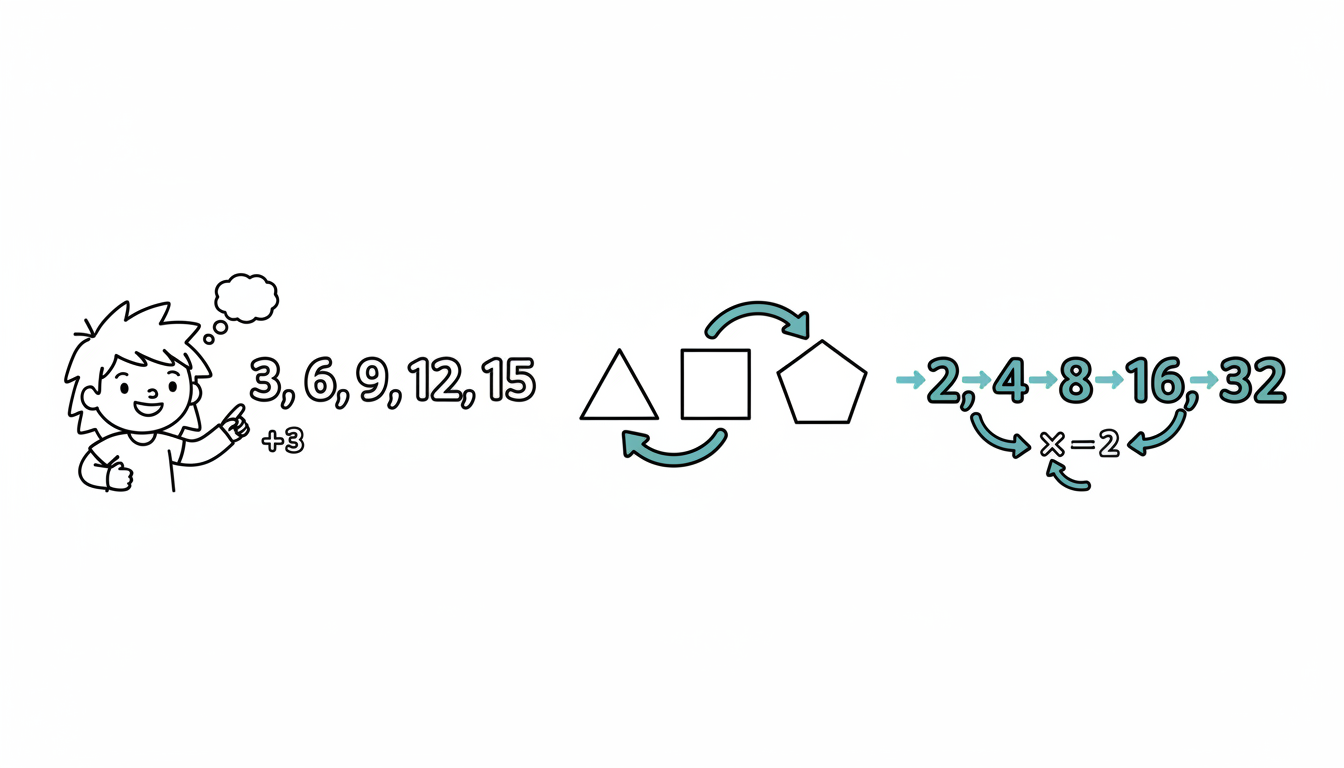
At a Glance
- Time: 2-3 minutes
- Prep: Prepare a pattern/sequence
- Group: Whole class or pairs
- Setting: Any
- Subjects: Universal (especially strong for Math & Science)
- Energy: Low
Purpose
Activate analytical thinking by identifying rules and predicting what comes next. Use this at the start of class, during transitions, or to prime mathematical thinking. Students practice observation, hypothesis formation, and inductive reasoning. Pattern recognition is foundational to mathematical thinking, scientific inquiry, and language learning.
How It Works
- PRESENT (15 seconds) - Display or say a sequence with a pattern
- ANALYZE (60 seconds) - Students identify the pattern and predict the next term
- SHARE (30 seconds) - Students offer answers and explain the rule
- REVEAL (15 seconds) - Confirm the pattern and next term
- EXTEND (optional, 30 seconds) - Ask for additional terms or variation
What to Say
"Look at this pattern: 2, 4, 6, 8, __. What comes next? What's the rule? You have 60 seconds. Think independently or discuss with a partner. Go!"
(After thinking time) "What comes next? Who can tell me the rule?"
Student: "10! The rule is add 2 each time." "Exactly! This is an arithmetic sequence with a common difference of 2. Let's try a trickier one..."
(Show harder pattern) "5, 10, 20, 40, __. What comes next?"
Why It Works
Pattern recognition is a core cognitive skill that humans naturally seek. The brain loves finding order and predictability. Identifying patterns requires observation, abstraction, and logical reasoning—all critical thinking skills. Successfully predicting the next term provides a satisfying "aha!" moment. These skills transfer directly to mathematical concepts (sequences, functions), scientific inquiry (observing and predicting), and reading comprehension (story structure, theme patterns).
Research Citation: Pattern recognition is fundamental to learning and intelligence (Mattson, 2014).
Teacher Tip
Start simple! Begin with arithmetic sequences, then build to geometric, Fibonacci-style, or multi-step patterns. If students struggle, show the first few steps of your thinking: "Let me look at how each number relates to the previous one..."
Variations
Sample Patterns
Easy (Arithmetic):
- 1, 3, 5, 7, __ (9: add 2)
- 10, 20, 30, 40, __ (50: add 10)
- 100, 90, 80, 70, __ (60: subtract 10)
Medium (Geometric/Multiplicative):
- 2, 4, 8, 16, __ (32: multiply by 2)
- 3, 9, 27, 81, __ (243: multiply by 3)
- 100, 50, 25, 12.5, __ (6.25: divide by 2)
Medium (Fibonacci-style):
- 1, 1, 2, 3, 5, 8, __ (13: add previous two)
- 0, 1, 1, 2, 3, 5, __ (8: Fibonacci sequence)
Hard (Multi-step or Complex):
- 2, 5, 11, 23, __ (47: double and add 1)
- 1, 4, 9, 16, 25, __ (36: perfect squares)
- A, C, E, G, __ (I: every other letter)
Visual Patterns:
- Shapes: Circle, Square, Triangle, Circle, Square, __ (Triangle)
- Colors: Red, Blue, Red, Blue, __ (Red)
Content-Specific Patterns
- Math: Sequences, series, functions
- Science: Growth patterns, periodic table trends, seasonal cycles
- Language: Grammar patterns, phonetic rules, spelling patterns
- History: Cyclical historical patterns, cause-and-effect chains
- Music: Rhythmic patterns, melodic sequences
For Different Settings
- Large Class: Display visually; whole class participates
- Small Class: Everyone shares their reasoning
- Online: Display on screen or type in chat
- Pairs: Partners collaborate on harder patterns
For Different Ages
- Elementary (K-5): Simple arithmetic patterns, visual patterns, color patterns
- Middle/High School (6-12): Geometric sequences, algebraic patterns, complex multi-step rules
- College/Adult: Advanced sequences, calculus-related patterns, abstract patterns
Online Adaptation
Excellent for Online:
- Display pattern on screen clearly
- Students type answers in chat or use annotation tools
- Breakout rooms for partner work on harder patterns
- Works perfectly virtually
Troubleshooting
Challenge: Students can't identify the pattern. Solution: Scaffold: "Look at the first two numbers. What happened to get from 2 to 4? Now look at 4 to 6. Is it the same operation?" Guide them step-by-step.
Challenge: Multiple students see different patterns. Solution: Excellent! "You're both seeing valid patterns. Let's test them: if the rule is [Pattern A], what would the 6th term be? If it's [Pattern B], what would it be?" Discuss which rule fits all given terms.
Challenge: Students guess randomly without analyzing. Solution: "Don't just guess! I want you to tell me the RULE. What operation connects each number to the next?"
Challenge: Pattern is too easy; everyone knows instantly. Solution: "Great! Let me give you a harder one..." Or extend: "What would the 10th term be?"
Extension Ideas
- Create Your Own: Students create their own patterns and challenge partners
- Extend the Sequence: "What's the 10th term? The 100th term?"
- Explicit Formula: "Can you write an equation or rule that generates this sequence?" (for older students)
- Backward Reasoning: "What came BEFORE the first term?"
- Connect to Content: "We just identified a pattern. Today we'll look for patterns in [data/text/historical events]."
- Multiple Representations: Show the same pattern in numbers, visually (shapes), and verbally
Related Activities: Odd One Out, Quick Math Challenge, Logic Puzzle