
Memory Palace (One-Fact Version)
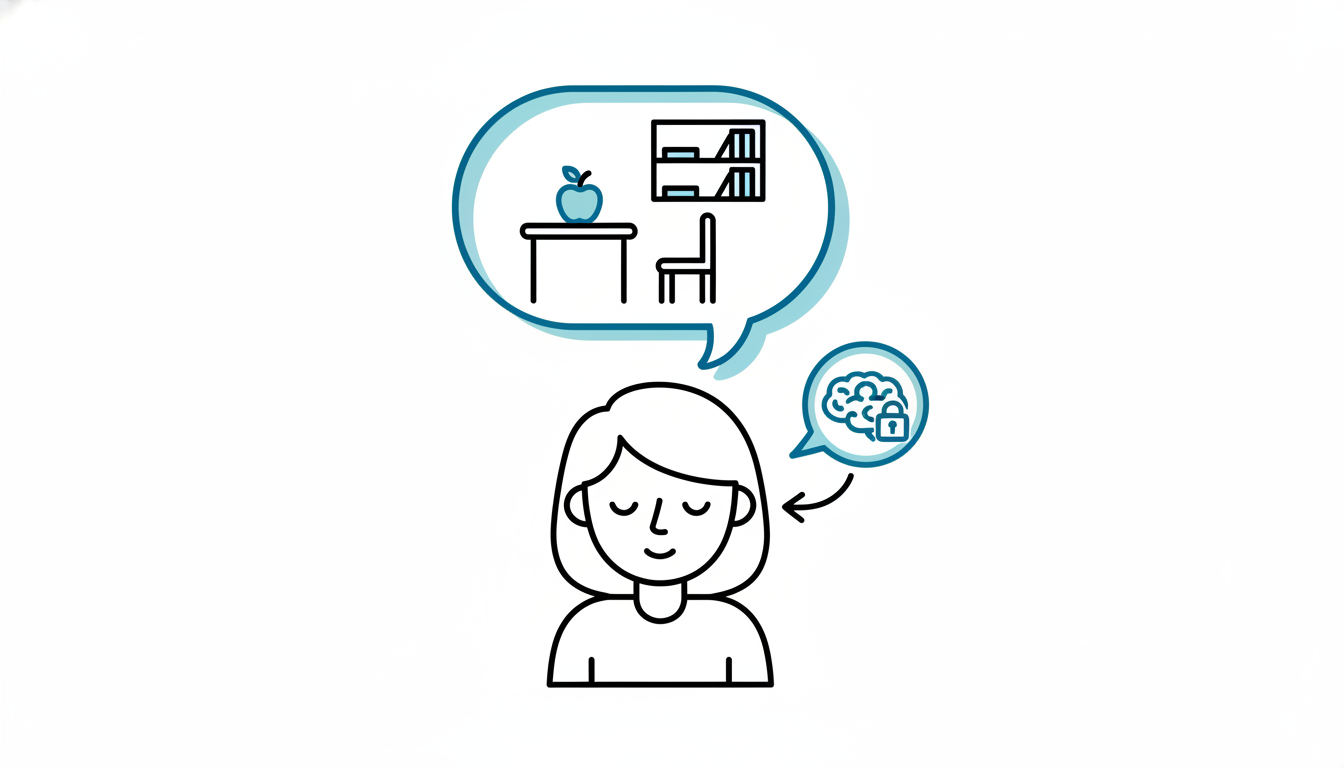
At a Glance
- Time: 45-60 seconds
- Prep: None
- Group: Whole class (individual practice)
- Setting: Any
- Subjects: Universal
- Energy: Low (calming, focused)
Purpose
Teach and practice a powerful memory technique by having students visualize storing one key fact in a memorable mental location. Use this to help students encode important information they need to remember for tests or to introduce memory strategies.
How It Works
Step-by-step instructions:
- INTRODUCE CONCEPT (15 seconds) - "Memory palaces work by linking information to locations you know well. We're going to store one fact in your mental space."
- IDENTIFY FACT (5 seconds) - "The fact we're storing: Mitochondria is the powerhouse of the cell."
- CLOSE EYES (5 seconds) - "Close your eyes. Picture your bedroom."
- VISUALIZE STORAGE (30 seconds) - "See your bedroom clearly. Now imagine a tiny powerhouse—like a miniature power plant—sitting on your pillow. See it glowing with energy. That's the mitochondria. Open your eyes."
- DEBRIEF (10 seconds) - "Tonight when you see your pillow, you'll remember: mitochondria = powerhouse. That's a memory palace."
What to Say
Opening: "I'm going to teach you a memory trick used by memory champions. Close your eyes. Picture your front door at home. Can you see it clearly? Good. Now, imagine a giant letter 'H' carved into that door—H for Hydrogen, the first element. See it? Tomorrow when you walk through that door, you'll remember Hydrogen. That's a memory palace—linking facts to locations. Let's try one more..."
Why It Works
The Method of Loci (memory palace technique) leverages spatial memory, which is evolutionarily strong in humans. By linking abstract information (facts) to concrete locations (places we know well), we create vivid, retrievable memories. Visualization engages the visual cortex, creating additional neural pathways beyond verbal memory. The brief mindfulness moment (eyes closed, visualization) also calms the nervous system and increases focus.
Research Citation: The Method of Loci is one of the most effective memory techniques, significantly improving recall (Yates, 1966; Bower, 1970).
Teacher Tip
Make the visualization VIVID and slightly bizarre. "Imagine a glowing, spinning mitochondria the size of a basketball hovering over your bed" works better than "imagine mitochondria." The weirder and more visual, the more memorable.
Variations
For Different Subjects
- Any Memorization: Link any fact to a familiar location (bedroom, car, classroom)
- Vocabulary: "Visualize the word 'magnanimous' written in huge letters on your refrigerator"
- Formulas: "Picture E=mc² painted on your front door"
- Historical Dates: "See 1776 carved into your desk"
- Science Facts: Link parts of a cell to parts of your house
For Different Settings
- Any Class Size: Works equally well for all sizes
- Online: Works perfectly—students do this individually with eyes closed
- Quick Version: 30 seconds—just visualize and open eyes
- Extended Version: 2-3 minutes—store multiple facts in multiple locations
For Different Ages
- Elementary (K-5): Use very familiar locations (their bedroom, kitchen). Keep it simple and fun.
- Middle/High School (6-12): Can handle more abstract concepts. Explain the neuroscience.
- College/Adult: Appreciate learning the actual technique. Frame as "professional memory strategy."
Online Adaptation
Tools Needed: None (just voice guidance)
Instructions:
- "Everyone close your eyes—really close them."
- Guide visualization: "Picture your bedroom... now picture [fact/concept] in a specific spot..."
- "Open your eyes."
Pro Tip: This works BETTER online than in person because students are in private spaces and can fully close eyes without self-consciousness.
Troubleshooting
Challenge: Students can't visualize or say "I don't see anything." Solution: "That's okay. Just think about your room. Don't worry about 'seeing' it perfectly. Even thinking about the location helps memory."
Challenge: It feels too "woo-woo" or mystical. Solution: Ground it in science: "This technique is backed by neuroscience. Spatial memory is extremely strong in humans. This leverages that."
Challenge: Students giggle or can't stay focused with eyes closed. Solution: Keep it VERY brief (30 seconds max). The shorter, the easier to maintain focus.
Extension Ideas
- Deepen: "Tonight, actually look at that location (your pillow, door, etc.). Does the fact come back? Test it."
- Connect: "Create a full memory palace: store 5 facts in 5 locations in your house. Quiz yourself tomorrow."
- Follow-up: "Before the test, mentally walk through your memory palace. Retrieve each fact from its location."
Related Activities: Air Writing, Silent Scream, Energy Check