
Snowball Groups / Pyramids
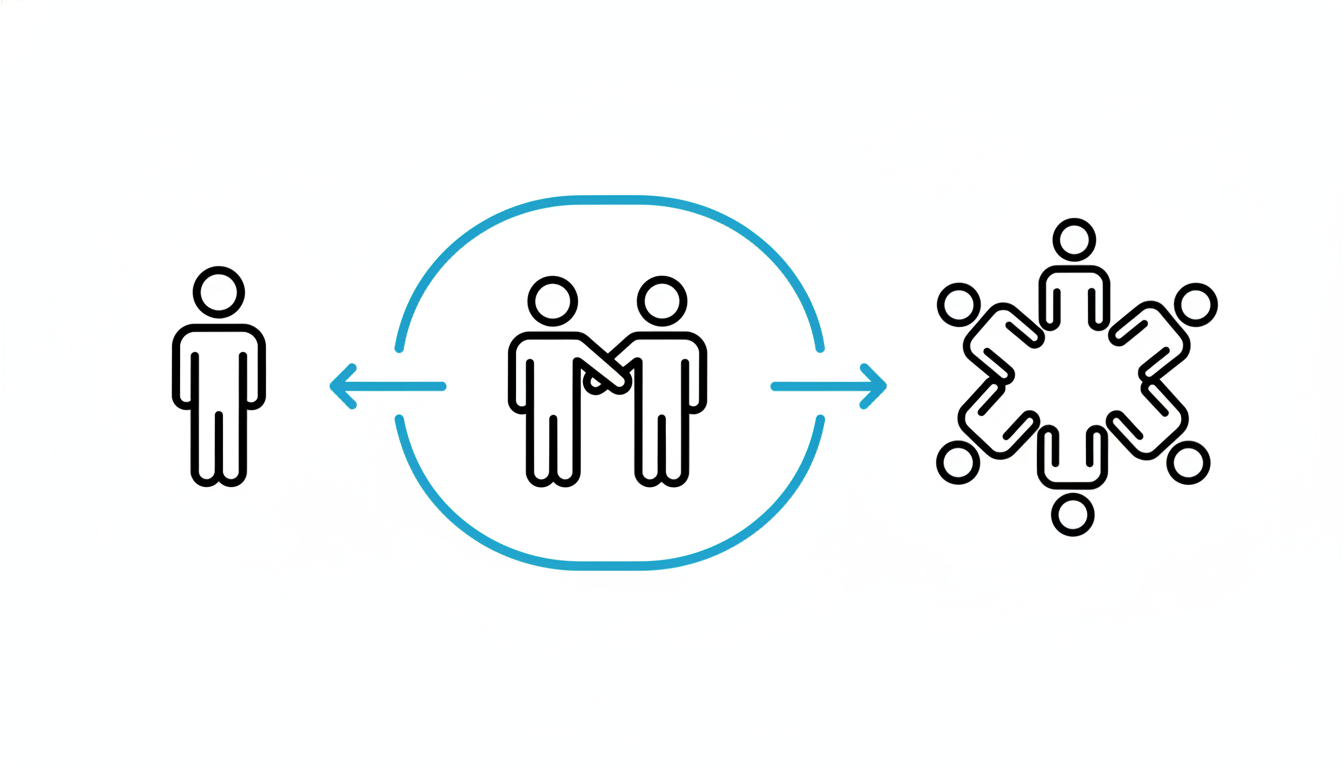
At a Glance
- Time: 8-12 minutes
- Prep: None
- Group: Progressive (individuals → pairs → quads)
- Setting: Any classroom
- Subjects: Universal - especially effective for prioritization and decision-making
- Energy: Medium to High
Purpose
Snowball Groups (also called Pyramids) progressively build consensus by starting with individual thinking, then moving to pairs, then groups of four, and potentially larger. Use this when you want ideas to be refined, defended, and merged through multiple rounds of negotiation. It's ideal for prioritization tasks, decision-making challenges, or generating well-vetted solutions. The structure ensures every voice is heard (starting solo), while the progressive grouping creates natural quality filtering—only the strongest ideas survive to the final stage.
How It Works
Step-by-step instructions:
-
INDIVIDUAL THINKING (1-2 minutes) - Pose a question or task that requires generating ideas, making a decision, or prioritizing options. Students work alone and write their thoughts.
-
PAIR UP (30 seconds) - Students turn to a partner to form pairs.
-
PAIR DISCUSSION (2-3 minutes) - Partners share their individual ideas and must agree on a single merged response or a prioritized list. They cannot simply list both ideas—they must discuss, defend, and consolidate.
-
FORM GROUPS OF FOUR (30 seconds) - Two pairs join to form a group of four.
-
QUAD DISCUSSION (3-4 minutes) - The group of four shares the ideas from each pair and must reach consensus on one final answer or list. Again, they cannot just combine lists—they must negotiate and select.
-
OPTIONAL: MERGE TO EIGHT (If time and class size allow) - Groups of four can merge to groups of eight for another round.
-
WHOLE-CLASS SHARING (2 minutes) - Each final group shares their result. Often, you'll find remarkable convergence—many groups arrive at similar conclusions independently.
What to Say
Individual Phase: "You have 90 seconds to think about this question on your own. Write down your top three ideas [or your answer, or your prioritized list]. This is individual work—no talking yet."
Pair Phase: "Now turn to a partner. Each of you share your individual list. Then, working together, you must narrow it down to your combined top three. You can't just merge—you have to discuss and select the best ideas. You have 2 minutes."
Quad Phase: "Pairs, join with another pair to form a group of four. Share your pair's top three. Now the group of four must create one final list of three items. You'll need to negotiate and defend your choices. You have 3 minutes."
Sharing: "Let's hear from each group of four. What's your final list?" [After several groups share] "Notice anything? Several groups selected [X] independently. That's significant—when different groups converge on the same idea through independent discussion, it's probably a strong idea."
Why It Works
Snowball Groups leverage multiple cognitive and social processes:
Hierarchical Refinement: Ideas are tested and refined at each stage. Weak ideas get filtered out through discussion, while strong ideas survive and strengthen through multiple rounds of defense.
Forced Prioritization: The requirement to consolidate (not just combine) forces students to evaluate, compare, and make difficult choices—all higher-order thinking skills.
Equitable Participation: Starting individually ensures every student generates ideas before hearing others. This prevents groupthink and gives quieter students a foundation to contribute from.
Distributed Cognition: The group of four has access to ideas from four individuals, two pairs worth of negotiations, and is making decisions as a newly formed unit. This creates cognitive diversity.
Consensus Practice: Students learn negotiation, compromise, and evidence-based argumentation in a low-stakes academic context.
Research Citation: The Snowball structure builds on research showing that structured controversy and consensus-building activities promote critical thinking and deeper learning than either individual work or unstructured group work (Johnson & Johnson, 2009).
Teacher Tip
The power of Snowball lies in the consolidation requirement at each stage. If you let students just combine lists (pair has six items instead of three, group of four has 12 items), you lose the forcing function that drives critical thinking. Be firm: "Your pair must have exactly three items, not six. That means you have to make tough choices." The constraint creates the cognitive work.
Variations
For Different Subjects
-
Math: Individual: Solve a problem. Pair: Compare solutions and identify the most efficient method. Quad: Evaluate all methods and select the best, explaining why.
-
Literature: Individual: Identify the most important theme. Pair: Agree on one theme and find textual evidence. Quad: Compare themes and defend your selection with the strongest evidence.
-
Science: Individual: Hypothesize what will happen in an experiment. Pair: Agree on one hypothesis. Quad: Develop the most testable hypothesis and design an experiment.
-
Social Studies: Individual: List factors that caused a historical event. Pair: Narrow to the top three factors. Quad: Rank the factors from most to least influential.
For Different Settings
-
Large Class (30+): Can go all the way to groups of eight. With 32 students: 32 individuals → 16 pairs → 8 quads → 4 eights.
-
Small Class (8-12): Still effective. May end with just 2 or 3 groups of four, which is fine.
-
Online: Works perfectly in virtual breakout rooms. Manually merge pairs into quads by reconfiguring breakout rooms.
For Different Ages
-
Elementary (K-5): Use simpler tasks: "What's the best rule for our classroom?" Individual → pair → quad narrows to top rule. May need more time at each stage.
-
Middle/High School (6-12): Standard format works well. Can handle abstract conceptual tasks.
-
College/Adult: Can extend to complex case study analysis or ethical dilemmas requiring nuanced judgment.
Online Adaptation
Tools Needed: Video conferencing with breakout rooms (Zoom, Google Meet)
Setup: Plan breakout room progressions in advance.
Instructions:
- Individual phase: Students work silently in main room or private in breakout rooms
- Create breakout rooms with 2 people each for pair phase (2 minutes)
- Bring everyone back, then create new breakout rooms with 4 people (previous pairs merged)
- After quad phase, return to main room for sharing
Pro Tip: In Zoom, you can pre-assign breakout rooms for pairs, then when merging to quads, rename rooms and manually reassign two pairs to each room. It takes practice but becomes smooth after one try.
Troubleshooting
Challenge: At the pair or quad stage, one dominant student makes the decision and others just agree passively.
Solution: Require evidence-based decisions: "Before you finalize your list, each person must say one reason why that item should be included. If you can't defend it with a reason, it doesn't make the list."
Challenge: Groups finish way earlier or later than planned, creating awkward timing.
Solution: Set visible timers and enforce them. When time is up, groups must move to the next phase even if they haven't reached perfect consensus. This models real-world decision-making under constraints.
Challenge: At the quad stage, the two pairs fight for their choices and can't reach consensus.
Solution: This is actually productive struggle! Don't rescue them. Say: "The disagreement means you're having the right conversation. Listen to each other's reasoning and see if you can identify which idea has the strongest evidence behind it."
Extension Ideas
-
Deepen: After the activity, ask: "What made the difference between an idea that survived all the rounds and one that got eliminated early?" Meta-cognitive reflection on quality criteria.
-
Connect: Use Snowball for pre-reading: "What questions do you have before we start this unit?" Individual → pair → quad. Then address the most common questions that emerged.
-
Follow-up: Written reflection: "What did you learn from having to defend your ideas to a partner? Did your thinking change during the process?"
Related Activities: Think-Pair-Share, Philosophical Chairs, Consensus Circles