
Fist to Five
At a Glance
- Time: 30 seconds - 1 minute
- Prep: None
- Group: Whole class
- Setting: Any
- Subjects: Universal
- Energy: Low
Purpose
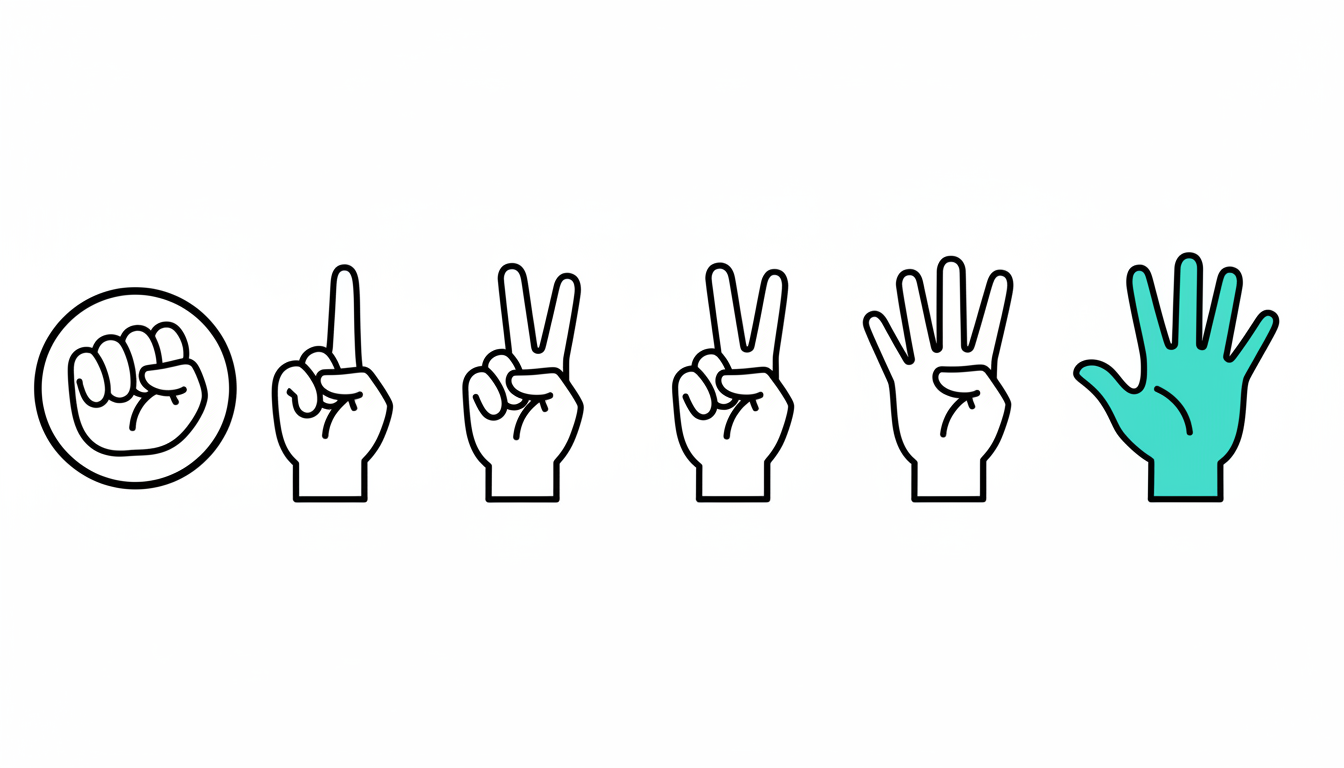
Provide instant visual snapshot of understanding or confidence by having students hold up 0-5 fingers in response to a prompt, creating an immediate, no-tech gauge of where the class stands.
How It Works
- Explain scale (15 sec) - "Fist = no understanding, 5 fingers = complete confidence"
- Ask check-in question (10 sec) - "Show me: How confident are you solving these equations?"
- Scan and respond (15 sec) - Teacher scans the room and adjusts instruction based on distribution
What to Say
Opening: "Fist to five check! Fist means 'I'm completely lost,' five fingers means 'I could teach this to someone else.' How confident are you with solving for X? Show me on 3: 1, 2, 3!"
During: [Scans room] "I see mostly 3s and 4s—good progress! Three fists and several 1s—you'll work with me in small group."
Closing: "Honest fist-to-five is valuable feedback. I'm not judging you—I'm adjusting my teaching to meet you where you are."
Why It Works
Simple kinesthetic signal requires no materials. Numeric scale provides more nuance than binary yes/no. Simultaneous whole-class response reduces social pressure—everyone shows at once, so individual struggling students aren't singled out.
Research Connection: Visible thinking strategies and self-assessment improve metacognitive awareness (Ritchhart et al., 2011; Andrade & Valtcheva, 2009).
Teacher Tip
Make it safe to show low numbers: "Yesterday I saw mostly 2s and 3s. Today I see mostly 4s and 5s. That's GROWTH! Showing a fist yesterday helped me teach better today."
Variations
Scale meanings: Understanding (0-5), confidence (0-5), agreement with statement (0-5), interest level (0-5) • Frequency: Beginning/end of lesson comparison, mid-lesson check, before/after instruction on same concept • Ages: K-5: Simplified 0-3 scale; 6-12: Full 0-5 standard; College: Can add 0-10 scale for more precision
Online
"Type a number 0-5 in chat on my count of 3." Or use reaction emojis as proxies: (0-1), (2-3), (4-5).
Troubleshooting
Everyone shows 5 (social conformity): "Tomorrow I'll ask 5s to explain the concept—show your true number so I can help effectively."
Extension
Double fist-to-five: "First fist-to-five: How well do you understand it? Second fist-to-five: How much do you CARE about learning it?" Reveals engagement vs. comprehension gaps.
Related: Traffic Light Self-Assessment, Thumbs Compass