
Focus Reset Ritual
At a Glance
- Time: 30-60 seconds
- Prep: None (establish ritual first)
- Group: Individual (personal practice)
- Setting: Any classroom
- Subjects: Universal
- Energy: Low
Purpose
Provide students with a consistent personal ritual for resetting attention and focus when they notice their minds have wandered, building metacognitive awareness and self-regulation skills by teaching an explicit process for returning to task after distraction, empowering students to manage their own attention rather than relying on teacher intervention.
How It Works
- Teach ritual (first time, 2-3 min) - Explicitly teach the focus reset sequence and when to use it
- Practice together (1-2 min) - Guide whole class through ritual once
- Individual use (ongoing, 30-60 sec) - Students deploy ritual independently when they notice distraction
- Optional cue (teacher-initiated) - Teacher can cue whole-class reset: "Focus reset time—use your ritual"
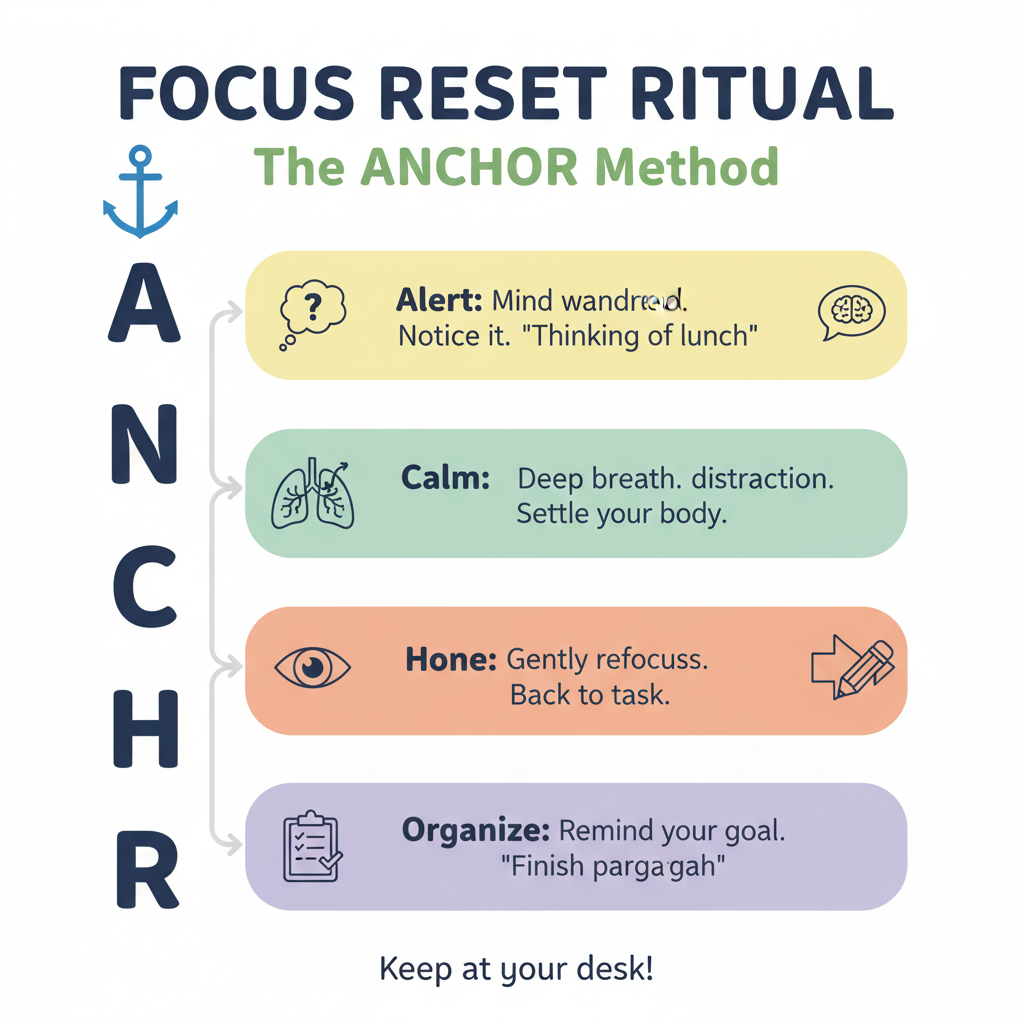
Suggested Ritual Sequence:
- Notice (5 sec) - "My mind has wandered"
- Pause (5 sec) - Stop what you're doing
- Physical reset (10 sec) - Sit up straight, feet flat on floor, shoulders back
- Breath (20 sec) - Three deep breaths (in through nose, out through mouth)
- Refocus (5 sec) - Look at task, mentally note: "I'm working on [X]"
- Resume (immediate) - Return to work with fresh attention
What to Say
Teaching the ritual (first time): "Your attention will wander—that's normal. What matters is bringing it BACK. We're going to learn a focus reset ritual you can use anytime you catch your mind drifting. Here's how it works..."
[Teach sequence step by step. Model it yourself.]
"Let's practice together right now. Notice your attention is here with me. Good. Now take a moment and imagine your mind has wandered. Ready? Focus reset: Pause. Sit up straight. Three deep breaths with me—in... out... in... out... in... out. Now look at what you were working on and say in your head: 'I'm working on [task name].' Resume work. That's it."
Cueing class reset: "I'm noticing attention is scattered right now. Everyone—focus reset. Use your ritual. 30 seconds starting now."
After students use independently: "Who used a focus reset today? What did you notice? Did it help?" [Reinforce metacognition]
Why It Works
Self-regulated learning requires metacognition—awareness of one's own cognitive processes—and self-control strategies (Zimmerman, 2002). Most students don't have explicit tools for recovering attention once lost; they simply remain distracted. Focus reset rituals provide a concrete, repeatable process students can deploy independently. The physical reset (posture adjustment) and breathwork activate the parasympathetic nervous system, reducing arousal and mental clutter. Naming the task ("I'm working on X") reestablishes intention and goal-directed behavior. Over time, the ritual becomes automatic—a go-to tool for managing attention.
Research Citation: Self-regulated learning (Zimmerman, 2002)
Teacher Tip
The ritual must be consistent and simple enough to remember without instructions. Complexity kills adoption—if students can't recall the steps, they won't use it. Post the ritual visually in classroom (poster, slide) until it's internalized. Also: model using it yourself. When YOU notice your attention drift mid-lesson, pause and do the ritual aloud: "My focus just wandered. I'm doing a reset..."
Variations
Different Ritual Components
Physical resets:
- Posture adjustment (sit up, shoulders back)
- Stretch briefly (arms overhead, roll shoulders)
- Touch anchor point (desk edge, feet on floor)
Breath patterns:
- Three deep breaths (simple)
- Box breathing (4-4-4-4)
- 4-7-8 breathing (calming)
Mental resets:
- Say task name internally
- Visualize completing the task
- Count backward from 5 to refocus
Different Initiation Modes
- Student-initiated: Individual uses ritual when noticing distraction (empowering)
- Teacher-cued: Teacher signals whole-class reset when attention wanes (scaffolded)
- Scheduled: Ritual happens at consistent times (start of work period, mid-task check-in)
Different Ages
- Elementary (K-5): Simple 3-step ritual (sit tall, breathe three times, look at work); use playful language
- Middle/High School (6-12): Standard ritual; emphasize independence and self-regulation
- College/Adult: Present as productivity/performance tool applicable beyond classroom
Online Adaptation
Tools Needed: None
Setup: Post ritual steps in chat or on screen
Instructions:
- Teach ritual during synchronous session
- Guide whole class through practice
- Post written ritual in shared space (chat, slide, LMS)
- Students use independently during online work
- Periodic check-ins: "Who's used a focus reset today?"
Pro Tip: Create simple visual graphic of ritual steps—share screen with graphic during initial teaching, then post in LMS for reference during asynchronous work.
Troubleshooting
Challenge: Students forget ritual steps; don't use it when needed Solution: Post visible reminder (poster, desk card). Also, cue whole-class resets regularly at first to build habit: "Focus reset time—everyone do the ritual." Frequency creates automaticity.
Challenge: Students claim ritual "doesn't work" or "doesn't help" Solution: Investigate: Are they actually following all steps, or skipping parts? Often students rush through or skip breath component. Also normalize: "It won't magically fix attention forever—it gives you 5-10 more minutes of focus. Use it multiple times in a work period."
Challenge: Ritual feels forced or "babyish" to older students Solution: Frame as high-performance tool: "Athletes and professionals use focus rituals. This isn't kid stuff—it's skill-building." Show examples of rituals in sports (free throw routines) or performance (actor preparation).
Extension Ideas
- Deepen: Personalized rituals—students design their own focus reset sequences (with core components); share and discuss variations
- Connect: Transfer beyond classroom—teach students to use ritual for homework, test-taking, work, life
- Follow-up: Attention logging—students track how many times they use ritual in a class period; discuss patterns (when does attention wander most? why?)
Related Activities: Breathing Break, Mindful Moment, Processing Pause