
Pair-Share-Repeat
At a Glance
- Time: 4-6 minutes
- Prep: None
- Group: Pairs (students change partners midway)
- Setting: Any classroom context
- Subjects: Universal - works in any discipline
- Energy: Medium to High
Purpose
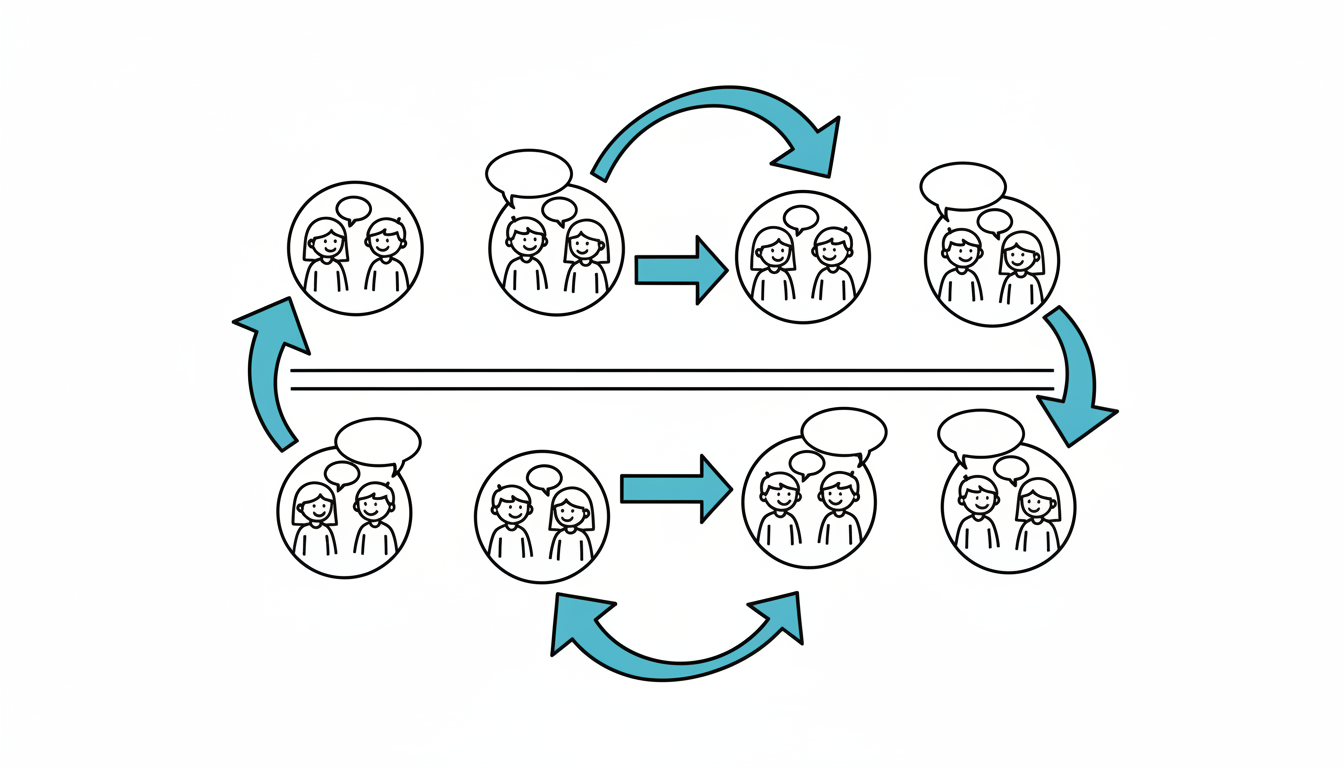
Pair-Share-Repeat takes the standard Think-Pair-Share and adds a powerful twist: students find a NEW partner and share what they learned from their first conversation. This creates cross-pollination of ideas throughout the classroom, ensuring that the best thinking doesn't stay trapped in isolated pairs but circulates widely. Use this when you want to maximize idea distribution and give students practice synthesizing and re-articulating others' thoughts.
How It Works
Step-by-step instructions:
-
STANDARD THINK-PAIR-SHARE (2-3 minutes) - Follow the complete Think-Pair-Share protocol: pose question, think individually (30 sec), pair up, share ideas (90 sec).
-
SIGNAL FOR NEW PARTNERS (10 seconds) - Get everyone's attention and announce: "Now find a NEW partner—someone you weren't just talking with."
-
ALLOW PARTNER FINDING (20-30 seconds) - Students stand, move around, and find a new partner. This brief movement energizes the room.
-
SHARE ROUND TWO (90 seconds) - Partners don't start over with the original question. Instead, they share: "What interesting idea came up in your first conversation?"
-
OPTIONAL WHOLE-CLASS HARVEST (1 minute) - Ask: "What idea did you hear in your second conversation that you hadn't thought of initially?"
What to Say
After First Pair Discussion: "You've had some great conversations with your partner. Now I want those ideas to spread throughout the room. Stand up and find a NEW partner—someone different from who you just talked with. You have 20 seconds. Go!"
For Round Two: "Here's your task with your new partner: Don't restart the original question from scratch. Instead, share the most interesting idea or perspective that came up in your FIRST conversation. What did your first partner say that made you think? You each have about 30 seconds to share."
During Round Two: [Circulate and listen. You might hear: "My first partner said..." or "We realized that..." This meta-conversation is exactly what you want.]
Closing: "Look how many different ideas just got shared around this room. That's the power of collaborative learning—your understanding grows by encountering multiple perspectives."
Why It Works
Pair-Share-Repeat amplifies the benefits of basic pair work through several mechanisms:
Idea Distribution: Instead of 30 ideas staying trapped in 15 isolated pairs, ideas circulate widely across the network of learners.
Synthesis Practice: Students must distill and re-articulate what they heard, which deepens their own understanding. Explaining someone else's idea is higher-level cognitive work than explaining your own.
Perspective Accumulation: By the end, each student has considered the original question through three lenses: their own initial thinking, their first partner's view, and their second partner's perspective.
Energy Management: The physical movement between partners provides a kinesthetic break that resets attention.
Social Connection: Students interact with multiple peers, building a more interconnected classroom community.
Research Citation: This technique builds on cooperative learning research showing that structured positive interdependence (where students need each other to succeed) leads to higher achievement and deeper understanding (Johnson & Johnson, 1999).
Teacher Tip
The key instruction that makes this work is telling students NOT to restart the original question with their new partner. If you skip this direction, students will simply repeat their first conversation with a new person—which has limited value. Instead, frame the second conversation as reporting and synthesizing: "Tell your new partner what you learned from your first partner." This transforms the activity from repetition to elaboration.
Variations
For Different Subjects
-
Math/Science: Round 1: Solve the problem with partner. Round 2: "Share the problem-solving strategy your first partner used. What was helpful about their approach?"
-
Humanities: Round 1: Analyze the text/artwork. Round 2: "What did your first partner notice that you didn't? Share that observation with your new partner."
-
Language Learning: Round 1: Practice dialogue in target language. Round 2: "Teach your new partner one useful phrase or correction your first partner taught you."
For Different Settings
-
Large Class (30+): Finding new partners works great with lots of options. Consider using movement rules: "Find someone in a different row" or "Find someone wearing a different color."
-
Small Class (10-15): Form trios instead of pairs in Round 1. In Round 2, trios break up and form new trios, ensuring everyone works with different people.
-
Auditorium/Fixed Seating: Students can pair-share with someone in their row, then lean forward/back to find a new partner in the row ahead/behind them.
For Different Ages
-
Elementary (K-5): Use concrete partner-finding methods: "Find someone with the same first letter in their name" or "Find someone who has a pet." This adds fun to the transition.
-
Middle/High School (6-12): Standard format works well. Students at this age often appreciate the movement break between discussions.
-
College/Adult: Can add complexity: "In your second conversation, identify one way your two discussions were similar and one way they differed."
Online Adaptation
Tools Needed: Video conferencing platform with breakout rooms (Zoom, Google Meet)
Setup: Prepare to manually reassign breakout rooms, or use the "auto-assign" feature twice.
Instructions:
- Round 1: Send students into auto-assigned breakout room pairs for 2 minutes
- Bring everyone back to main room
- Give instructions for Round 2: "Share what your first partner said that was interesting"
- Round 2: Re-shuffle into NEW breakout room pairs (use "Recreate" rooms with new assignments)
- After 90 seconds, return to main room for debrief
Pro Tip: In Zoom, you can use the "Breakout Rooms" feature and click "Recreate" to automatically form new pairs. Students love this because they never know who they'll be paired with next.
Troubleshooting
Challenge: Some students struggle to find a new partner quickly, leading to awkward standing around.
Solution: Set a specific search strategy: "Find someone you haven't worked with yet today" or "Find someone from a different part of the room." If someone is still searching after 20 seconds, pair them yourself or create a trio.
Challenge: In Round 2, students still talk about their own original ideas instead of what their first partner said.
Solution: Be more explicit: "I want to hear the voice of your FIRST partner in this conversation, not your own ideas yet. Start by saying, 'My partner thought that...' or 'Something interesting my partner said was...'"
Challenge: The activity feels too long and loses momentum.
Solution: Keep each phase timed and brisk. Use a visible timer. If you notice energy flagging, skip the whole-class harvest and move directly into your next activity.
Extension Ideas
-
Deepen: Add a third round with a new partner and a synthesis task: "Compare what you heard in conversations 1 and 2. What's one theme that emerged across both?"
-
Connect: Use this as a review strategy: "Round 1: Explain concept A. Round 2: Explain concept B to a new partner. Round 3: With a third partner, explain how A and B connect."
-
Follow-up: Have students write a reflection: "What did you understand more deeply after hearing multiple perspectives on this question?"
Related Activities: Think-Pair-Share, Speed Networking, Rotating Trios