
3-2-1 Reflection
At a Glance
- Time: 3-4 minutes
- Prep: None (or printed template)
- Group: Individual writing
- Setting: Any classroom
- Subjects: Universal
- Energy: Low
Purpose
Create structured, multi-dimensional closure that captures both content learning and metacognitive processing by having students reflect through a simple numerical framework that prompts them to identify key learnings, connections, and remaining questions, ensuring comprehensive reflection without overwhelming students with open-ended prompts while providing teachers with rich formative assessment data across multiple cognitive dimensions.
How It Works
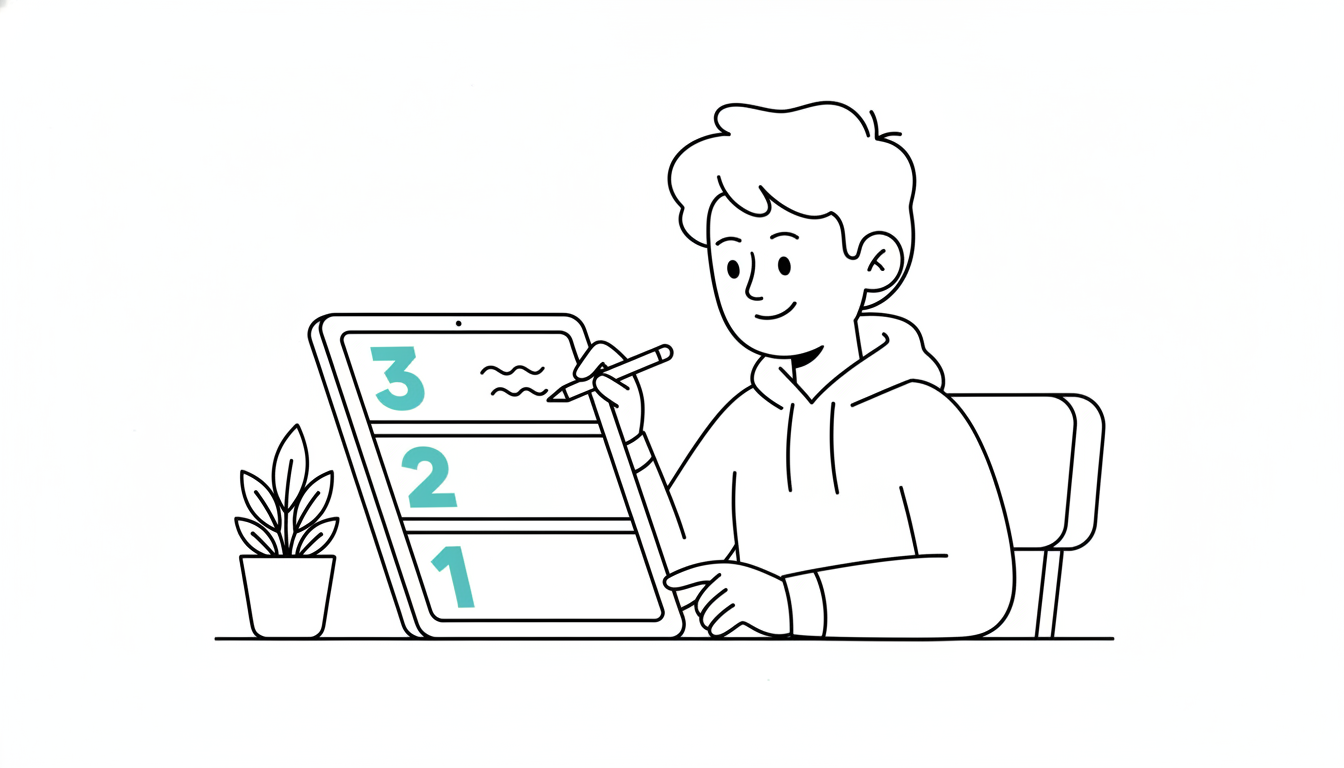
- Introduce the framework (15 sec) - Display 3-2-1 structure on board: "3 things you learned, 2 connections you made, 1 question you still have"
- Individual reflection (3 min) - Students write responses to all three prompts
- Optional sharing (60 sec) - Sample a few students' responses, especially questions
- Collection or closure (15 sec) - Collect for formative assessment or have students keep in notes
What to Say
Opening: "We're closing with 3-2-1 reflection. You have 3 minutes to write: 3 things you learned today, 2 connections you made to other ideas or experiences, and 1 question you still have. Go."
Prompt display (on board):
3 - Things I learned today
2 - Connections I made (to other concepts, classes, life)
1 - Question I still have
During writing: "For your 3 learnings, be specific—not vague. For your 2 connections, think about how today links to something else you know. For your 1 question, make it real—what are you actually wondering about?"
Closing: "Who wants to share one question? Let's hear what you're still curious about." [Take 2-3 questions.] "Great questions. We'll explore those tomorrow/in our next unit."
Why It Works
The 3-2-1 structure provides cognitive scaffolding for reflection (Fisher & Frey, 2014). Many students struggle with unstructured "What did you learn?" prompts—they freeze or write superficially. The numerical framework makes reflection concrete and manageable. The three components target different cognitive processes: recall (3 learnings), integration (2 connections), and self-assessment (1 question). This multi-dimensional reflection is more effective than single-prompt closures. For teachers, the "1 question" component is particularly valuable formative assessment data, revealing conceptual gaps or curiosities that should shape future instruction.
Research Citation: Structured reflection frameworks (Fisher & Frey, 2014)
Teacher Tip
Adapt the prompts to fit your lesson goals. The "3-2-1" format is flexible—you could do "3 key terms, 2 examples, 1 application" for science or "3 characters, 2 themes, 1 prediction" for literature. Keep the structure, but customize the content categories.
Variations
For Different Subjects
- Math/Science: "3 problem types I can now solve, 2 formulas/concepts that connect, 1 type of problem I still struggle with"
- Humanities: "3 important ideas from the text, 2 connections to other texts/events, 1 question I want to explore further"
- Skills-based: "3 strategies I used today, 2 times I could use these strategies elsewhere, 1 challenge I still face"
For Different Settings
- Large Class (30+): Collect as exit tickets; review for common questions to address next class
- Small Group (5-15): After individual writing, do rapid-fire sharing of questions (1 per student)
For Different Ages
- Elementary (K-5): Simplify to "2-1: 2 things I learned, 1 question I have" or use visual/drawing component
- Middle/High School (6-12): Standard 3-2-1 format
- College/Adult: Extend to 5-3-1 for longer sessions or denser content
Online Adaptation
Tools Needed: Google Form, Padlet, or shared doc template
Setup: Create form with three sections matching 3-2-1 structure
Instructions:
- Share 3-2-1 reflection form link in chat 5 minutes before class ends
- Students complete form individually
- Optional: Display Padlet board showing everyone's "1 question" anonymously
- Teacher reviews submissions to identify patterns
- Next class: "Based on your questions, let's start by clarifying..."
Pro Tip: Create reusable 3-2-1 template students can access each class—builds consistent reflection routine.
Troubleshooting
Challenge: Students list superficial or redundant learnings ("I learned about atoms" three times) Solution: Require variety: "Your 3 learnings should be THREE DIFFERENT ideas—not the same thing repeated. What are three DISTINCT takeaways?"
Challenge: Students can't think of 2 connections Solution: Provide prompts: "Connect to: (1) something from another class, (2) something in current events, (3) something in your personal life, (4) something we learned earlier this year. Pick 2."
Challenge: Students write "no questions" because they're afraid to admit confusion Solution: Reframe: "Your question doesn't have to be about confusion. It can be curiosity—'I wonder why...' or 'What would happen if...' Smart people always have questions."
Extension Ideas
- Deepen: "3-2-1-0: 3 learnings, 2 connections, 1 question, 0 things you'll forget (what MUST you remember?)"
- Connect: Periodically review past 3-2-1s: "Look back at your 3-2-1 from Week 1. Have your questions been answered? Have you made more connections?"
- Follow-up: Use student questions from 3-2-1 to generate future lesson content: "Your questions from last unit are driving our next investigation."
Related Activities: Exit Tickets, Connection Web, Reflection Rapid Fire