
Lead with Different Body Parts
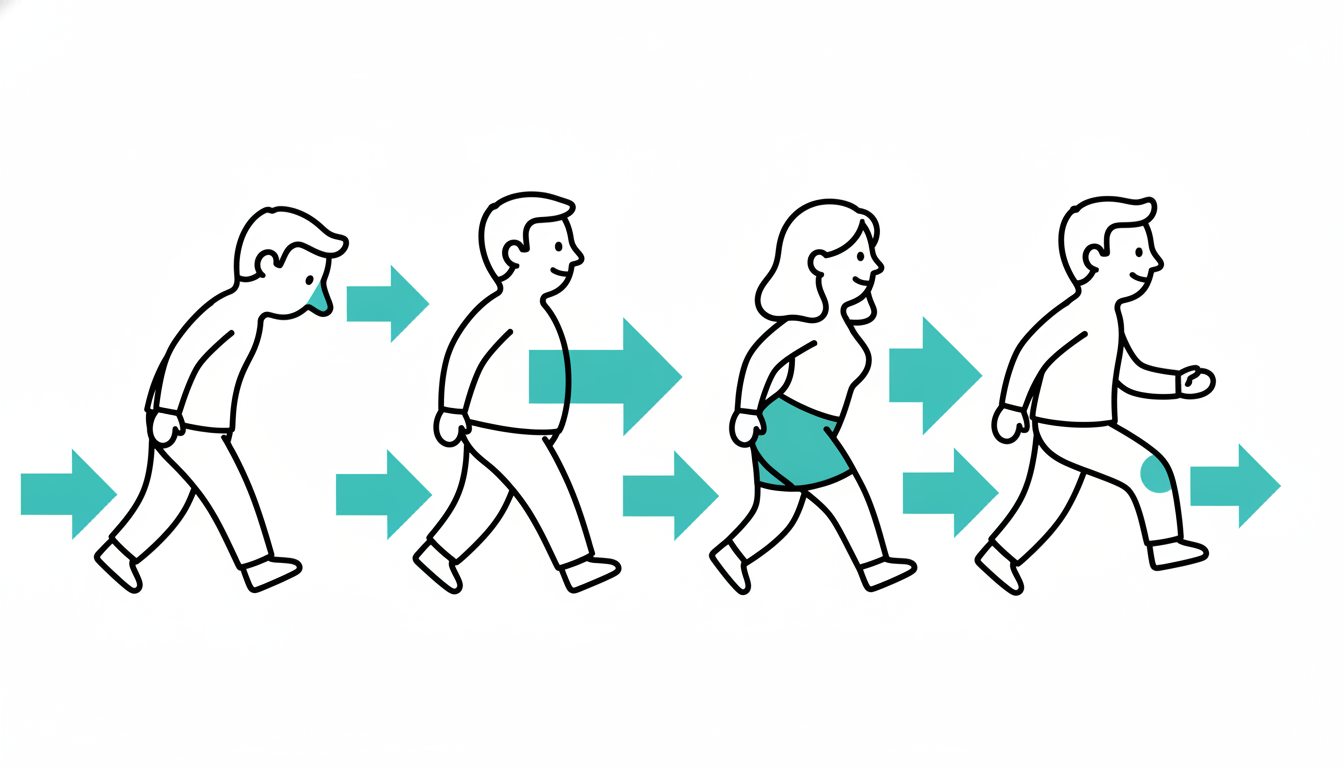
At a Glance
- Time: 2-3 minutes
- Prep: None
- Group: Whole class
- Setting: Any space with room to walk around
- Subjects: Universal - applicable to any subject as brain break or character exploration
- Energy: Medium
Purpose
Develop kinesthetic awareness and explore how physicality affects character, emotion, and presence by having students walk while leading with different body parts (nose, hips, chest, knees), a classic drama technique that serves as both an engaging brain break and a gateway to understanding embodiment and perspective-taking.
How It Works
- Establish neutral walking (20 sec) - Students spread out and walk naturally around the space at their own pace
- Introduce leading (15 sec) - "Imagine a string is attached to your nose, pulling you forward. Let your nose lead your whole body as you walk."
- Lead with nose (30 sec) - Students walk around space with nose leading
- Change body parts (30 sec each) - Every 30 seconds, call out new body part: "Now lead with your chest... Now lead with your hips... Now lead with your knees... Now lead with one elbow..."
- Return to neutral (20 sec) - "Release all leading. Walk naturally. Notice how your normal walk feels now."
- Brief reflection (15 sec) - "How did leading with different parts change how you felt?"
What to Say
Opening: "Find a spot with personal space around you. Begin walking at a comfortable pace. Now, imagine your NOSE is pulling you forward like a magnet. Let it lead your whole body. Everything follows where your nose goes."
Changing body parts: "Release the nose. Now lead with your CHEST. Push your chest forward and let everything else follow... Release. Now lead with your HIPS. Let your hips pull you around the space... Release. Now lead with your KNEES. Bend them slightly and let them be the driving force..."
Closing: "Stop and shake it out. Notice how one simple change in where you lead from completely changed your walk, your posture, even how you felt. That's embodied learning."
Why It Works
This classic drama exercise demonstrates the powerful connection between physicality and psychology. Different body parts leading create different emotional and characterological qualities: leading with the chest suggests confidence or pride, leading with the head suggests intellectual focus, leading with the hips suggests sensuality or playfulness. Students experience viscerally how body language communicates meaning and affects internal state, a principle crucial for both character analysis in humanities and understanding body language in social contexts (Mehrabian's nonverbal communication research).
Research Citation: Embodied cognition and emotional contagion research (Niedenthal, 2007)
Teacher Tip
Connect this explicitly to your content. Before reading a scene with a proud character, have students walk leading with their chest. Before discussing a sneaky character, lead with elbows pulled back. The physicality creates an experiential understanding that discussion alone can't provide. Students FEEL what it's like to move as that character moves.
Variations
For Different Subjects
- Math/Science: Lead with different parts to embody concepts - "Lead with your head held high like a lighthouse scanning" or "Lead with shoulders hunched like you're molecules under pressure"
- Humanities: Character analysis - "How would this character walk? What body part would lead them?" Try leading with part that represents their key trait
- Universal: Emotional exploration - "Lead with the body part that feels sad/excited/nervous to you"
For Different Settings
- Large Class (30+): Define traffic patterns (clockwise circle, or two lines passing each other) to prevent collisions while still maintaining flow
- Small Group (5-15): Can add observer role - half class observes while half performs, then discuss what they noticed about how different leads changed appearance
For Different Ages
- Elementary (K-5): Make it playful with animal connections - "Lead with your nose like an elephant's trunk!" or "Lead with your tail like a puppy!"
- Middle/High School (6-12): Standard approach; can explicitly connect to character analysis in literature or historical figures' bearing
- College/Adult: Sophisticated debriefing about how this applies to professional presence, interview posture, or public speaking stance
Online Adaptation
Tools Needed: Video platform with cameras enabled; students need space to move in frame
Setup: Students position cameras to show full standing body if possible, or upper body for seated version
Instructions:
- Standing version: Students move in place while leading with different parts (march, sway, shift weight)
- Seated version: "Lead with your head leaning forward... now your chest pushing out... now one shoulder... now pull back with your elbows"
- Students perform simultaneously while viewing themselves and others in gallery view
- Brief chat reflection: "Type one word describing how leading with your chest made you feel"
Pro Tip: The self-view in video actually enhances this activity - students can SEE how their posture changes, making the learning more explicit.
Troubleshooting
Challenge: Students feel self-conscious or laugh at themselves Solution: Lead by example - do it yourself enthusiastically: "Look, when I lead with my nose, I look ridiculous! That's part of the fun. Just commit to it." Model full commitment.
Challenge: Students don't understand what "leading" means Solution: Demonstrate exaggerated version yourself: "Watch - my chest goes first, then the rest of me follows. It's pulling me forward. Let your body part be in charge."
Challenge: Movement looks identical regardless of body part Solution: Call for exaggeration: "Make it BIGGER. Really let that knee bend deeply and drag everything else. We should be able to tell from across the room which part is leading."
Extension Ideas
- Deepen: Combine body parts - "Lead with both your chest AND your nose" or create character walks by leading with unusual combinations
- Connect: Before reading dramatic texts, have students walk as they think each character would walk, then identify which body part was leading
- Follow-up: Writing prompt - "Describe a character by describing how they walk and what body part leads them. What does their walk tell us about their personality?"
Related Activities: Concept Acting Charades, As-If Transitions, Environments