
Attention Clap
At a Glance
- Time: 10-20 seconds
- Prep: None (establish pattern first)
- Group: Whole class
- Setting: Any classroom
- Subjects: Universal
- Energy: Low-Medium
Purpose
Instantly capture attention using rhythmic clapping patterns that students echo back, leveraging auditory pattern recognition and participatory response to redirect scattered focus without raising voice, while building a quick, playful classroom routine that signals transitions and refocuses energy through physical and auditory engagement.
How It Works
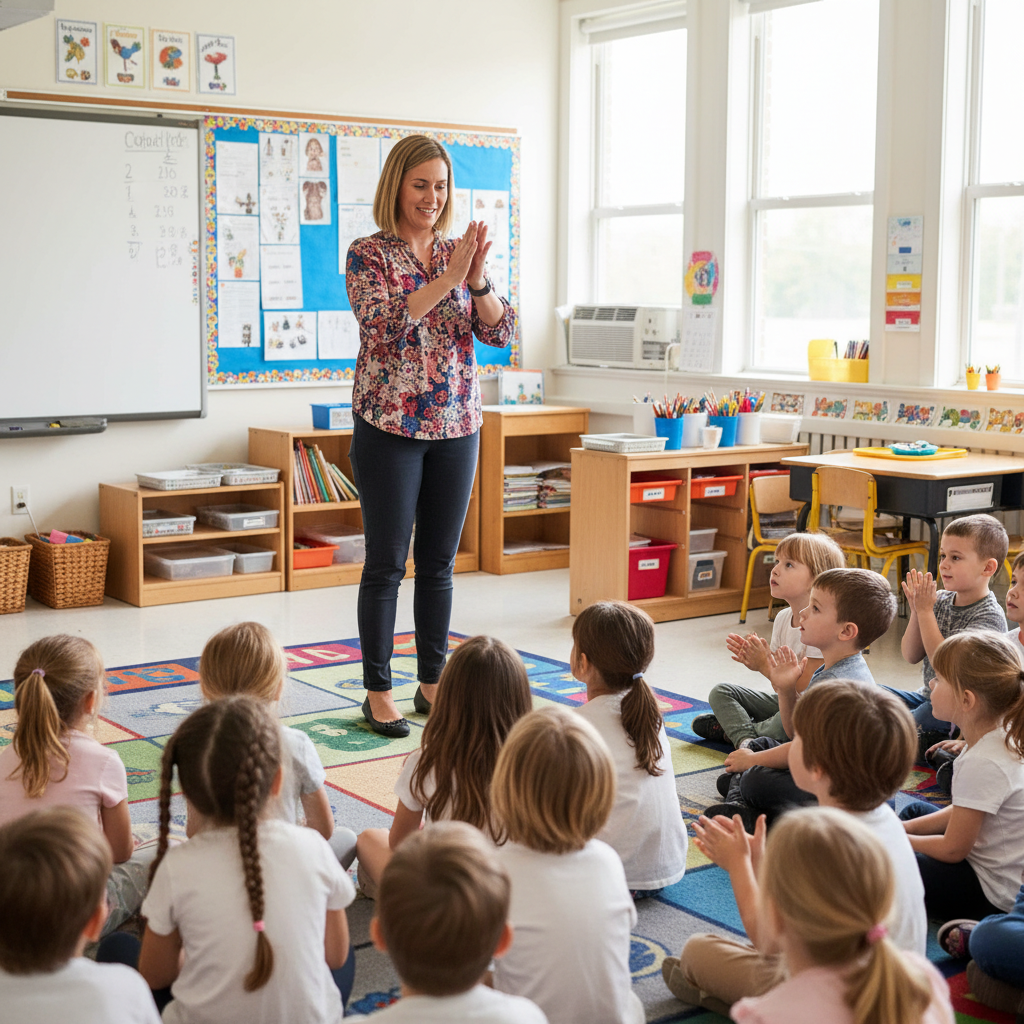
- Teacher claps pattern (3 sec) - Clap a distinctive rhythm (e.g., clap-clap-clap-clap-CLAP)
- Students echo (3 sec) - Students clap the exact pattern back
- Attention secured (immediate) - All students stop what they're doing, eyes on teacher
- Brief instruction (5-10 sec) - Teacher gives next direction
What to Say
Opening (establish first time): "Here's our attention signal. I'll clap a pattern. You clap it back EXACTLY. Then you stop everything and look at me. Let's try: [clap pattern]"
Regular use: [Just clap the pattern. No words needed. Students will respond.]
After echo: "Thank you. Here's what's next: [instruction]."
Why It Works
Rhythmic auditory patterns automatically capture attention through the brain's pattern completion drive (Patel, 2011). When students hear an established pattern, they're compelled to complete it—evolutionary survival mechanism (recognizing familiar vs. unfamiliar sounds). The participatory response (echoing the clap) ensures active engagement rather than passive hearing. Physical clapping also activates motor cortex, breaking fixation on previous task. Over time, the pattern becomes a Pavlovian cue: hear clap → respond → attend. No words, no volume, just rhythm.
Research Citation: Rhythm and attention (Patel, 2011)
Teacher Tip
Choose ONE signature pattern and use it consistently for 2-3 weeks before varying. Consistency creates automaticity. My favorite: clap-clap...clap-clap-clap (pause makes it distinctive). Once automatic, you can occasionally vary for fun, but return to signature pattern most of the time.
Variations
Different Pattern Complexity
- Simple: clap-clap-clap (elementary)
- Medium: clap-clap...clap-clap-clap (pause adds interest)
- Complex: clap-CLAP-clap-clap-CLAP (varied volume/intensity)
- Very complex: Incorporate snaps, stomps, or table taps
Different Purposes
- Attention getter: Quick single pattern
- Brain break: Series of 3-4 patterns students echo
- Energizer: Fast, loud patterns
- Calmer: Slow, quiet patterns
Different Ages
- Elementary (K-5): Simple, fun patterns; can add silly variations
- Middle/High School (6-12): Sophisticated patterns or content-based (morse code, math rhythm)
- College/Adult: Professional but effective; brief pattern
Online Adaptation
Tools Needed: Audio/video connection
Setup: Microphone on
Instructions:
- Teacher claps pattern clearly near microphone
- Students clap pattern back (muted if large group, or use chat/reactions)
- Students stop multitasking, focus on screen
- Teacher proceeds with instruction
Pro Tip: For large online classes, use "reactions" feature—teacher claps, students click reaction button () immediately—visual version of echo.
Troubleshooting
Challenge: Students don't echo back; ignore the clap Solution: Stop. Say nothing. Clap pattern again. Wait. Don't proceed until 100% echo. Make echoing non-negotiable by pausing all activity until they respond.
Challenge: Echo is sloppy—students clap any random pattern Solution: "That wasn't the pattern. Listen carefully. Here it is again: [clap]. Now you." Practice until they match it exactly. Precision matters for brain training.
Challenge: Pattern loses effectiveness over time; students habituate Solution: Refresh by introducing one new variant pattern per month, OR raise stakes: "If everyone echoes perfectly in one try, we get [small reward]."
Extension Ideas
- Deepen: "Rhythm leader"—student creates pattern, class echoes (builds leadership and listening)
- Connect: Content-based patterns: clap the syllables of vocabulary words, rhythm of historical dates
- Follow-up: "Pattern complexity challenge"—gradually increase pattern complexity over semester to build working memory
Related Activities: Call-and-Response, Countdown Timer, Energy Check