
Concept Acting & Charades
At a Glance
- Time: 3-4 minutes
- Prep: None
- Group: Pairs or small groups
- Setting: Any
- Subjects: Science, Language, History, Universal
- Energy: High
Purpose
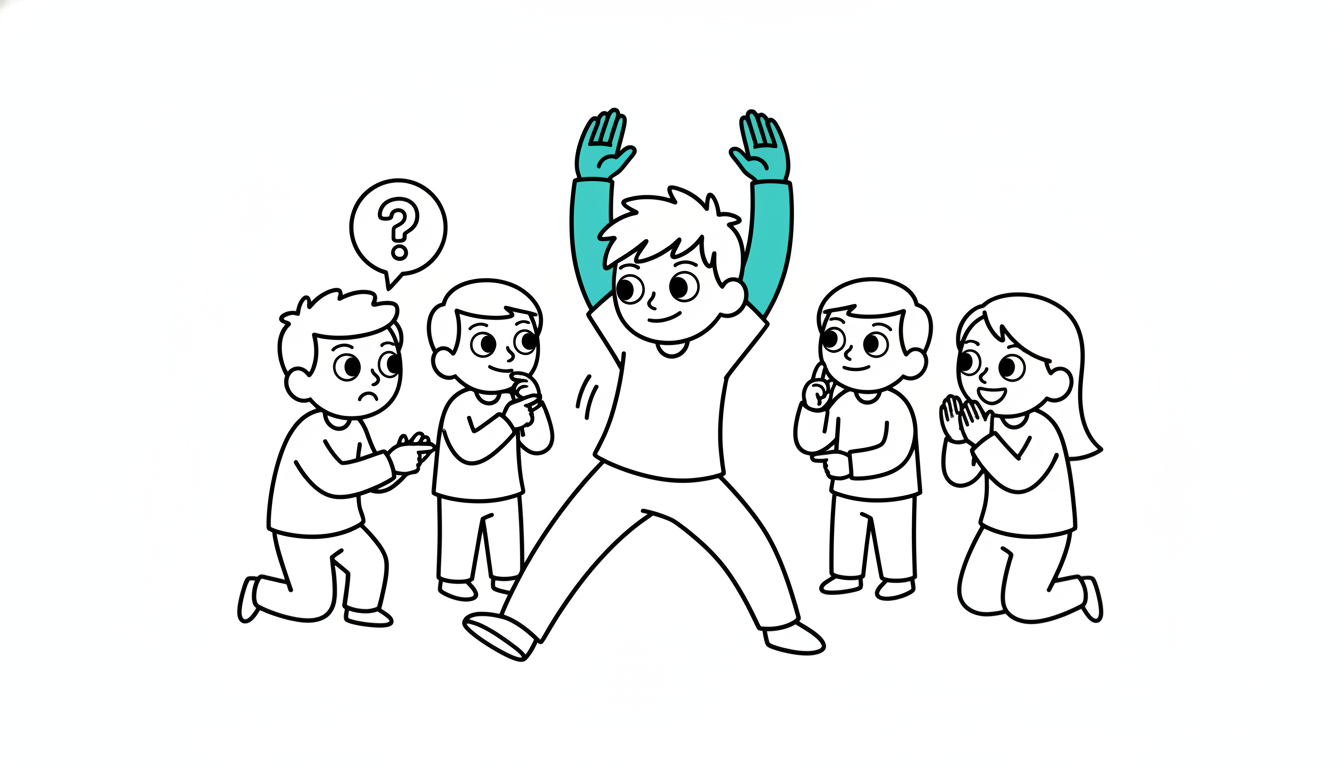
Transform abstract vocabulary, scientific processes, or historical events into physical action by having students act out concepts without words, forcing deep conceptual understanding through embodied representation.
How It Works
- Assign concepts (30 sec) - Give students vocabulary words, process stages, or events to act out
- Prepare and perform (2-3 min) - Students silently act out their concept while others guess
- Debrief (1 min) - Discuss what physical representations revealed about the concept
What to Say
Opening: "Your word is 'photosynthesis.' You have 30 seconds to plan, then act it out silently. Your classmates will guess. Use your whole body—show the process!"
During: "Show the inputs... now the transformation... what's being produced?... Keep it silent—let your body tell the story!"
Closing: "When you HAD to show mitosis with your body, you had to understand the sequence. That physical encoding helps you remember better than just reading about it."
Why It Works
Acting out concepts requires translation from verbal/textual knowledge into procedural/motor knowledge—a form of deep processing. Physical enactment creates multi-modal memory traces (visual, kinesthetic, spatial) that improve retrieval.
Research Connection: Enactment effect shows physical action during encoding significantly improves recall (Engelkamp & Zimmer, 1994).
Teacher Tip
For complex processes (water cycle, cellular respiration), assign different students to play different roles: "You're glucose, you're oxygen, you're the mitochondria." Watch them physically negotiate the process.
Variations
Content types: Vocabulary words (adjectives like "gregarious"), scientific processes (water cycle stages), historical events (signing Declaration), math concepts (fractions) • Format: Solo performance, partner charades, whole-class synchronized enactment • Ages: K-5: Simple actions; 6-12: Complex sequences; College: Abstract concepts
Online
Students perform for camera during breakout rooms or in gallery view. Works surprisingly well—screen becomes a stage. Use chat for guesses.
Troubleshooting
Students too self-conscious: Start with whole-class synchronized actions: "Everyone act out 'expanding' together—go!" Build comfort before solo performances.
Extension
Chain charades: First student acts a concept, next student adds the next step in the sequence, continuing until full process is enacted by the group.
Related: Kinesthetic Vocabulary, Machines