
Rapid Fire
At a Glance
- Time: 60-90 seconds
- Prep: None (prepare 8-10 yes/no questions)
- Group: Whole class (individual participation)
- Setting: Any (in-person or online)
- Subjects: Universal
- Energy: High
Purpose
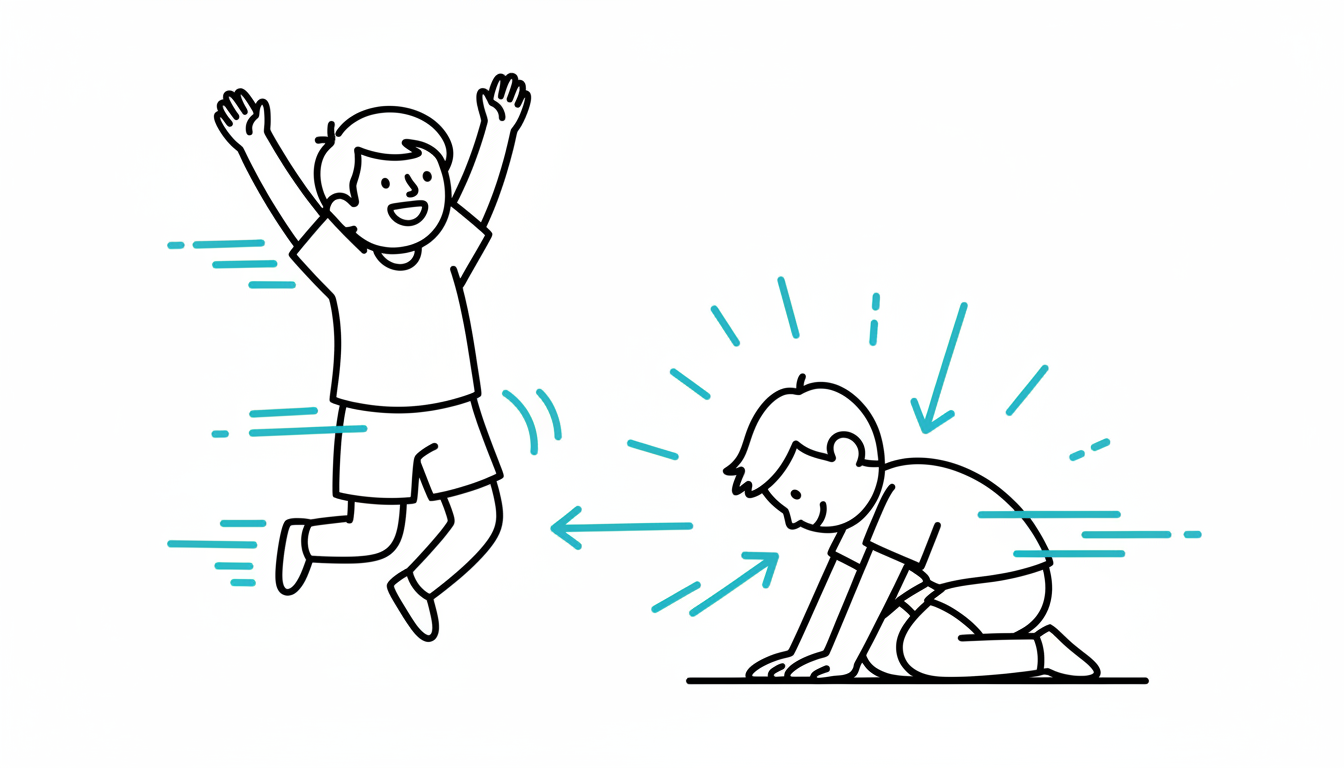
Create instant engagement and physical movement by having students respond to rapid yes/no questions with jumping (yes) or sitting (no). Use this to review content, check comprehension, or simply energize a sluggish class with quick decision-making.
How It Works
Step-by-step instructions:
- ESTABLISH PROTOCOL (10 seconds) - "Stand up! When I ask a yes/no question: Jump if YES, sit down if NO."
- RAPID QUESTIONS (60 seconds) - Ask 8-10 yes/no questions rapidly (5-7 seconds each)
- RESPOND - Students jump or sit for each question
- FINISH (10 seconds) - "Last question! ...Great energy! Everyone sit down. Let's use those activated brains."
What to Say
Opening: "Stand up! I'm going to ask rapid yes/no questions about photosynthesis. If the answer is YES, JUMP. If NO, sit down quickly. Ready? Question 1: Does photosynthesis require sunlight? [Students jump] YES! Stand back up. Question 2: Do plants photosynthesize at night? [Students sit] NO! Correct. Stand up..."
Continue rapid-fire through 8-10 questions, ending with: "Last one: Can photosynthesis occur without chlorophyll? [Students sit] Correct! Sit down. You just reviewed 10 key facts in 60 seconds."
Why It Works
Rapid decision-making under time pressure activates executive function and forces retrieval of knowledge quickly. The physical movement (jumping/sitting repeatedly) increases heart rate, pumping oxygen to the brain and boosting alertness. The game-like format makes review fun rather than tedious. Students must listen carefully to each question—inattention is immediately obvious. The rhythm of question-response-question creates engagement momentum.
Research Citation: Rapid response activities improve information retrieval speed and strengthen memory traces through active recall (Roediger & Karpicke, 2006).
Teacher Tip
Keep questions SHORT and clear. Complex questions slow the pace and create confusion. "Is this true or false?" works better than "In most cases, considering various factors, would you say..." The speed is what makes this work.
Variations
For Different Subjects
- Science: True/false about scientific concepts
- Math: "Is 12 prime?" (sit) "Is 20 even?" (jump)
- History: "Did this event happen before 1900?"
- Literature: "Is this character the protagonist?"
- Grammar: "Is this sentence grammatically correct?"
- Any Content: Fact checking, concept review, misconception checking
For Different Settings
- Large Class (30+): Perfect for this! The energy is contagious.
- Small Class (5-15): Still effective. Energy may be lower but engagement is 100%.
- Limited Space/Ceiling: Modify: Stand up (yes) / Squat down (no), or Hands up (yes) / Hands down (no)
- Online: Stand/sit on camera, or Raise hand (yes) / Put hand down (no)
For Different Ages
- Elementary (K-5): LOVE this. Keep questions simple. Can do 12-15 questions.
- Middle/High School (6-12): Works great. Keep pace fast to maintain energy.
- College/Adult: Frame as "quick content review." Adults will participate if pace is brisk and purposeful.
Online Adaptation
Tools Needed: Zoom, Teams, any video platform
Setup: Students visible on camera, standing
Instructions:
- "Everyone stand where I can see you on camera."
- "Jump if YES, sit down if NO. Ready?"
- Ask questions rapidly
- Watch responses in gallery view
Pro Tip: This works surprisingly well online because you can see everyone's responses simultaneously. The visual feedback is actually clearer than in a large classroom.
Troubleshooting
Challenge: Students are unsure/hesitant about answers. Solution: "If you're unsure, make your best guess! This is practice, not graded. Jump or sit—choose one!"
Challenge: The pace is too fast—students can't keep up. Solution: Slow slightly. Give 7-10 seconds per question instead of 5. Clarity over speed.
Challenge: Some questions are too ambiguous. Solution: Stick to clear true/false or yes/no facts. "Is water H2O?" not "Is water usually considered essential in most biological contexts?"
Extension Ideas
- Deepen: After the activity: "Which question was hardest? Let's discuss that concept more deeply."
- Connect: "We just practiced quick recall. In emergencies, quick accurate recall saves lives. That's why we practice."
- Follow-up: "Create 5 rapid-fire questions about today's topic for homework. We'll use them tomorrow."
Related Activities: Lightning Round, Speed Sort, Fist to Five