
Four Corners
At a Glance
- Time: 3-5 minutes
- Prep: Corner labels (optional)
- Group: Whole class
- Setting: Space to move to four corners
- Subjects: Universal
- Energy: High
Purpose
Build community and reveal preferences while adding movement and energy. Use this to energize, facilitate discussions, or activate prior knowledge. Students practice decision-making, explaining reasoning, and recognizing that people hold different perspectives. The physical movement to corners makes opinions visible and creates opportunities for interaction with like-minded peers.
How It Works
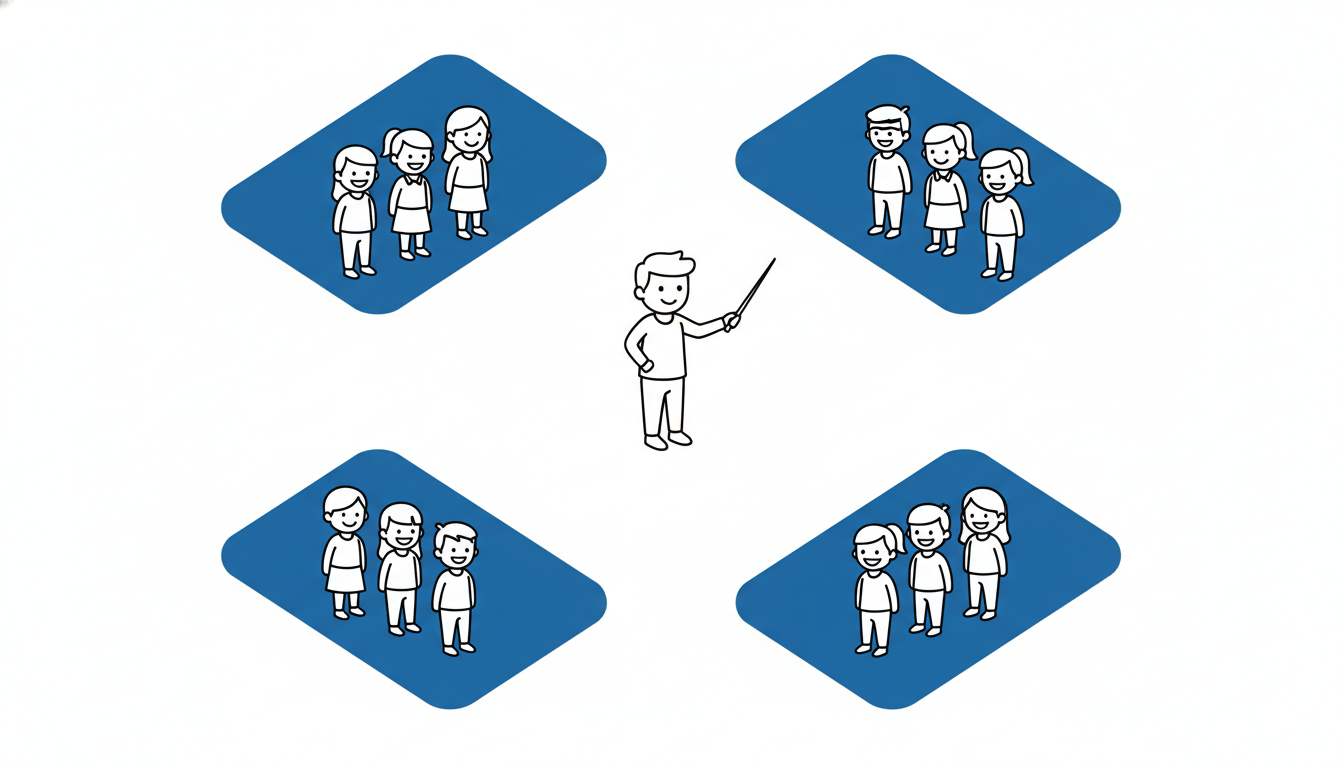
- LABEL CORNERS (30 seconds) - Assign each corner a label (A/B/C/D or specific options)
- POSE QUESTION (15 seconds) - Give students a question with 4 possible answers
- DECIDE & MOVE (30 seconds) - Students move to the corner that represents their choice
- SHARE (90-120 seconds) - Each corner briefly explains why they chose that option
- REPEAT (optional) - Ask 2-3 more questions
What to Say
"Look at the four corners of the room. This corner (point) is Spring. This corner is Summer. This corner is Fall. And this corner is Winter.
Here's the question: What's your favorite season? Think for 5 seconds... Now move to your corner! Go!"
(After students move) "Let's hear from the Spring corner. Why is spring your favorite? Someone share." (Take 1-2 responses)
"Summer corner, your turn!" (Continue through all corners)
"Interesting how we all have different preferences! Let's do another one..."
Why It Works
Movement activates the brain and increases engagement. Physically standing with others who share your opinion creates a sense of belonging and validation. Hearing different perspectives from other corners teaches that multiple viewpoints exist. The visual representation (seeing how many people are in each corner) provides instant data about class preferences. The low-stakes nature makes participation safe and accessible.
Research Citation: Physical movement during learning improves engagement and memory (Beilock & Goldin-Meadow, 2010).
Teacher Tip
Don't let any corner feel bad for being small! If only 2 students choose a corner, celebrate: "Wow, we have some unique thinkers here! Let's hear your reasoning." This teaches that minority opinions are valued, not wrong.
Variations
Sample Questions
Preferences:
- Favorite season: Spring / Summer / Fall / Winter
- Learning style: Visual / Auditory / Kinesthetic / Reading/Writing
- Superpower: Fly / Invisibility / Super strength / Read minds
- Study time: Morning / Afternoon / Evening / Late night
Academic Content:
- Math: Problem-solving approach: Algebraic / Visual / Guess-and-check / Work backwards
- Science: Which ecosystem: Ocean / Forest / Desert / Arctic
- Literature: Character type: Hero / Villain / Sidekick / Anti-hero
- History: Time period to visit: Ancient / Medieval / Industrial / Modern
Opinion/Debate:
- Best form of communication: Text / Call / Video / In-person
- Most important skill: Creativity / Communication / Critical thinking / Collaboration
For Different Settings
- Large Class: Perfect—use all four corners
- Small Class: Can use 3 corners or 2 sides if needed
- Online: Not ideal; use "Would You Rather" or polling instead
- Limited Space: Use classroom quadrants or assign areas
For Different Ages
- Elementary (K-5): Concrete questions: "Favorite food type: Pizza / Tacos / Pasta / Burgers"
- Middle/High School (6-12): Can handle abstract or opinion-based questions
- College/Adult: Use professional or field-specific questions
Content Integration
- Pre-Assessment: "How confident are you about [topic]? Very / Somewhat / A little / Not at all"
- Review: "Which step in the process comes first? A / B / C / D"
- Opinion Formation: "Which argument is most convincing? A / B / C / D"
Online Adaptation
Not Ideal for Online:
- The physical movement to corners is the core feature
- Alternative: Use polling features with 4 options, then discuss in breakout rooms
- Or use annotation tools: students click on quadrants of a screen
Troubleshooting
Challenge: One corner has no students (everyone chose other options). Solution: Acknowledge it! "Interesting—no one chose this corner. Why not? Would anyone like to play devil's advocate and defend this option?"
Challenge: Students follow friends instead of choosing authentically. Solution: "Close your eyes and think about YOUR real answer. Then open your eyes and walk to your corner with confidence!"
Challenge: Corners get too crowded (large class). Solution: Use multiple areas: "If Summer is too crowded, form a Summer line along this wall."
Challenge: Students change corners mid-discussion (peer influence). Solution: "Once you've chosen, stay put! You can change your mind for the next question, but stick with your first instinct for this one."
Extension Ideas
- Mini-Debate: Corners take turns defending their position
- Find a Partner: "In your corner, find someone and discuss WHY you both chose this. Find commonalities."
- Convince Me: One corner tries to convince another corner to switch sides
- Data Visualization: Take a photo of the corners, create a bar graph of class preferences
- Writing Prompt: "Defend your corner choice with evidence and reasoning in a paragraph."
- Follow-Up Discussion: "What did you notice? Were you surprised by any corner's size? What did you learn?"
Related Activities: Would You Rather, Human Barometer, Thumbs Compass