
Teacher and Student
At a Glance
- Time: 5-7 minutes
- Prep: None
- Group: Pairs
- Setting: Any classroom context
- Subjects: Universal - especially effective for review
- Energy: Medium
Purpose
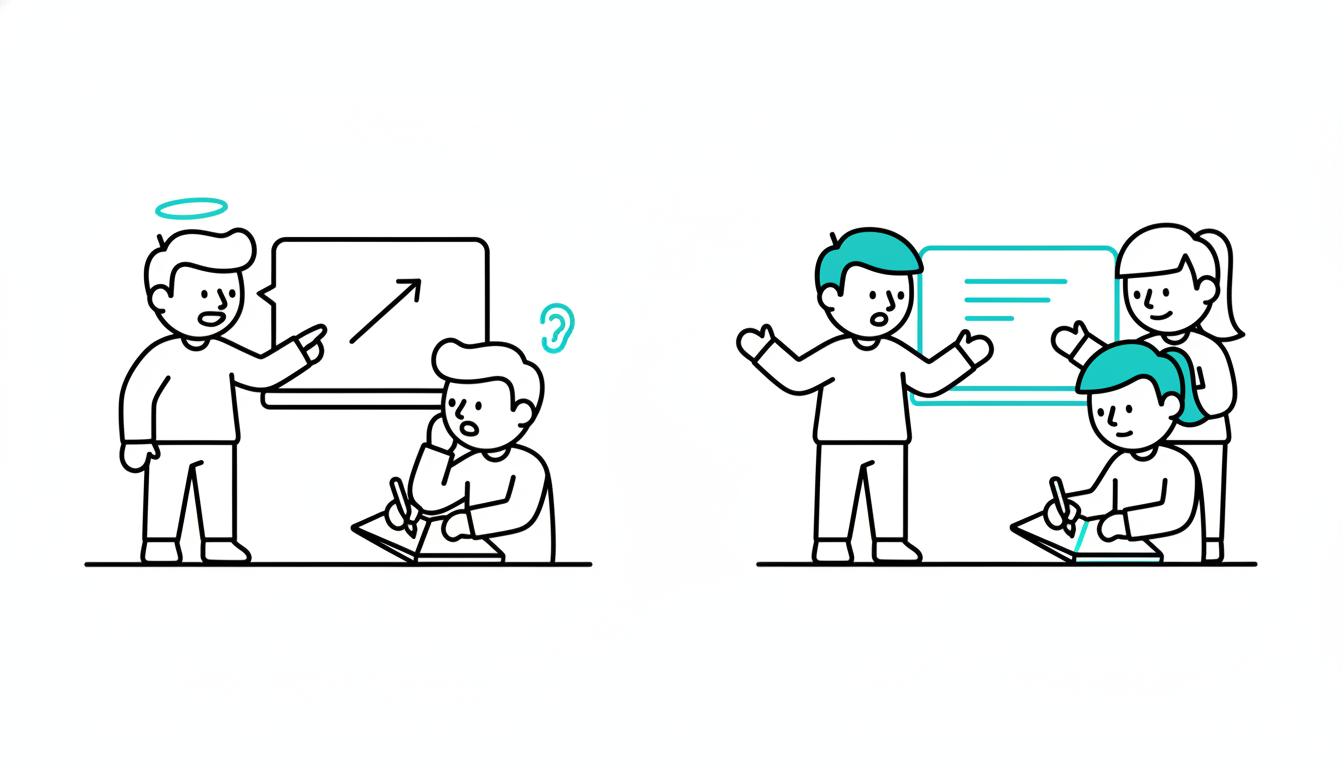
Teacher and Student is a peer-teaching review activity where one partner explains recently learned content while the other listens actively and identifies gaps. The "teacher" reinforces learning through explanation, while the "student" practices critical listening and catches missing information. Use this activity after a lesson or reading to check comprehension, identify gaps, and give students practice articulating concepts in their own words.
How It Works
Step-by-step instructions:
-
STUDENTS PREPARE INDIVIDUALLY (1-2 minutes) - Each student lists the key points from the recent lesson, reading, or video. This becomes their checklist.
-
PAIR UP (15 seconds) - Students form pairs.
-
ASSIGN ROLES (15 seconds) - Designate one person as "Teacher" and one as "Student" in each pair. Simple method: "Person whose birthday is earlier in the year is the Teacher first."
-
TEACHER EXPLAINS (2-3 minutes) - The "Teacher" explains the main points of the lesson from memory, as if teaching someone who wasn't there.
-
STUDENT LISTENS ACTIVELY (During explanation) - The "Student" listens and crosses off points from their list as the Teacher mentions them. They take notes on anything the Teacher explains that wasn't on their original list.
-
STUDENT IDENTIFIES GAPS (30 seconds) - After the Teacher finishes, the Student says: "Here are key points you didn't mention..." and adds any missing information.
-
SWITCH ROLES (Optional, if time) - Partners swap roles and repeat with a different topic or section.
What to Say
Setup: "We just covered [TOPIC]. Now you're going to test your understanding through peer teaching. First, individually, make a list of the 5-7 key points from what we just learned. You have 90 seconds."
Pairing: "Find a partner. One of you will be the Teacher, one will be the Student. Person wearing more blue is the Teacher first."
Teacher Role: "Teachers, your job is to explain the lesson as if your partner wasn't here for class. Cover all the main points from memory. You have 2 minutes. Students, while the Teacher is explaining, cross off items from your own list as they're mentioned. Also, add anything the Teacher explains that you didn't have on your list. Teachers, begin."
Student Feedback: "Stop. Students, your turn. Tell your Teacher: 'Here are important points you didn't mention...' Share anything from your list that the Teacher missed. This isn't criticism—it's helping them fill gaps."
Switch (Optional): "Now switch roles. The Student becomes the Teacher and explains a different concept or adds more depth to the same topic."
Why It Works
Teacher and Student leverages multiple powerful learning mechanisms:
Learning Through Teaching: Explaining concepts forces the "Teacher" to organize knowledge and identify what they truly understand vs. what they've merely memorized. Teaching is one of the highest-impact learning strategies.
Active Listening: The "Student" isn't passively receiving information—they're critically comparing what they hear to what they know, a form of active retrieval practice.
Immediate Feedback: The Student's identification of gaps provides immediate formative feedback to the Teacher about what they missed or misunderstood.
Metacognition: Students become aware of what they know and don't know through the act of trying to teach it.
Peer Language: Students often explain concepts to each other in more accessible language than textbooks or teachers use.
Research Citation: The "protégé effect" shows that students who teach concepts to peers learn the material more deeply than those who only study it for themselves (Chase et al., 2009).
Teacher Tip
The "Student" role is not passive. Emphasize that Students have a critical job: catching gaps and errors. Say: "Students, you're quality control. Your Teacher is counting on you to tell them what they missed. That's how we all learn." This reframes listening as an active, valuable contribution, not a lesser role.
Variations
For Different Subjects
-
Math: Teacher explains how to solve a problem step-by-step. Student checks whether all steps are included and correct.
-
Science: Teacher explains a process (photosynthesis, cell division, scientific method). Student checks for missing steps or misconceptions.
-
History/Social Studies: Teacher summarizes a historical event with causes and effects. Student checks for missing factors.
-
Language Arts: Teacher explains the theme or main idea of a text. Student checks whether supporting evidence was mentioned.
For Different Settings
-
Large Class (30+): All pairs work simultaneously. Circulate and listen to sample conversations for formative assessment.
-
Small Class (10-15): Can do as a whole-group activity with one student teaching the whole class while others identify gaps.
-
Online: Works perfectly in breakout room pairs.
For Different Ages
-
Elementary (K-5): Keep it simple: "Tell your partner what we learned today." The listener says, "One thing you forgot is..."
-
Middle/High School (6-12): Standard format works well. Can handle complex content.
-
College/Adult: Can extend to longer explanations (5+ minutes) of sophisticated concepts.
Online Adaptation
Tools Needed: Video conferencing with breakout rooms
Setup: No special setup required.
Instructions:
- Students create individual lists of key points (main room or in private)
- Send students to breakout room pairs
- Assign roles (can use first/last alphabetically as Teacher/Student)
- Teacher explains while Student listens and tracks
- Student identifies gaps
- Optional: switch roles
- Return to main room
Pro Tip: In virtual settings, the Student can use the chat function to type the "missing points" they identified. This creates a written record useful for later review.
Troubleshooting
Challenge: The "Teacher" just reads their list rather than explaining in narrative form.
Solution: Give clearer instructions: "Don't read your list. Put it away. Explain the concepts as if you're telling a story or teaching someone. Use your own words."
Challenge: The "Student" is too aggressive or critical in pointing out gaps.
Solution: Model supportive language: "Not 'You messed up'—instead say, 'One additional point that could strengthen your explanation is...' We're helping each other, not evaluating."
Challenge: Both partners had incomplete or incorrect understanding, so gaps aren't caught.
Solution: After the peer teaching, provide the correct/complete information to the whole class: "Here are the key points. Check how many you and your partner captured." This calibrates their understanding.
Extension Ideas
-
Deepen: After both partners have taught, have them collaborate to create ONE combined, complete explanation that's better than either individual version.
-
Connect: Use this activity repeatedly throughout a unit. Students become more skilled at explaining and identifying gaps with practice.
-
Follow-up: Have students write a reflection: "One thing I understood better after explaining it to my partner was... One thing I realized I still don't fully understand is..."
Related Activities: Jigsaw, Wisdom from Another, Peer Teaching Pairs