
Traffic Light Learning
At a Glance
- Time: 2-3 minutes
- Prep: Minimal (red, yellow, green cards or objects for each student)
- Group: Whole class
- Setting: Any classroom
- Subjects: Universal - works for any content or task
- Energy: Low-Medium
Purpose
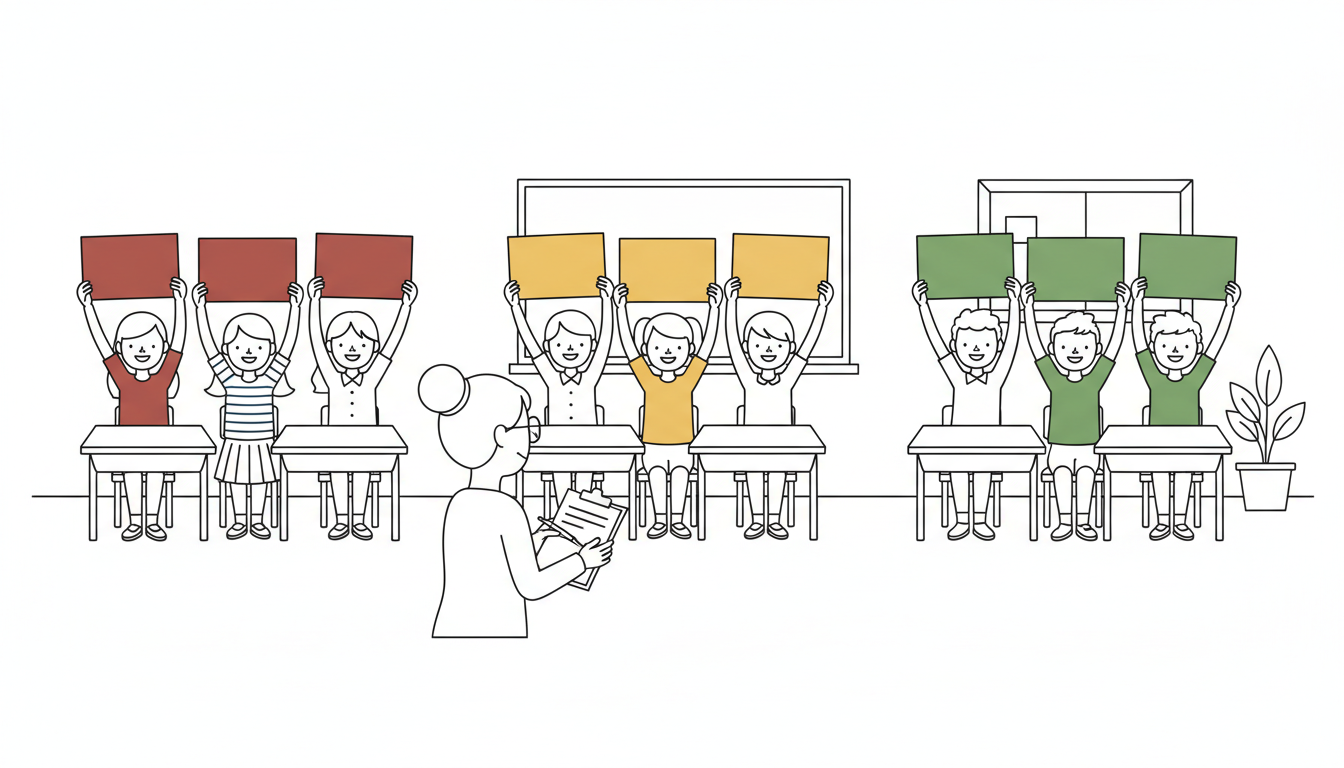
Provide instant visual feedback on student comprehension and pacing needs through a simple color-coded system where students physically display red (stop and help), yellow (caution, slow down), or green (go, ready to proceed), enabling teachers to make immediate instructional adjustments based on real-time class needs while building students' metacognitive self-assessment skills.
How It Works
- Distribute traffic light cards (15 sec) - Each student has red, yellow, and green cards (or colored objects) at their desk
- Explain the code (30 sec) - "Red = I'm stuck and need help. Yellow = I'm working but unsure. Green = I understand and I'm ready to move on."
- Check-in moments (5-10 sec each) - At strategic points during lesson, call for check: "Show me your traffic light for this concept"
- Respond to signals (varies) - Adjust pacing, provide support, or proceed based on color distribution displayed
- Movement variation (optional, 30 sec) - "Stand and move to the wall that matches your color" for full kinesthetic version
What to Say
Opening: "At your desk you have three colored cards—red, yellow, and green, like a traffic light. When I ask for a check-in, hold up the color that matches your understanding. Red = stop, I need help. Yellow = caution, I'm working on it. Green = go, I've got this. Let's practice: How confident are you with yesterday's homework? Show me your color."
During lesson check-ins: "We just covered three causes of the Civil War. Traffic light check—how's your understanding? Hold up your color... I see mostly green and yellow, a few reds. Great honesty!"
Responding to colors: "I'm seeing several reds. Red light students, I'm coming to work with you in small group. Yellow lights, pair up and discuss with a green light student. Green lights, move ahead to the extension task."
Movement version: "Traffic light check! This time, stand up and walk to the wall that matches your understanding. Red wall is by the door, yellow wall is by the windows, green wall is in the back."
Why It Works
Self-assessment is a critical metacognitive skill that improves learning outcomes (Zimmerman, 2002). Traffic light learning lowers the social risk of admitting confusion by making it a routine, normalized practice where everyone participates simultaneously. The visual display gives teachers actionable real-time data that's more honest than asking "Does everyone understand?"—a question that typically yields misleading unanimity. The physical act of selecting and displaying a color forces students to consciously reflect on their current understanding rather than passively assuming they're keeping up.
Research Citation: Self-regulated learning (Zimmerman, 2002)
Teacher Tip
Use traffic lights frequently (every 10-15 minutes) so it becomes routine rather than feeling like a "test." This normalizes the idea that learning involves moving through stages of confusion, work, and clarity—red, yellow, green aren't permanent states but phases everyone cycles through. Also, track patterns over time: Does one student always show red? That's data for intervention. Does everyone show green too quickly? They may not be self-assessing accurately yet.
Variations
For Different Subjects
- Math/Science: Check after each problem type or concept (solving equations, balancing formulas, understanding photosynthesis steps)
- Humanities: Check during reading comprehension, after discussing complex themes, or when analyzing primary sources
- Universal: Use for process checks ("How's your draft going?"), pacing ("Are you finished with this section?"), or effort monitoring ("How hard are you working right now?")
For Different Settings
- Large Class (30+): Cards work better than movement for large groups; can take photo of room showing color distribution for later analysis
- Small Group (5-15): Movement version more feasible; students physically move to colored zones in room for each check
For Different Ages
- Elementary (K-5): Use actual red/yellow/green objects (colored cups stacked, colored popsicle sticks); connect to familiar traffic lights on streets
- Middle/High School (6-12): Standard cards; can add nuance with "light green" (confident) vs. "dark green" (very confident)
- College/Adult: Digital version using colored slides on shared screen or emoji reactions () in chat
Online Adaptation
Tools Needed: Video platform with reactions, polling, or annotate features
Setup: Multiple methods available depending on platform
Instructions:
- Emoji method: Students use emojis in reactions or chat
- Poll method: Quick poll with three options: "Red - need help," "Yellow - working on it," "Green - got it"
- Annotate method: Use whiteboard annotation tools where students place colored dots next to their names
- Physical cards on camera: Students hold colored paper/cards up to camera
Pro Tip: Zoom's "raise hand" and emoji reactions can approximate this - for red, for green, for yellow.
Troubleshooting
Challenge: Students all show green to avoid admitting confusion (or all show red to avoid work) Solution: Build trust by validating red/yellow: "I LOVE seeing yellows and reds—that means real learning is happening. Green all the time means the work is too easy." Share your own traffic light when learning new things.
Challenge: Same students always show red Solution: This is valuable diagnostic data, not a problem—it indicates need for intervention. Provide these students with scaffolding, pre-teaching, or modified materials rather than expecting traffic light to "fix" their understanding.
Challenge: Students lose or misplace their colored cards Solution: Laminate cards and hole-punch them; keep them on a ring attached to desk. Alternative: use colored pencils/markers laid on desk to indicate color, or fingers (1 finger=red, 2=yellow, 3=green).
Extension Ideas
- Deepen: Add specificity - "If you're yellow or red, write down WHAT specifically is confusing you" to develop precise self-diagnosis skills
- Connect: Track personal traffic lights over a unit - "On Day 1, most of you were red. Today most are green. That's learning growth!"
- Follow-up: "Traffic light conferences" - meet briefly with red light students while green lights work independently; yellow lights work in peer pairs
Related Activities: Fist to Five, Confidence Corners, Self-Assessment Sticky Notes