
Commonalities and Differences
At a Glance
- Time: 3-5 minutes
- Prep: None
- Group: Pairs or small groups (3-4)
- Setting: Any
- Subjects: Universal
- Energy: Low
Purpose
Build connections and community by discovering shared experiences and celebrating differences. Use this during the first weeks of class, before group work, or when forming new teams. Students practice observation, categorization, and perspective-taking. The activity explicitly teaches that we're simultaneously similar and unique—a foundation for inclusive, respectful classrooms.
How It Works
- EXPLAIN (30 seconds) - "Find a partner. You'll discover things you have in common AND things that make you different."
- FIND COMMONALITIES (90 seconds) - "Find 3 things you have in common. They can't be obvious (like 'we're both in this class'). Go beyond the surface!"
- FIND DIFFERENCES (90 seconds) - "Now find 3 ways you're different. Not better or worse—just different!"
- SHARE (60-90 seconds) - Pairs share one surprising commonality or difference with the whole class
What to Say
"Partner up with someone you don't know well. You have 90 seconds to find THREE things you have in common. But here's the challenge—they can't be obvious things like 'We're both in this classroom' or 'We both have eyes.' Go deeper! Maybe you both have a pet, or you've both been to the same place, or you both love pizza. Ready? Go!"
(After 90 seconds) "Now switch. Find THREE ways you're different from each other. Remember, different isn't bad—it's just different! Maybe one of you is left-handed, or one likes mornings and one likes nights. You have 90 seconds. Go!"
(After 90 seconds) "Let's hear one surprising thing. Who found an interesting commonality or difference?" (Take 3-4 volunteer shares)
Why It Works
Searching for commonalities builds connection and belonging ("we're similar!"). Explicitly celebrating differences teaches acceptance and curiosity ("different is interesting!"). The cognitive task of comparing and contrasting is a fundamental thinking skill that transfers to academic content. The activity creates psychological safety by showing that everyone shares both commonalities and differences—no one is fully "same" or fully "other."
Research Citation: Structured peer interaction builds social bonds that improve classroom climate and learning outcomes (Johnson & Johnson, 1999).
Teacher Tip
Participate! Share your own commonality or difference with a student. This models vulnerability and breaks down teacher-student barriers. Students love discovering they share something with their teacher.
Variations
For Different Subjects
- Content Version: "Find 3 ways photosynthesis and cellular respiration are similar and 3 ways they're different"
- Text Analysis: "How are these two characters similar and different?"
- Math: "How are fractions and decimals similar and different?"
- Historical Comparison: "What did ancient Rome and ancient Egypt have in common? How were they different?"
For Different Settings
- Large Class: Pairs, then share out to whole group
- Small Class: Do as whole group together, making a shared list
- Online: Breakout rooms for pairs, then report back in main room
- Small Groups: Groups of 3-4 instead of pairs (may need more time)
For Different Ages
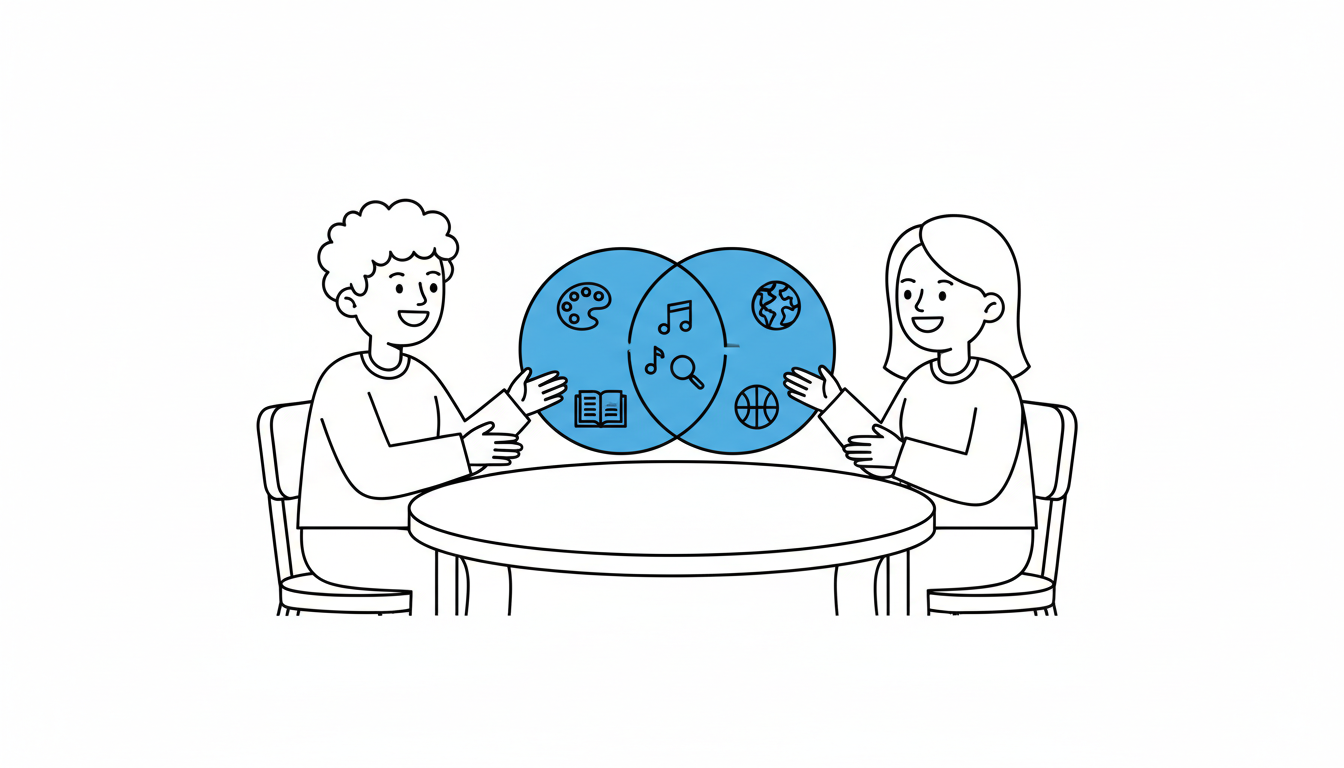
- Elementary (K-5): May need concrete prompts: "Do you have pets? Siblings? Favorite colors?" Use a graphic organizer (Venn diagram)
- Middle/High School (6-12): Can handle abstract comparisons. Challenge them: "No physical appearance differences!"
- College/Adult: Can explore professional or intellectual commonalities/differences
Depth Variations
- Quick (2 min): Just find commonalities
- Standard (3-5 min): Commonalities + differences
- Deep (7-10 min): Commonalities + differences + written reflection or whole-class debrief about what we learned
Online Adaptation
Perfect for Online:
- Breakout rooms for pairs
- Can use shared Google Doc or chat to record findings
- Works just as well virtually as in-person
- Optional: Use Jamboard or collaborative whiteboard for Venn diagram
Troubleshooting
Challenge: Pairs quickly say "We have nothing in common!" Solution: "Keep looking! Everyone has commonalities. Try these categories: family, hobbies, food, places you've been, things you like to do, fears, dreams..." Provide category prompts.
Challenge: Students focus on surface-level physical differences (appearance, race, gender). Solution: Set explicit parameters: "Focus on experiences, interests, preferences, and skills—not physical appearance."
Challenge: Students finish very quickly. Solution: "Great! Now find 3 MORE. Go deeper!" Or: "Now find the most SURPRISING commonality or the most INTERESTING difference."
Challenge: One student dominates; partner doesn't share. Solution: "Take turns. Partner A shares first, then Partner B. Make sure both people talk equally!"
Extension Ideas
- Venn Diagram: Draw a Venn diagram showing commonalities (overlap) and differences (separate circles)
- Gallery Walk: Pairs post their findings on posters around room; class does gallery walk to read others'
- Reflection: "What surprised you? What did you learn about your partner? About yourself?"
- Connect to Content: "We just practiced comparing and contrasting—a critical skill we'll use when we analyze [texts/experiments/historical events/mathematical concepts]."
- Class Data: Compile all commonalities—do any patterns emerge across the whole class?
Related Activities: Two Truths and a Lie, Would You Rather, My Name and A Thing