
Jigsaw
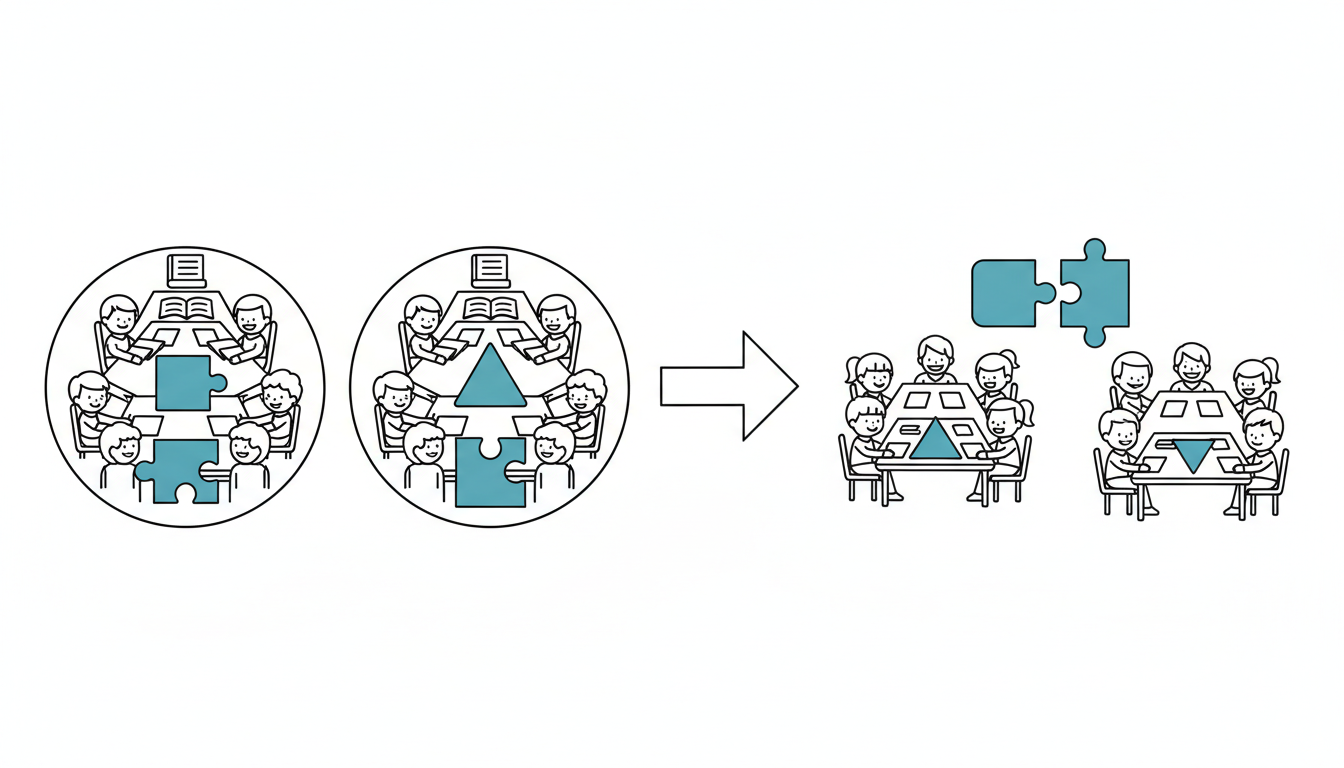
At a Glance
- Time: 10-15 minutes (can extend to 20-30 for complex content)
- Prep: Moderate - divide content into 3-5 segments
- Group: Small groups of 4-5 students
- Setting: Any classroom with moveable seating
- Subjects: Universal - especially effective for text-heavy content
- Energy: Medium to High
Purpose
Jigsaw is a sophisticated cooperative learning strategy that transforms students into teachers. Use it when you have complex content that can be divided into distinct sections and you want to avoid death-by-PowerPoint or tedious whole-class presentations. Each student becomes an expert on one piece of content and is responsible for teaching it to peers. This creates positive interdependence—students need each other to learn the complete picture.
How It Works
Step-by-step instructions:
-
DIVIDE CONTENT INTO PIECES (Before class) - Break the topic into 3-5 distinct segments. Create materials for each segment (readings, videos, problem sets, etc.).
-
FORM HOME GROUPS (1 minute) - Divide class into "home groups" of 4-5 students. These are heterogeneous, mixed-ability groups.
-
ASSIGN EXPERT TOPICS (30 seconds) - Within each home group, assign each member a different expert topic (Expert A, B, C, D, or E). Multiple students across different home groups will share the same expert topic.
-
FORM EXPERT GROUPS (1 minute) - All the "As" form one group, all the "Bs" another, etc. Students move to sit with their expert group.
-
EXPERT GROUPS STUDY (5-7 minutes) - Expert groups study their assigned material together, discuss key points, and prepare to teach it to their home groups. They become the masters of this content.
-
RETURN TO HOME GROUPS (30 seconds) - Students return to their original home groups.
-
TEACH ROUND-ROBIN (6-10 minutes) - Each expert takes turns teaching their segment to their home group members. Home group members take notes and ask clarifying questions.
What to Say
Initial Setup: "We have five important topics to cover today. Instead of me lecturing on all five, you're going to become experts and teach each other. First, count off 1-2-3-4-5 in your home groups. Ones will be Expert A, twos will be Expert B, and so on."
Forming Expert Groups: "Now, all the Expert As, move to the front left corner. Expert Bs, front right. Expert Cs, back left..." [Direct traffic clearly to avoid chaos]
In Expert Groups: "Your job right now is to become the expert on your topic. Read the material, discuss what's most important with your fellow experts, and figure out how you'll explain this to your home group. You have 7 minutes."
Return to Home Groups: "Experts, return to your home groups now. You'll take turns teaching your segment. We'll go in order—Expert A will teach first, then B, then C. Each expert gets 2 minutes to teach. Home group members, your job is to learn from your peers and ask questions."
Closing: "Notice what just happened—you learned five topics, but I only taught zero. You taught each other. That's the power of collaborative learning."
Why It Works
Jigsaw leverages multiple powerful learning principles:
Positive Interdependence: Students cannot succeed individually—they need their groupmates' expertise. This creates genuine collaboration rather than pseudo-group work where one person does everything.
Learning Through Teaching: The best way to learn material is to teach it. When students know they're responsible for teaching others, they process information more deeply.
Individual Accountability: Each student has a unique role. No one can hide or coast—their group is counting on them.
Cognitive Engagement: Students are active throughout—studying, discussing, teaching, questioning—never passive.
Efficiency: Jigsaw allows you to cover more content in less time than traditional lecture, while achieving deeper understanding.
Research Citation: Developed by Elliot Aronson in 1971, Jigsaw has been extensively researched. Meta-analyses show it increases achievement, improves cross-racial/ethnic relations, and develops empathy (Aronson & Patnoe, 2011).
Teacher Tip
The most common Jigsaw mistake is not giving expert groups enough time to truly master their content. If experts feel uncertain, their teaching will be weak, and the whole structure fails. Give expert groups more time than feels comfortable—7-10 minutes. They should leave the expert group confident and prepared. Also, circulate among expert groups during their study time to answer questions and check understanding. Your teaching happens in the expert groups, not in the whole-class phase.
Variations
For Different Subjects
-
Literature: Divide a complex text into sections. Expert groups analyze their section, then teach it to home groups, building a collective understanding of the full text.
-
Science: Each expert group investigates one part of a system (e.g., different organ systems, different planets, different chemical reactions), then teaches it to create a complete picture.
-
History: Different expert groups study different perspectives on the same event (e.g., British, Colonial, Native American views of the American Revolution), then share to build nuanced understanding.
-
Math: Different expert groups master different problem-solving strategies, then teach their method to home groups, showing multiple solution pathways.
For Different Settings
-
Large Class (30+): Jigsaw works beautifully here. You might have 6-7 home groups, each with 5 members, creating 5 expert groups of 6-7 students each.
-
Small Class (12-15): Create 3 home groups with 4 members each, so you have 4 expert groups of 3 students. Smaller numbers work fine.
-
Online: Use breakout rooms. Expert groups go to breakout rooms, then return to home group breakout rooms for teaching.
For Different Ages
-
Elementary (K-5): Use shorter content segments and provide more structure. Give expert groups a worksheet to complete together. Limit to 3 expert topics maximum.
-
Middle/High School (6-12): Standard format works well. Can handle more complex content and self-directed expert group work.
-
College/Adult: Can extend expert group time to 15-20 minutes for complex academic texts or case studies.
Online Adaptation
Tools Needed: Video conferencing with breakout rooms (Zoom, Google Meet) + shared digital materials (Google Docs, PDFs in LMS)
Setup: Pre-assign students to home groups and expert topics before class. Share materials digitally.
Instructions:
- Brief students on Jigsaw process in main room
- Send expert groups to designated breakout rooms (name rooms "Expert A," "Expert B," etc. for clarity)
- After 7-10 minutes, close expert rooms and reassign students to home group breakout rooms
- Each home group teaches round-robin style
- Return to main room for debrief
Pro Tip: In online Jigsaw, provide a shared Google Doc template for each expert group to complete together. This document becomes their "teaching notes" when they return to home groups.
Troubleshooting
Challenge: Some expert groups finish way earlier than others and sit idle.
Solution: Build in an extension task: "Once your group has mastered the content, create three quiz questions you could ask to assess whether someone else understood your topic."
Challenge: When one expert returns to the home group unprepared, the entire group's learning suffers.
Solution: Circulate actively during expert group time. Assess each group's readiness. If needed, extend expert time for struggling groups or briefly teach them yourself before they return to home groups.
Challenge: Teaching takes longer than planned, and you run out of time.
Solution: Set a timer for each expert and hold students accountable. "Expert A, you have 2 minutes starting... now." When time is up, move to the next expert even if they're mid-sentence. This keeps energy high and ensures all content gets covered.
Extension Ideas
-
Deepen: Add an assessment at the end where students individually answer questions covering all topics, showing they learned from their peers.
-
Connect: Use "Jigsaw Part 2" the next day: regroup with different home groups and compare notes across groups to deepen understanding.
-
Follow-up: Have students create a synthesis product: "Now that you've learned all five topics, create a concept map showing how they're interconnected."
Related Activities: Gallery Walk, Rotating Trios, Expert Interviews