
Balloon Physics
At a Glance
- Time: 3-4 minutes
- Prep: Minimal (1-2 inflated balloons)
- Group: Whole class or groups of 8-12
- Setting: Any classroom with adequate ceiling clearance
- Subjects: Science (physics), adaptable to other subjects
- Energy: High
Purpose
Combine physical activity with verbal explanation by challenging students to keep a balloon aloft while simultaneously explaining physics concepts (or other content), creating dual-task processing that strengthens understanding through embodied practice while maintaining high energy and engagement through playful competition.
How It Works
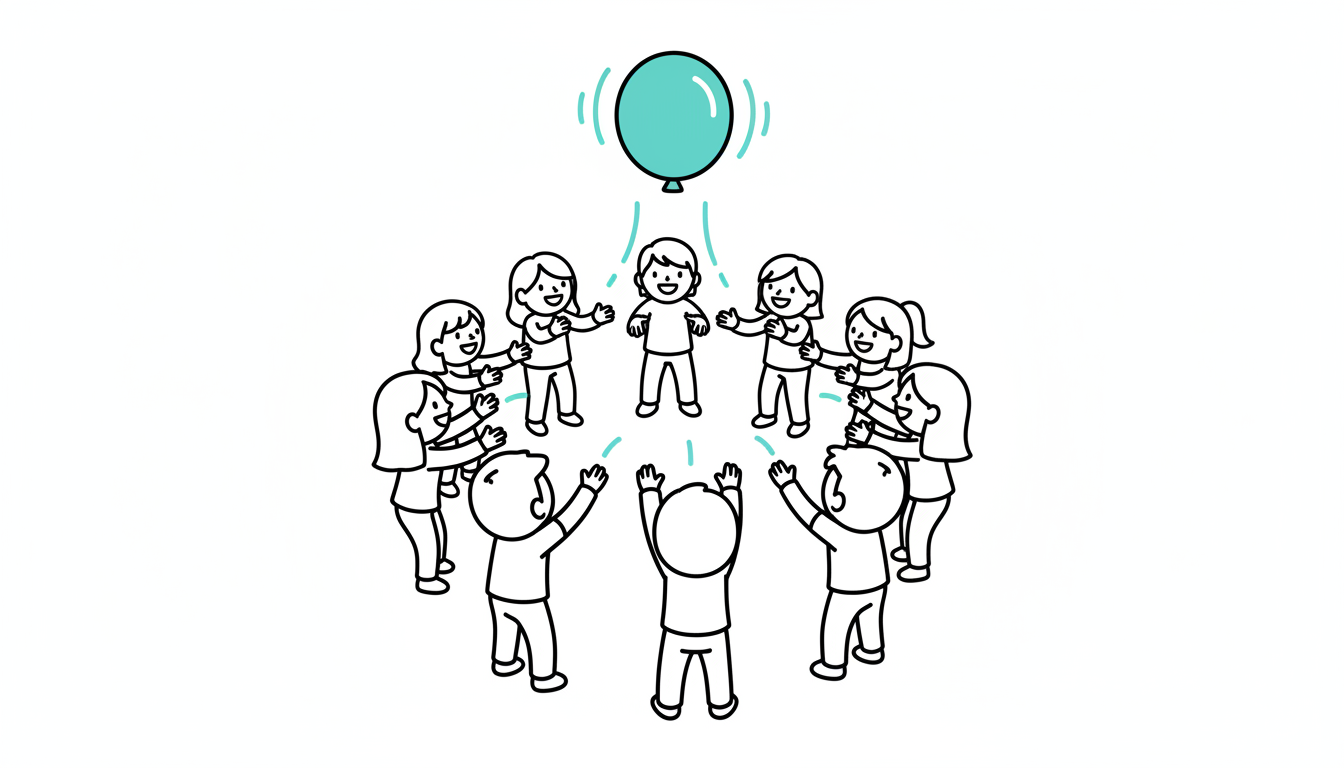
- Form circle (20 sec) - Students stand in circle (or divide into multiple circles for large class)
- Introduce challenge (20 sec) - "Keep the balloon in the air by tapping it. Each time you hit it, you must say one fact about [force/motion/energy/our current topic]. No repeats!"
- Start balloon (2-3 min) - Toss balloon into circle; students tap it while calling out facts
- Add complexity (optional, 30 sec) - Add second balloon or require complete sentences instead of single words
- Quick debrief (30 sec) - "What physics concepts did we just experience? How did the balloon demonstrate [force/gravity/air resistance]?"
What to Say
Opening: "Form a circle. We're going to keep this balloon in the air while reviewing physics concepts. Each time you tap the balloon, shout out one fact about force and motion. Let's see how long we can keep it up and how many facts we can recall! Ready? Go!"
During: "Keep it up! No repeats! If you can't think of a new fact, just keep the balloon moving for someone else!"
Adding challenge: "Let's add a second balloon! Now you need to track two and still call out facts!"
Debrief: "Great energy! Let's connect this to what we just learned. When you tapped the balloon upward, what force were you applying? What force was pulling it back down? How did air resistance affect the balloon's movement?"
Why It Works
This activity engages multiple cognitive processes simultaneously: motor planning (hitting the balloon), spatial reasoning (predicting trajectory), and semantic retrieval (recalling facts). The dual-task demand strengthens neural pathways between declarative knowledge (facts about physics) and procedural knowledge (experiencing physical forces). The playful competition activates dopamine systems that enhance memory consolidation, while the balloon's slow, floating movement provides ample think time between hits—creating a perfect balance of challenge and achievability (Ratey, 2008).
Research Citation: Exercise and cognitive function (Ratey & Hagerman, 2008)
Teacher Tip
This works surprisingly well as a review tool for ANY subject, not just physics. History balloon: "Each tap, name an event from the Revolutionary War!" Vocabulary balloon: "Each hit, use today's vocabulary word in a sentence!" The balloon is just the engagement mechanism—the learning happens through retrieval practice. Also, underinflate the balloon slightly; it floats slower, giving students more thinking time.
Variations
For Different Subjects
- Math: Call out multiples of 7, state properties of quadrilaterals, or give equations equal to a target number
- Humanities: Name historical figures, state themes from a novel, list vocabulary words with definitions
- Science: Physics (forces, energy), biology (parts of cell, body systems), chemistry (elements, compounds)
- Universal: Vocabulary, study guide facts, definitions, formulas, chronological events
For Different Settings
- Large Class (30+): Multiple simultaneous circles of 8-10 students each with one balloon per group
- Small Group (5-15): One circle; can use beach ball for larger groups or balloon for intimate groups
For Different Ages
- Elementary (K-5): Simpler prompts (name colors, count by 5s, name animals); beach ball instead of balloon for easier hitting
- Middle/High School (6-12): Complex facts requiring full sentences; can add rule that facts must connect to previous person's fact
- College/Adult: Highly technical vocabulary; require explanations not just terms; can add philosophy balloon where each hit includes an argument or counterargument
Online Adaptation
Tools Needed: This activity doesn't translate well to purely virtual settings
Alternative: Use a "virtual hot potato" where a shared object (virtual background, filter, or chat message) is "passed" between students randomly, and whoever has it must share a fact before passing it on. Or use online collaborative whiteboard where students must add a fact to keep a virtual balloon bouncing on screen.
Pro Tip: If any students are together physically in hybrid learning, they can do balloon physics in breakout room while others watch via camera and shout facts from home.
Troubleshooting
Challenge: Balloon escapes circle or gets stuck on ceiling/furniture Solution: Establish boundaries: "If balloon leaves our circle, nearest person grabs it and tosses it back in—no penalty." Have backup balloon ready. For ceiling-stick situations, have long stick or ruler available for retrieval.
Challenge: Same students dominate; others don't participate Solution: Add rule: "You can't hit the balloon twice in a row—must let at least one other person hit between your turns." Or: "Each person must hit at least once before anyone can go twice."
Challenge: Students repeat facts or give incorrect information Solution: Assign a "fact checker" role to 1-2 students not in the circle who track what's been said and verify accuracy. Rotate this role.
Extension Ideas
- Deepen: "Explanation balloon" - instead of single facts, each tap requires explaining HOW two concepts connect
- Connect: Physics analysis afterward - "Calculate how much force we applied, estimate the balloon's velocity, identify all forces acting on the balloon during our game"
- Follow-up: Students write physics lab report analyzing balloon behavior observed during activity, including calculations and diagrams
Related Activities: Ball Pass Review, 5-4-3-2-1 Movement, Machines