
Energy Shift
At a Glance
- Time: 30-90 seconds
- Prep: None
- Group: Whole class
- Setting: Any classroom
- Subjects: Universal
- Energy: Variable (strategic—can raise or lower energy)
Purpose
Intentionally shift classroom energy level up or down to match the needs of the next learning activity, using brief movement or stillness exercises to modulate arousal and attention, teaching students that energy is manageable rather than fixed while creating optimal readiness state for different task types.
How It Works
- Assess current energy (5 sec) - Teacher gauges room: too low? too high? just right?
- Announce shift direction (10 sec) - "Energy is dragging. We're shifting UP" or "Energy is too high. We're shifting DOWN."
- Execute shift activity (30-60 sec) - Lead brief exercise matched to desired direction
- Confirm shift (10 sec) - "How do we feel now? Better match for [next activity]? Let's go."
Energy Shift Strategies:
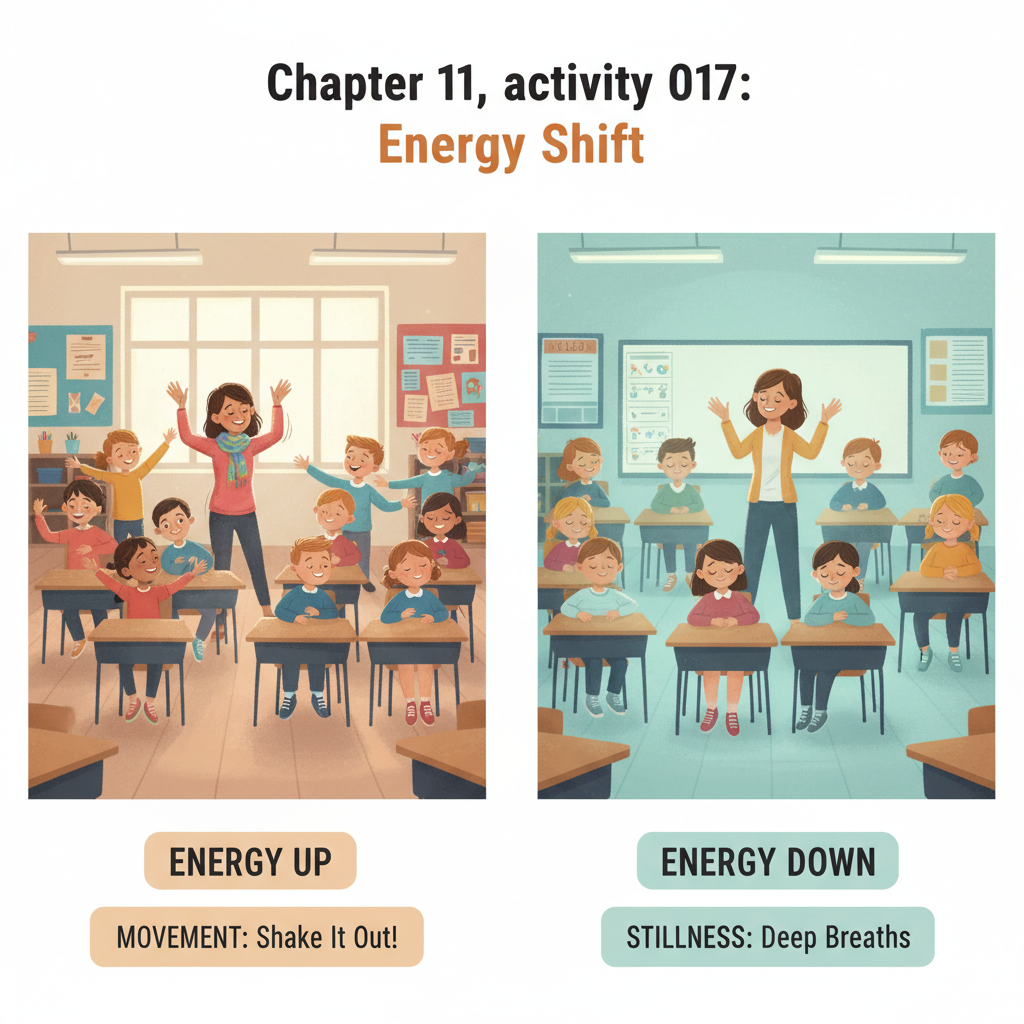
Shift UP (increase energy):
- Fast movements: jumping jacks, arm circles, shake-outs
- Loud vocalizations: countdown shouts, cheers
- Competitive elements: speed challenges
Shift DOWN (decrease energy):
- Slow movements: stretches, gentle sways
- Deep breathing: 4-7-8 breath, box breathing
- Quiet focus: mindful moment, stillness
What to Say
Opening (shift UP example): "I'm noticing energy is really low right now—we're all a bit sluggish. We need to shift energy UP because we're about to do a group activity that requires alertness. Stand up. We're doing 30 seconds of fast arm circles. Ready? Go!"
Opening (shift DOWN example): "Energy is bouncing off the walls right now. We need to shift DOWN because our next task requires quiet focus. Everyone sit. Close your eyes. Three slow, deep breaths with me. Breathe in... hold... out..."
Closing: "Energy shift complete. We were [too low/too high]; now we're at the right level for [next activity]. Let's use this energy effectively."
Why It Works
Arousal level—physiological and psychological activation—affects task performance (Yerkes-Dodson Law): low arousal impairs performance on active tasks; high arousal impairs performance on complex/focused tasks. Energy shifts provide intentional arousal regulation, moving students toward the optimal activation level for upcoming work. This also builds metacognitive awareness: students learn to notice their energy state and understand that they can actively change it rather than being at its mercy. Naming the shift ("We're shifting UP") makes the process explicit and empowering.
Research Citation: Arousal and performance (Yerkes & Dodson, 1908)
Teacher Tip
The key is diagnosing energy correctly before choosing shift direction. Don't default to "shift up"—sometimes the room needs calming, not energizing. Watch for cues: Are students slumped and yawning? Shift up. Are they chatty and scattered? Shift down. Match the intervention to the diagnosis.
Variations
Different Shift Directions
UP (energizing):
- Fast movements: Jumping jacks, high knees, speed stretches
- Loud sounds: Clapping, stomping, cheering
- Competition: Who can do X fastest? Race against timer.
DOWN (calming):
- Slow movements: Stretches, tai chi motions, swaying
- Quiet focus: Deep breathing, silent counting, mindfulness
- Stillness: Freeze in position, hold balance pose
NEUTRAL (reset without changing level):
- Stand and sit three times
- Roll shoulders forward and back
- Close eyes, open eyes
Different Activity Pairings
Before high-energy activity (group work, discussion): Shift UP Before focused work (test, reading, writing): Shift DOWN Before presentation or performance: Shift UP (alertness) then DOWN (calm nerves)
Different Ages
- Elementary (K-5): Name energy levels playfully ("We're at turtle level; we need to get to cheetah level!")
- Middle/High School (6-12): Use straightforward language ("Our energy doesn't match what we're about to do—let's adjust")
- College/Adult: Frame as performance optimization and self-regulation skill
Online Adaptation
Tools Needed: Webcam/audio
Setup: Students at home with space to move
Instructions:
- Assess energy via student engagement cues (camera body language, chat activity)
- "We need to shift energy [up/down]. Here's what we're doing..."
- Lead activity on camera (stand and do jumping jacks for UP; sit and breathe deeply for DOWN)
- Students follow along at home (cameras optional)
- "Energy shifted. Let's continue."
Pro Tip: Use music as energy shifter online—play 30 seconds of upbeat track (shift up) or calming track (shift down) and have students move or breathe accordingly.
Troubleshooting
Challenge: Students resist energy shifts; claim they're "fine" at current level Solution: Explain rationale: "I'm not saying you're doing anything wrong. I'm saying our current energy doesn't match what we're about to do. This is strategic—like warming up before sports. Trust me."
Challenge: Energy shift doesn't work; room still feels too low or too high after intervention Solution: Do a second, longer shift: "That helped but not enough. Let's do one more minute." Sometimes initial shift is insufficient; be flexible and extend.
Challenge: Difficult to diagnose room's energy accurately; unsure which direction to shift Solution: Ask students: "Quick check—on a scale of 1-10, what's your energy level right now?" Or: "Do you need to wake UP or calm DOWN right now?" Metacognitive check-in makes diagnosis explicit.
Extension Ideas
- Deepen: Energy tracking—chart class energy at different times of day/week; identify patterns and plan shifts proactively
- Connect: Student self-regulation—teach students to notice their own energy and choose personal shift strategies (homework break = walk, test anxiety = breathing)
- Follow-up: Metacognitive discussion: "Why does energy matter for learning? What activities require high energy vs. low energy? How can you manage your energy outside school?"
Related Activities: Shake It Off, Breathing Break, Energy Check