
Micro-Movement
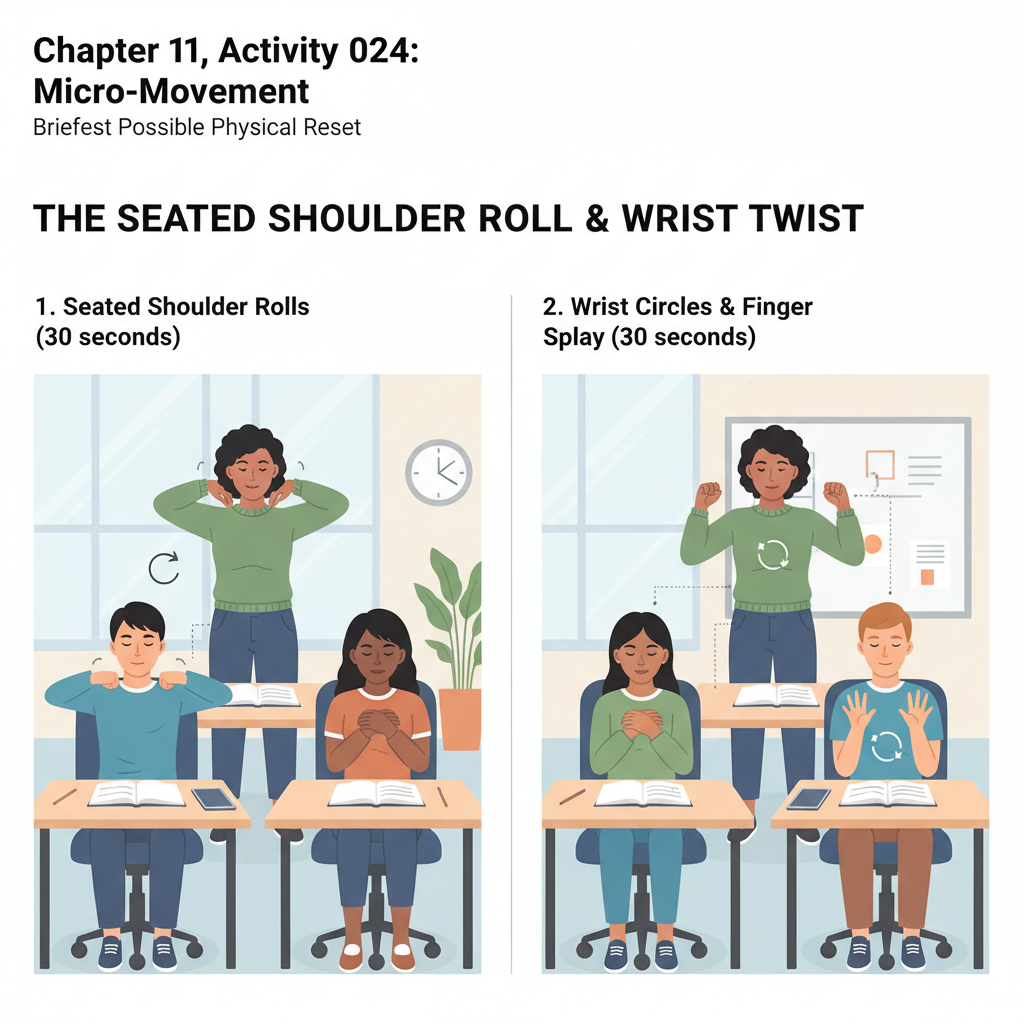
At a Glance
- Time: 15-30 seconds
- Prep: None
- Group: Whole class (individual movements)
- Setting: Any classroom (at desks)
- Subjects: Universal
- Energy: Low-Medium
Purpose
Provide the briefest possible physical reset using tiny movements that activate muscles and increase circulation without requiring students to leave seats or create disruption, demonstrating that even minimal movement—10-20 seconds of seated or standing micro-movements—provides cognitive and physical benefits, making movement accessible even in constrained environments.
How It Works
- Announce micro-movement (3 sec) - "Micro-movement. [Specific action]. 15 seconds. Go."
- Students perform movement (15-20 sec) - Execute simple, contained movement at/near desk
- Stop (2 sec) - "Stop. Feel different? Good. Back to work."
Micro-Movement Options (15-30 seconds each):
Seated:
- Shoulder shrugs: Raise shoulders to ears, hold 2 sec, release (repeat 5x)
- Ankle circles: Circle ankles clockwise, then counterclockwise (10 sec each)
- Seated twists: Twist torso left and right gently (10x)
- Hand squeezes: Make tight fists, hold 5 sec, release (repeat 3x)
- Neck rolls: Slowly roll neck in circle (5 sec each direction)
Standing (at desk):
- Rise and sit: Stand up, sit down (repeat 5x)
- Toe raises: Rise up on toes, lower (10-15x)
- Knee lifts: Lift knees alternately toward chest (10-15x)
- Arm circles: Small circles forward/backward (10 sec each)
What to Say
Opening: "Everyone—right now—shoulder shrugs. Raise your shoulders to your ears like you're saying 'I don't know.' Hold... and release. Again. Up... and down. Five times total. Go."
During: [Count or time silently. Watch students perform movement.]
Closing: "Stop. Blood flowing? Muscles awake? That was 15 seconds. Back to [task]."
Why It Works
Even minimal physical movement interrupts prolonged static postures that impair circulation and glucose metabolism (Hamilton et al., 2008). Micro-movements activate muscle contractions that pump blood back to the heart and brain, improving oxygen delivery and metabolic waste removal. Brief movement also triggers mild sympathetic nervous system activation, increasing alertness without overwhelming arousal. The key insight: duration matters less than frequency—brief movements every 20 minutes are more effective than one long break per hour. Micro-movements make high-frequency movement realistic in time-constrained classrooms.
Research Citation: Sedentary behavior and metabolism (Hamilton et al., 2008)
Teacher Tip
Keep it FAST. Micro-movements lose effectiveness if they take 2-3 minutes. Announce, execute, stop—under 30 seconds total. No explanation, no setup. "Ankle circles, 20 seconds, go." Done. Speed maintains momentum and prevents disruption to learning flow.
Variations
Different Movement Types
Upper body (seated):
- Shoulder shrugs, rolls
- Arm circles (small)
- Hand/wrist circles
- Neck stretches (gentle)
Lower body (seated):
- Ankle circles
- Leg extensions (straighten knee, hold, lower)
- Foot taps (rapid alternate tapping)
- Knee lifts (seated)
Core (seated):
- Seated twists
- Side bends
- Gentle seated cat-cow spine movements
Full body (standing at desk):
- Rise-and-sit
- Toe raises
- Alternating knee lifts
- Quick marching in place
Different Durations
- Ultra-micro (10 sec): Single movement type, minimal reps
- Standard micro (15-30 sec): Single movement type, full reps
- Extended micro (30-45 sec): Two movement types in sequence
Different Ages
- Elementary (K-5): Playful micro-movements (wiggle like jelly, scrunch face, shake hands like drying them)
- Middle/High School (6-12): Quick, no-nonsense movements; efficient
- College/Adult: Professional framing ("circulation break"); optional but recommended
Online Adaptation
Tools Needed: None (verbal instruction only)
Setup: Students at home workspaces
Instructions:
- "Micro-movement: shoulder shrugs, 20 seconds, starting now"
- Teacher models on camera (optional)
- Students perform at home (cameras optional)
- "Stop. Back to work."
Pro Tip: For online classes, visual timer on screen keeps micro-movement brief and maintains accountability.
Troubleshooting
Challenge: Students resist micro-movements, claim they "don't need it" or it's "pointless" Solution: Explain physiology: "Your brain needs oxygen. Blood delivers oxygen. Movement pumps blood. 20 seconds now = better focus for 20 minutes. Non-negotiable." Frame as performance optimization, not fun break.
Challenge: Micro-movements feel too brief; students complain it's "not enough" Solution: Correct expectation: "This isn't a workout—it's a reset. Brief frequent movement beats long infrequent movement. We'll do another in 20 minutes." Emphasize cumulative effect.
Challenge: Difficult to remember to cue micro-movements regularly; teacher forgets Solution: Set timer on phone for every 20-25 minutes. When it vibrates, cue micro-movement. After 2-3 weeks, it becomes automatic habit.
Extension Ideas
- Deepen: Micro-movement menu—post list of 10 options on wall; teacher or student calls out different one each time
- Connect: Student-led micro-movements—rotate leadership; different student chooses and leads movement each session
- Follow-up: Self-initiated micro-movements—teach students to notice their own need for movement and do micro-movements independently during work time
Related Activities: Stretch Break, Desk Exercises, Stand-and-Stretch Signal