
Concentric Circles / Speed Networking
At a Glance
- Time: 5-8 minutes
- Prep: Minimal - need space for two circles
- Group: Pairs (rotating partners)
- Setting: Requires open space for movement
- Subjects: Universal - especially effective for review and brainstorming
- Energy: High
Purpose
Concentric Circles (also called Speed Networking or Inside-Outside Circle) is a dynamic structure that facilitates many short, focused conversations in a compressed time frame. Use it when you want students to share ideas with multiple peers quickly, practice explaining concepts repeatedly, or review material from diverse perspectives. The constant rotation creates high energy and ensures every student speaks with many classmates, not just their usual friend group.
How It Works
Step-by-step instructions:
-
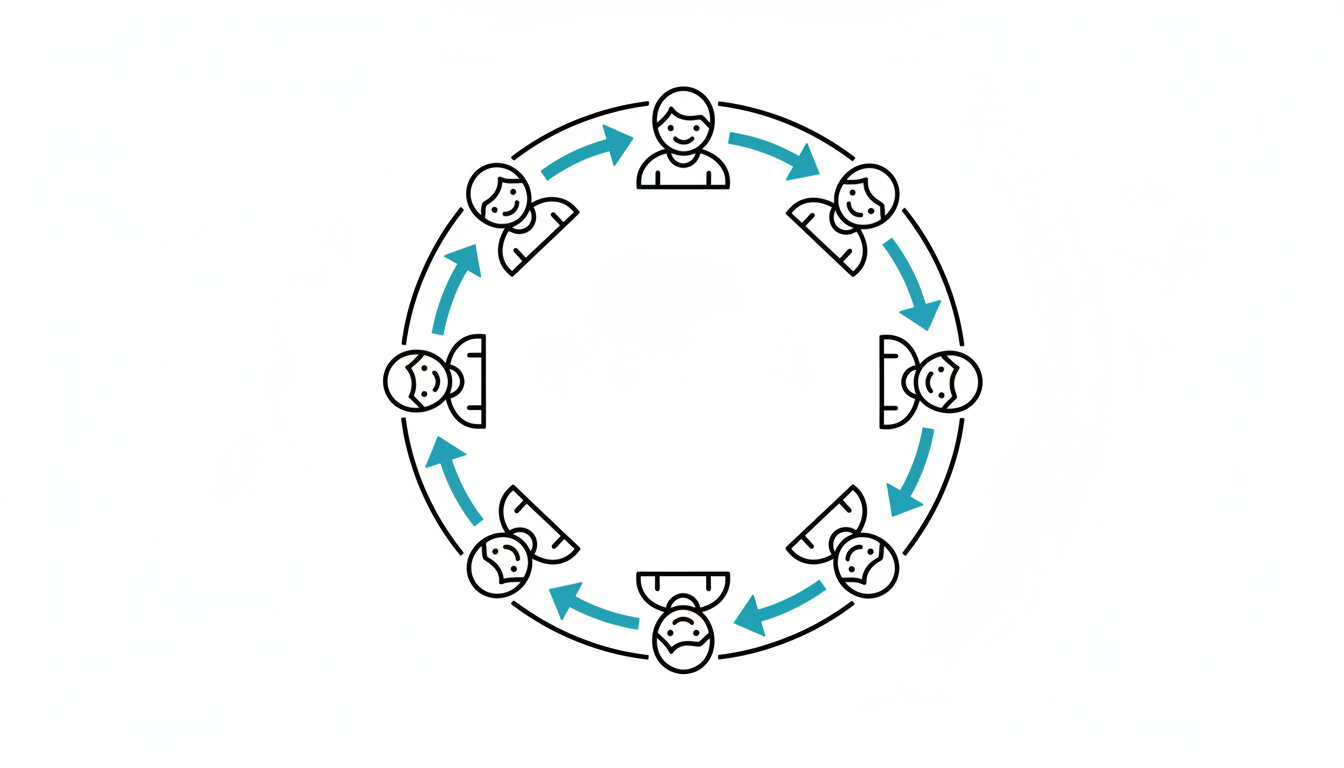
FORM TWO CIRCLES (1 minute) - Divide class in half. One half forms an inner circle facing outward. The other half forms an outer circle facing inward. Each person in the inner circle should face a partner in the outer circle.
-
POSE FIRST PROMPT (10 seconds) - Give a question or discussion topic.
-
FIRST DISCUSSION (45-60 seconds) - Partners discuss the prompt. You can structure it ("Inner circle person shares first for 30 seconds, then outer circle person") or leave it open.
-
SIGNAL ROTATION (5 seconds) - Use a clear signal: "Outer circle, rotate clockwise to the next person."
-
OUTER CIRCLE ROTATES (10 seconds) - Only the outer circle moves. Each person shifts one position clockwise. Inner circle stays still.
-
POSE NEXT PROMPT (10 seconds) - Give a new question or topic (or continue with the same one).
-
REPEAT CYCLE - Continue the pattern: discuss, rotate, new prompt. Aim for 4-6 rotations total.
-
DEBRIEF (1 minute) - Bring the class together and ask: "What interesting ideas did you hear?"
What to Say
Setup: "Everyone stand up. Count off: 1-2-1-2-1-2. All the ones, come form a circle facing outward [demonstrate]. All the twos, form a circle around them facing inward, so you're facing a partner. This is called Concentric Circles."
First Prompt: "Here's your first question: [POSE QUESTION]. Inner circle, you'll share first for 30 seconds. Then outer circle shares for 30 seconds. Ready? Inner circle, begin."
Rotation: "Stop. Outer circle, rotate clockwise one person. You now have a new partner. Here's your next question: [NEW PROMPT]. This time, outer circle shares first. Begin."
After Several Rotations: "Last rotation—move clockwise one more person. For this round, I want you to share the most interesting idea you heard from a PREVIOUS partner. Begin."
Debrief: "Return to your seats. What themes did you notice across the conversations? What idea came up multiple times?"
Why It Works
Concentric Circles harness multiple powerful learning mechanisms:
Distributed Practice: Students encounter the same concept or question multiple times with different partners, which strengthens memory through repeated retrieval and elaboration.
Perspective Accumulation: Each conversation exposes students to a new viewpoint, building a richer, more nuanced understanding than they could develop alone.
Social Fluency: Shy students benefit from low-stakes practice talking to many peers in quick succession. The time constraint removes pressure.
Physical Movement: Standing and rotating combats cognitive fatigue. The kinesthetic element boosts engagement and attention.
Efficiency: In 6 minutes with 5 rotations, every student has 5 different conversations—far more interaction than traditional discussion allows.
Research Citation: This technique builds on speed-dating research showing that brief, structured conversations efficiently facilitate connection and information exchange. Educational applications show increased participation and content retention (Kagan, 1994).
Teacher Tip
The first time you use Concentric Circles, students will be confused about who moves and which direction. This is normal. Just laugh, reset, and clarify: "Only the outer circle moves. Inner circle, you're stationary—plant your feet." After one awkward first try, it becomes second nature. Also, make sure you have an even number of students. If you have an odd number, jump in as a participant yourself or create one trio.
Variations
For Different Subjects
-
Math: Each rotation poses a new problem. Students explain their solution strategy to a new partner each time.
-
Language Arts: Quote analysis—each rotation discusses a different quote from the text.
-
Science: Review concepts—each rotation covers a different topic from the unit.
-
Foreign Language: Conversation practice—each rotation uses a different discussion prompt in the target language.
For Different Settings
-
Large Class (30+): Works beautifully. You'll have 15 people per circle, so 15 rotations possible (though 5-6 is usually enough).
-
Small Class (10-15): Still effective with smaller circles of 5-8 per circle.
-
Limited Space: Use "Lines" instead of circles—two lines of students face each other. One line shifts down after each rotation.
For Different Ages
-
Elementary (K-5): Keep rotations to 30 seconds each, and use concrete, simple prompts. Model the rotation pattern multiple times before starting.
-
Middle/High School (6-12): Standard 60-second rotations work well. Students enjoy the social energy of this activity.
-
College/Adult: Can extend to 90-second rotations for more complex conceptual discussions.
Online Adaptation
Tools Needed: Video conferencing with breakout rooms (Zoom)
Setup: Pre-assign students to "Inner Circle" and "Outer Circle" groups.
Instructions:
- Manually create breakout room pairs (one inner + one outer circle person per room)
- Send pairs to breakout rooms for 60 seconds
- Bring everyone back
- Re-pair: keep inner circle fixed, rotate outer circle members (each outer person gets matched with the next inner person alphabetically)
- Repeat 4-6 times
Pro Tip: Online Concentric Circles requires more manual management than in person, but it works. Alternatively, use a simpler method: rapid-fire breakout rooms with Zoom's "auto-assign" feature, accepting that students won't necessarily talk to "everyone" but will still have multiple conversations.
Troubleshooting
Challenge: The circles get misaligned and some people don't have a partner.
Solution: Pause and reset: "Everyone freeze. Inner circle, take one step closer together to tighten your circle. Outer circle, spread out evenly around them." Physical adjustment fixes this quickly.
Challenge: Students finish their discussion in 20 seconds and stand awkwardly waiting for rotation.
Solution: Give two-part prompts: "First, share your answer. Then, ask your partner a follow-up question about their answer." The question requirement extends discussion time.
Challenge: The same students dominate every conversation, leaving partners little airtime.
Solution: Structure the turns explicitly: "Inner circle talks for 30 seconds while outer circle listens. Then switch—outer circle talks for 30 seconds." Use a timer audibly so everyone hears when to switch.
Extension Ideas
-
Deepen: Final rotation synthesis task: "For this last conversation, don't answer the question yourself. Instead, compare what you heard from your previous four partners. What did they agree on? Where did they disagree?"
-
Connect: Use progressive prompts that build on each other: Rotation 1 = Define the term. Rotation 2 = Give an example. Rotation 3 = Explain why it matters. Rotation 4 = Connect it to another concept.
-
Follow-up: Written reflection: "You spoke with five classmates. Whose idea most challenged or changed your thinking? Why?"
Related Activities: Speed Networking, Pair-Share-Repeat, Four Corners