
Silent Collaboration
At a Glance
- Time: 5-8 minutes
- Prep: Minimal - chart paper or shared document
- Group: Small groups (3-5 students)
- Setting: Any classroom
- Subjects: Universal - brainstorming and idea generation
- Energy: Low to Medium
Purpose
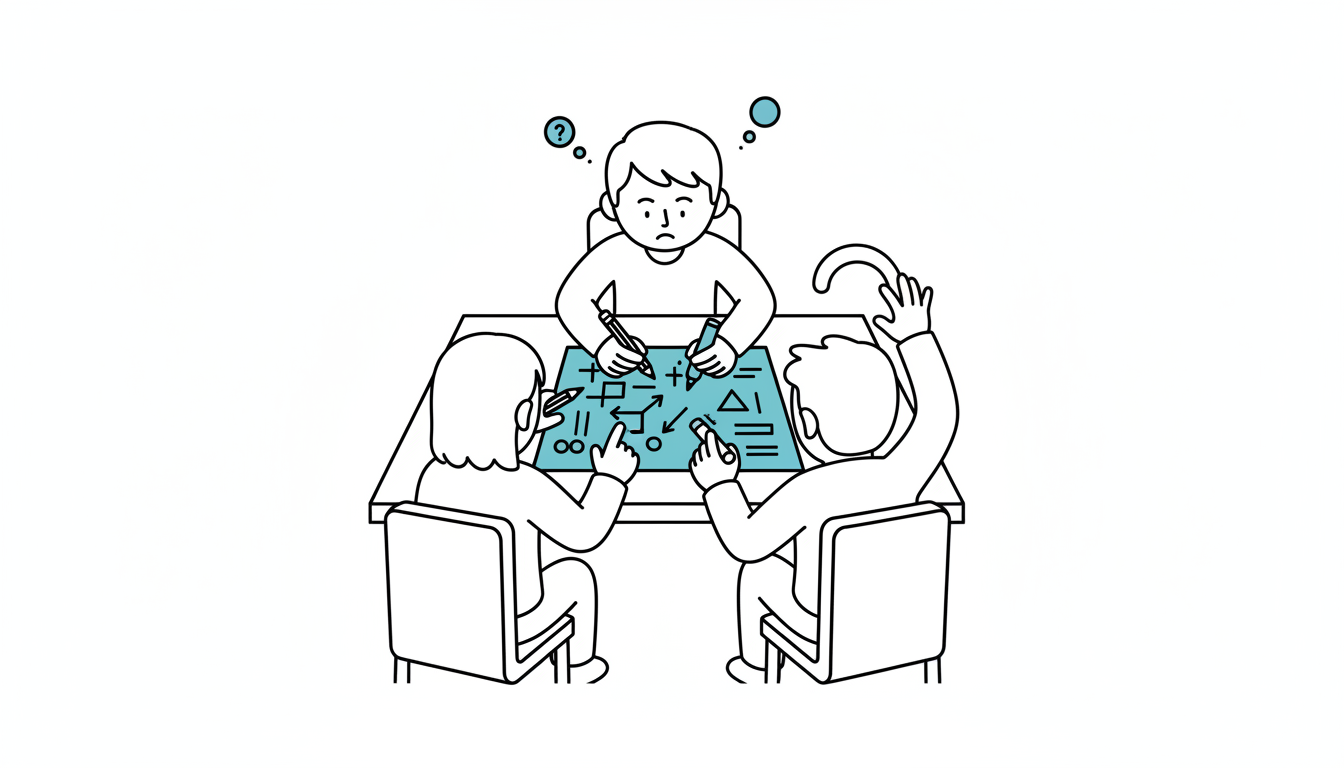
Silent Collaboration requires groups to work together WITHOUT talking—all communication happens through writing, drawing, or gestures. Use this when you want to include quieter students who might be overshadowed in verbal discussions, practice written communication skills, or create a focused, calm brainstorming environment. The constraint of silence often produces surprising creativity.
How It Works
Step-by-step instructions:
-
SET SILENCE RULE (30 seconds) - Explain that for the next 5-7 minutes, absolutely NO talking is allowed.
-
POSE TASK (30 seconds) - Give a problem to solve, question to answer, or concept to explore.
-
PROVIDE SHARED SPACE (15 seconds) - Give each group one large sheet of paper and multiple markers OR access to a shared digital document.
-
SILENT WORK (5-7 minutes) - Groups work together silently, writing, drawing, pointing, nodding, but never speaking. They build on each other's contributions visually.
-
BREAK SILENCE (10 seconds) - Signal that talking is now allowed.
-
DEBRIEF (2-3 minutes) - Groups share what they created and reflect on the silent collaboration experience.
What to Say
Setup: "We're doing Silent Collaboration. For the next 7 minutes, NO talking. Not a single word. Not even whispers. All communication happens through writing, drawing, or gestures. Here's your task: [STATE TASK]. You have one sheet of paper and markers. Work together in silence. Begin."
During: [Enforce silence strictly. If someone speaks, give a gentle reminder gesture—finger to lips. Otherwise, circulate silently and observe.]
Break Silence: "You may now speak. Take 30 seconds in your group to verbally discuss what you created."
Debrief: "What was challenging about working silently? What was surprisingly easy? Did you come up with ideas you wouldn't have in a verbal discussion?"
Why It Works
Silent Collaboration changes group dynamics in powerful ways:
Equity of Participation: Verbal extroverts can't dominate. Everyone's ideas appear equally on the page.
Deep Thinking: Without the pressure to speak quickly, students think more carefully before contributing.
Visual Communication: Some students express themselves better through drawing or writing than through speaking.
Focus: Silence creates a calm, focused environment free from the chaos of simultaneous conversations.
Novelty: The unusual constraint makes the activity memorable and engaging.
Research Citation: Research on think-alouds vs. silent problem-solving shows that silence can reduce cognitive load and allow for deeper processing (Ericsson & Simon, 1993).
Teacher Tip
The first time you do this, students will test the boundaries—giggling, mouthing words, almost-talking. Be firm and playful: "Complete silence. Treat this like a game—can you communicate everything you need to without sound?" After one awkward minute, they'll settle into the challenge and creativity will flow.
Variations
For Different Subjects
- Math: Solve a multi-step problem silently on shared paper, showing all work visually.
- Science: Design an experiment silently—diagram the setup, label variables, show procedure.
- Literature: Create a character map or theme web silently.
- Any Subject: Brainstorm causes, effects, examples, connections—all without speaking.
For Different Settings
- Online: Use shared Google Doc or Jamboard. Turn off cameras and microphones for full silence effect.
For Different Ages
- Elementary (K-5): Keep shorter (3-5 minutes). Allow more drawing and fewer words.
- Middle/High School (6-12): Standard format works perfectly.
- College/Adult: Can extend to 10 minutes for complex tasks.
Online Adaptation
Tools Needed: Google Docs, Jamboard, or Miro
Setup: Create shared document/canvas for each group.
Instructions:
- Send students to breakout rooms
- Enforce silence: "Turn off microphones. No using the chat feature to talk. Only type/draw in the shared document."
- Monitor breakout rooms to ensure silence
- After time ends, allow verbal discussion
Pro Tip: Virtual silence is actually easier to enforce than in-person—you can mute everyone.
Troubleshooting
Challenge: Students break the silence rule repeatedly.
Solution: Make it a competition: "Let's see which group can complete the entire activity in perfect silence. No points for talking!" Gamification increases compliance.
Challenge: Without talking, groups struggle to coordinate who does what.
Solution: That's the point! Let them struggle briefly, then they'll figure out nonverbal communication strategies—pointing, gesturing, drawing arrows, building on each other's work organically.
Challenge: The shared paper becomes messy and disorganized.
Solution: That's okay! The messiness reflects authentic collaborative thinking. In the debrief, ask: "How could you have organized this better silently?"
Extension Ideas
-
Deepen: After silent collaboration, have groups organize their messy ideas into a coherent presentation—now WITH talking.
-
Connect: Compare silent and verbal collaboration: Do the same task twice with different topics—once silently, once with talking. Reflect on differences.
-
Follow-up: Individual written reflection: "One advantage of silent collaboration was... One disadvantage was... One strategy we used to communicate without words was..."
Related Activities: Graffiti Wall, Board Rotation, Circle of Voices