
Learning Strategy Sharing
At a Glance
- Time: 3-4 minutes
- Prep: None
- Group: Pairs or small groups of 3-4
- Setting: Any classroom
- Subjects: Universal - works for any content area
- Energy: Low
Purpose
Build students' metacognitive awareness and expand their repertoire of learning strategies by having them explicitly share study techniques that work for them, creating a peer-to-peer knowledge base of practical approaches while helping students recognize that effective learning involves intentional strategy selection, not just effort.
How It Works
- Pose the prompt (15 sec) - "Think of one study technique or learning strategy that really works for you. It could be how you memorize, how you organize notes, how you prepare for tests—anything that helps you learn."
- Individual reflection (60 sec) - Students think silently about their most effective personal strategy
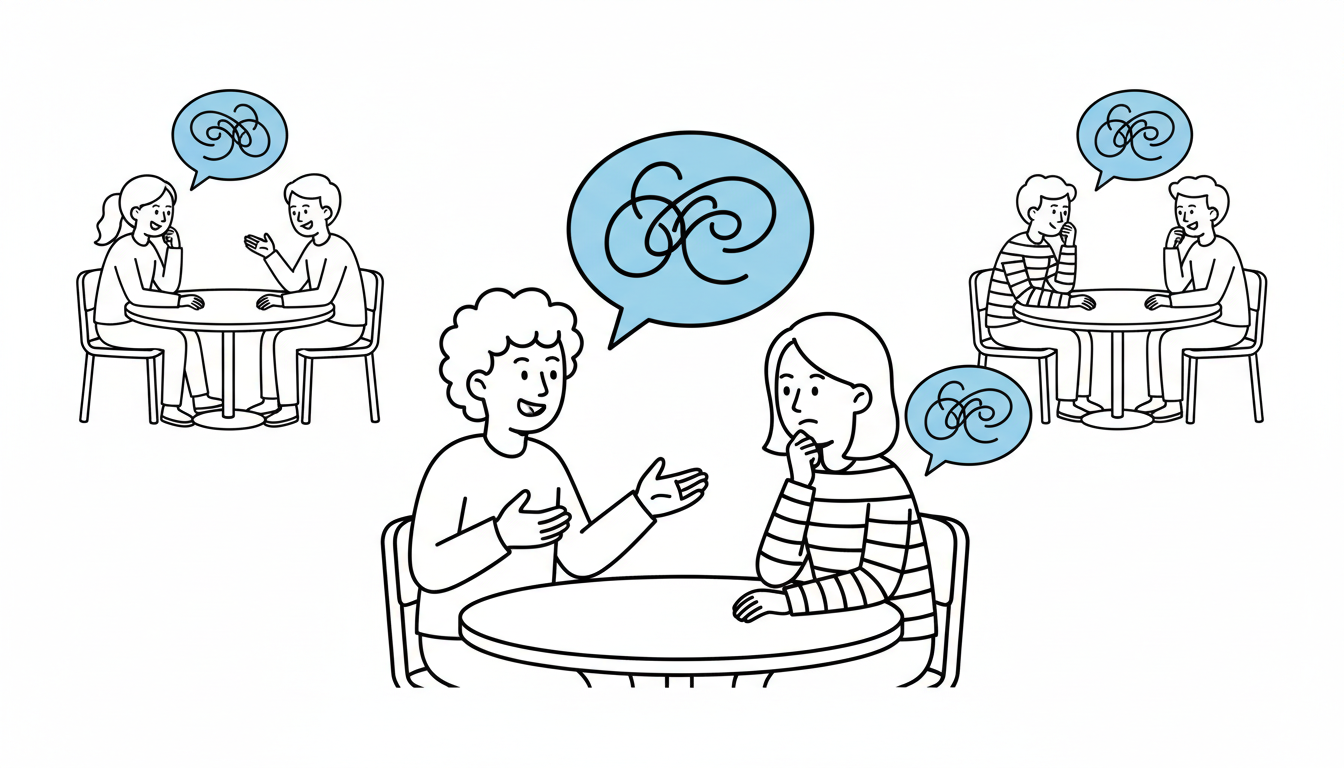
- Pair/group sharing (2-3 min) - Students share their strategy with partner or small group, explaining specifically what they do and why it helps
- Whole-class harvest (optional, 30 sec) - "Who heard a strategy from your partner you want to try?"
What to Say
Opening: "Everyone has strategies that help them learn—some you might use without even realizing it. Take a minute to think: What's ONE study technique or learning approach that really works for you? It doesn't have to be fancy. Maybe it's re-writing notes, maybe it's teaching your dog the material, maybe it's making acronyms. Identify your go-to strategy."
During: "Now share with your partner. Don't just name it—explain exactly HOW you do it and WHY you think it works for you. Your partner might want to borrow your technique!"
Closing: "Raise your hand if you just heard a strategy you've never tried before. That's the power of sharing—you just expanded your learning toolbox by listening to someone else's success."
Why It Works
Metacognitive awareness—knowing how you learn—is one of the strongest predictors of academic success (Dunlosky et al., 2013). Most students use learning strategies unconsciously or inconsistently. This activity makes strategy use explicit and deliberate. By articulating their own approaches, students clarify what works and why. By hearing peers' strategies, they discover new techniques and recognize that there are multiple valid paths to learning. The peer-to-peer format removes the teacher-knows-best dynamic, positioning students as experts on their own learning processes.
Research Citation: Dunlosky et al. (2013) on effective learning techniques
Teacher Tip
Listen carefully during sharing and note strategies that align with evidence-based practices (retrieval practice, spaced repetition, elaborative interrogation). Later, you can publicly validate these: "I heard several of you mention testing yourselves, which research shows is one of the most powerful study strategies." This connects students' intuitive successes to broader learning science principles.
Variations
For Different Subjects
- Math/Science: "What strategy helps you solve problems or understand formulas?"
- Humanities: "How do you remember key dates/terms/quotes?" or "What helps you write better essays?"
- Universal: "What do you do when you're stuck and don't understand something?"
For Different Settings
- Large Class (30+): Do a "gallery walk" where students write their strategy on a sticky note, post it on wall, circulate to read others' strategies
- Small Group (5-15): Whole-class popcorn sharing where each student briefly shares their strategy
For Different Ages
- Elementary (K-5): Provide categories: "memorizing," "understanding," "staying focused"—students share strategies within one category
- Middle/High School (6-12): Standard approach; can add requirement to explain WHY the strategy works neurologically or psychologically
- College/Adult: Deep dive into discipline-specific strategies; connect to learning science research
Online Adaptation
Tools Needed: Video platform with breakout rooms or collaborative document (Padlet, Google Jamboard)
Setup: Prepare shared digital space for strategy collection
Instructions:
- Post prompt in chat: "Share ONE learning strategy that works for you"
- Individual silent thinking (60 seconds)
- Breakout rooms (2-3 students, 2 minutes) to share verbally
- Return to main room; students add their strategy to collaborative board
- Gallery walk the digital board; comment on strategies they want to try
Pro Tip: Create a permanent "Class Strategy Bank" document students can reference all year; add to it monthly.
Troubleshooting
Challenge: Students say "I don't have any strategies" or "I just study" Solution: Probe with specific questions: "When you study, where do you sit? Do you read out loud or silently? Do you use flash cards? Do you rewrite things? Those are ALL strategies—they just feel automatic to you now."
Challenge: Students share ineffective strategies (like re-reading or highlighting passively) Solution: Don't immediately correct—ask follow-ups: "Does that strategy help you remember long-term? Have you ever tried testing yourself instead?" Guide toward reflection on effectiveness.
Challenge: Same students dominate sharing; quiet students don't contribute Solution: Use timed-pair-share protocol: "Partner A has exactly 60 seconds to share. Partner B listens. Then we switch." Strict time limits equalize participation.
Extension Ideas
- Deepen: Have students rank their top 3 strategies by effectiveness and explain their ranking
- Connect: After teaching a new study strategy (Cornell notes, SQ3R, retrieval practice), ask students to compare it to their existing strategies: "How is this similar to or different from what you already do?"
- Follow-up: Next week: "Did anyone try a strategy you heard from a classmate? How did it work for you?"
Related Activities: Learning Style Recognition, Study Buddy Matching, Reflection Rapid-Fire