
Confidence Corners
At a Glance
- Time: 2-3 minutes
- Prep: Minimal (label corners)
- Group: Whole class
- Setting: Spacious classroom
- Subjects: Universal
- Energy: Medium-High
Purpose
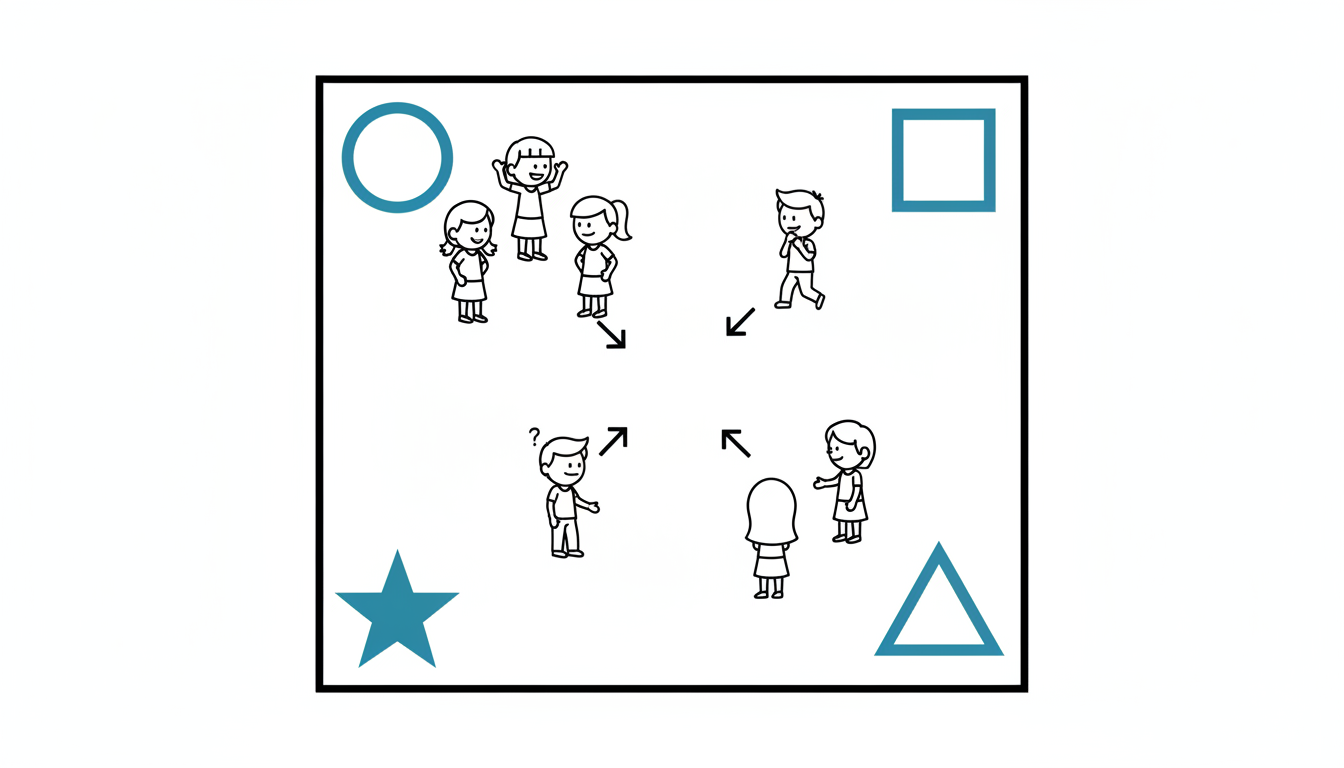
Physically demonstrate confidence levels by having students move to corners representing different understanding levels, making learning needs visible for targeted support and peer grouping.
How It Works
- Label corners (30 sec) - Post signs: "Got it!", "Getting there", "Need help", "Totally lost"
- Students move (1 min) - Based on confidence with concept, move to appropriate corner
- Form groups or address needs (1 min) - Use groupings for differentiated instruction or peer help
What to Say
Opening: "Four corners represent confidence levels with solving quadratic equations. 'Got it!' = can teach others. 'Getting there' = mostly understand. 'Need help' = confused on key parts. 'Totally lost' = don't know where to start. Move NOW—be honest!" During: [After movement] "Look around—you're not alone in your corner. 'Got it' people, you'll be peer tutors. 'Need help' and 'Totally lost,' you'll get targeted instruction." Closing: "This visual data tells me exactly how to use our next 20 minutes. Thank you for your honesty."
Why It Works
Physical movement energizes. Public commitment to corner increases honesty. Teacher instantly sees class distribution. Students see they're not alone in confusion. Enables immediate differentiation and peer pairing.
Teacher Tip
Use 4 corners, not 3—gives students more nuanced options. "Need help" vs. "Totally lost" matters for grouping decisions.
Variations
Labels: Confidence levels, skill mastery stages, readiness for test, interest levels • Follow-up: Differentiated tasks by corner, peer tutoring pairs, targeted mini-lessons • Ages: K-5: simple 3-corner system; 6-12: 4 corners; College: nuanced competency levels
Online
Use polling tool with 4 options. Assign breakout rooms based on responses for differentiated instruction.
Troubleshooting
Everyone goes to "Got it": "Tomorrow's quiz includes this concept—be honest about your real confidence."
Extension
After targeted instruction, repeat Confidence Corners. Watch students physically move to higher confidence levels—visible growth.
Related: Four Corners, Traffic Light Self-Assessment