
Predict-Observe-Explain
At a Glance
- Time: 3-5 minutes
- Prep: Demonstration or image to show
- Group: Whole class or pairs
- Setting: Any
- Subjects: Science (adaptable to others)
- Energy: Low
Purpose
Activate prior knowledge and scientific thinking by having students predict an outcome before observing it. This classic inquiry strategy reveals misconceptions, creates curiosity, and models the scientific method. The cognitive dissonance between prediction and reality drives deep learning.
How It Works
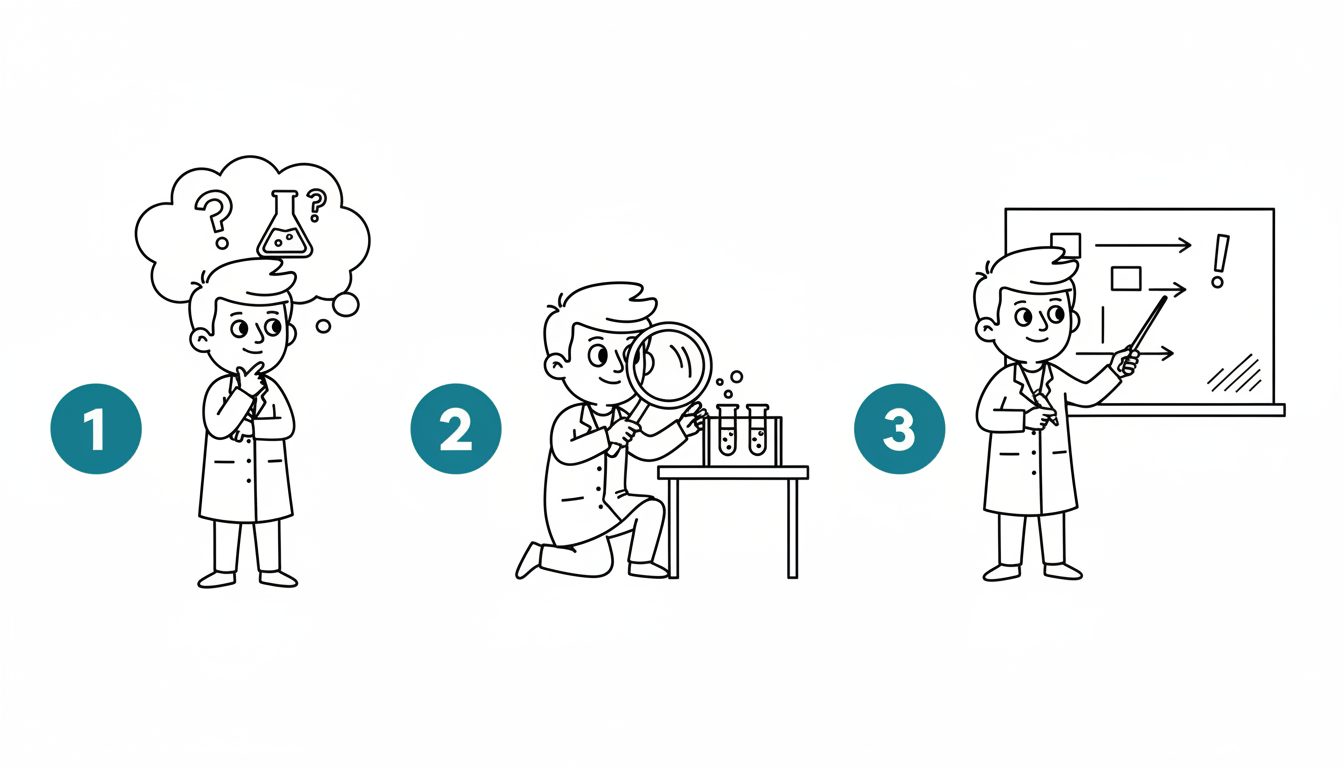
- PREDICT (60-90 seconds) - Present a scenario; students predict what will happen and why
- OBSERVE (30-60 seconds) - Conduct demonstration or show result
- EXPLAIN (90-120 seconds) - Students explain what happened; discuss discrepancies between predictions and observations
What to Say
"I'm going to show you something in a moment. But first, I want you to PREDICT what will happen. Here's the situation: [describe scenario]. What do you think will happen? Why? Turn to a partner and make your prediction. You have 60 seconds."
(After predictions) "Okay, let's OBSERVE. Watch carefully."
(Conduct demonstration or show image/video)
"Now, EXPLAIN: What happened? Was it what you predicted? If not, why do you think it turned out differently?"
Example - Sinking/Floating:
- Predict: "I have a can of regular soda and a can of diet soda. I'm going to put them in water. Predict: Will they sink or float? Why?"
- Observe: (Place cans in water; diet floats, regular sinks)
- Explain: "What happened? Why did one float and one sink? What does this tell us about density?"
Why It Works
Prediction activates prior knowledge and creates investment in the outcome. When predictions are wrong, the surprise creates a "desirable difficulty" that enhances memory. POE explicitly models scientific inquiry: hypothesize → test → analyze. The structure reveals misconceptions in a low-stakes way—wrong predictions are reframed as learning opportunities. This approach teaches that science is about testing ideas, not already knowing answers.
Research Citation: Predict-Observe-Explain improves conceptual understanding and engages learners in authentic scientific practices (White & Gunstone, 1992).
Teacher Tip
Choose phenomena that will surprise students! The bigger the gap between prediction and reality, the more memorable the learning. Also, celebrate wrong predictions: "This is excellent! You had a hypothesis, and now we get to revise it based on evidence."
Variations
Sample POE Scenarios
Science - Physics:
- Will a feather and a rock fall at the same speed in a vacuum?
- What happens when you mix baking soda and vinegar?
- Will a penny or a paper clip conduct electricity?
Science - Biology:
- What will happen to a plant left in the dark for a week?
- Will warm water or cold water evaporate faster?
Math:
- If I cut a circle in half, then in half again, what fraction do I have?
- What shape will this net fold into?
Social Studies:
- Look at this map. Predict where the highest population density is. Why?
Literature:
- Based on this opening paragraph, predict what the story will be about
Observation Methods
Live Demonstration: Teacher performs experiment/demonstration Video: Show a short clip of phenomenon Image Reveal: Show before/after images Simulation: Use digital simulation to show outcome
For Different Settings
- Large Class: Whole-class predictions; discuss as group
- Small Class: Everyone shares predictions before observing
- Online: Screen share demonstration or video
- Pairs: Partners discuss predictions together
For Different Ages
- Elementary (K-5): Simple, concrete phenomena; emphasize observation skills
- Middle/High School (6-12): More abstract concepts; discuss WHY it happened
- College/Adult: Complex phenomena requiring disciplinary knowledge to explain
Online Adaptation
Excellent for Online:
- Use screen share to show demonstrations or videos
- Polls for quick prediction tallies
- Breakout rooms for prediction discussions
- Chat for sharing explanations
- Works well virtually
Troubleshooting
Challenge: Students' predictions are all correct; no surprise. Solution: Choose more counterintuitive phenomena. Or extend: "You predicted correctly! Now explain the science behind WHY that happened."
Challenge: Students can't explain the observation; frustration builds. Solution: Scaffold: "Let's think about what we know about [concept]. How might that apply here?" Or: "That's what today's lesson is about—you'll understand by the end!"
Challenge: Students are embarrassed about wrong predictions. Solution: Normalize: "In science, being wrong is how we learn! Scientists make wrong predictions all the time, then revise based on evidence. That's literally how science works."
Challenge: No resources for live demonstration. Solution: Use videos, simulations, images, or thought experiments. POE doesn't require physical materials.
Challenge: Running out of time. Solution: Do Predict and Observe quickly (2 min total), then save Explain for after the lesson.
Extension Ideas
- Record Predictions: Students write predictions; revisit at lesson's end to compare
- Multiple Predictions: "Predict three possible outcomes. Rank them by likelihood."
- Scientific Explanation: After initial discussion, students write formal scientific explanations
- Design Experiment: "How could we test your prediction? Design an experiment."
- Iterative POE: Do multiple rounds with slight variations to test hypotheses
Related Activities: Anticipation Guide, Think-Pair-Share, KWL Chart