
Socratic Seminar
At a Glance
- Time: 20-30 minutes
- Prep: High - select text, prepare opening question
- Group: Whole class or inner/outer circles
- Setting: Chairs arranged in circle
- Subjects: Best for humanities, social studies
- Energy: Medium
Purpose
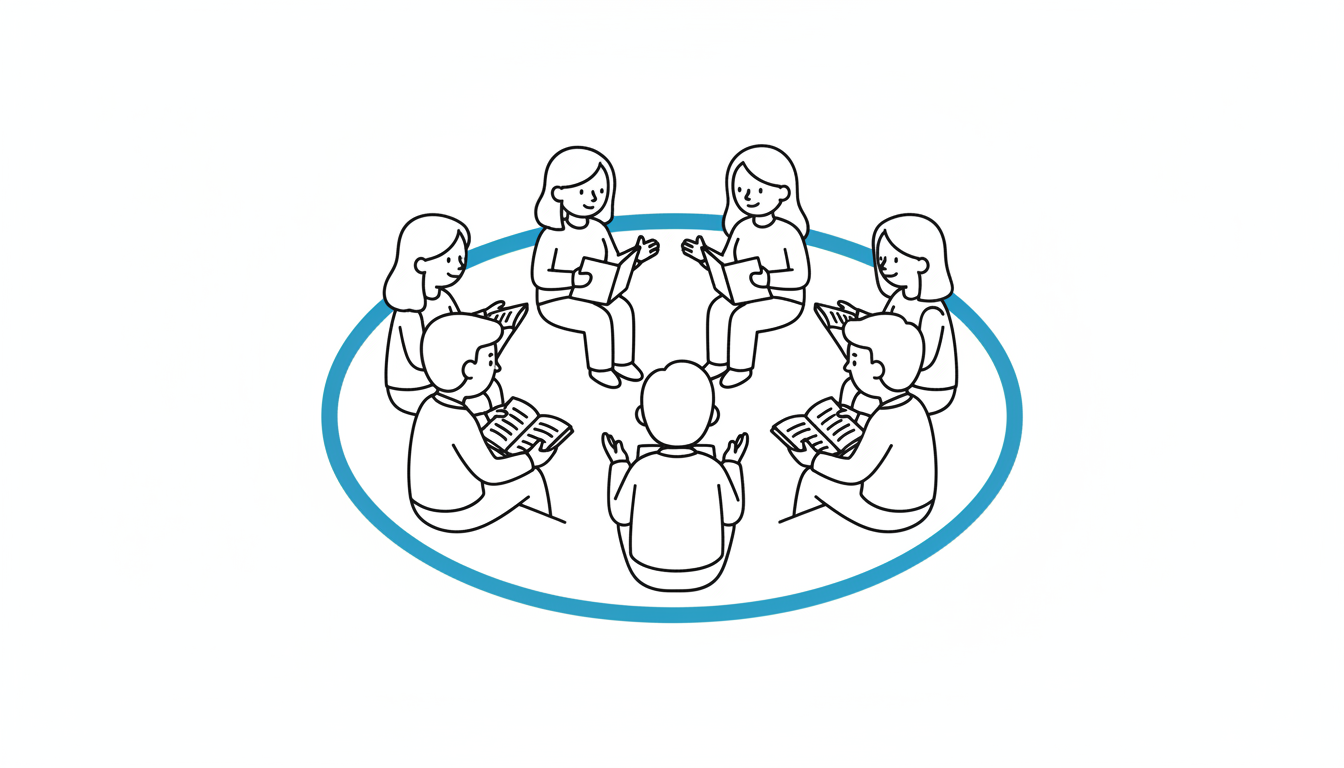
Socratic Seminar is a formal discussion protocol centered on a text, question, or idea. Students sit in a circle and engage in dialogue using open-ended questions, textual evidence, and respectful challenge. The teacher facilitates minimally—students lead the discussion. Use this for deep textual analysis, exploring complex issues, or developing sophisticated discussion skills.
How It Works
Step-by-step instructions:
-
PRE-READING (Before class) - Students read a complex text and annotate it with questions and observations.
-
ARRANGE CIRCLE (2 minutes) - All students sit in one circle, or create inner/outer circles (inner discusses, outer observes).
-
ESTABLISH NORMS (2 minutes) - Review Socratic Seminar norms: speak to each other (not the teacher), use evidence, listen actively, build on others' ideas.
-
OPENING QUESTION (1 minute) - Teacher poses an open-ended question about the text. No right answer—multiple interpretations possible.
-
STUDENT-LED DISCUSSION (15-20 minutes) - Students discuss. Teacher only intervenes to redirect, ask follow-up questions, or manage time. Students reference the text, ask each other questions, and build on ideas.
-
CLOSING REFLECTION (3-5 minutes) - Debrief the discussion: What did we discover? What evidence was most compelling? How did the discussion evolve our thinking?
-
WRITTEN REFLECTION (Optional homework) - Students write about how their understanding changed through dialogue.
What to Say
Norms: "In Socratic Seminar, YOU lead the discussion, not me. Speak to each other. Back up your ideas with evidence from the text. Listen to understand, not just to respond. Challenge ideas respectfully: 'I see it differently because...' or 'What about this passage that suggests...?'"
Opening Question: "Here's our opening question: [POSE OPEN-ENDED QUESTION]. Take 30 seconds to think, then someone begin."
During (Minimal Intervention): [Teacher mostly listens. Occasionally: "Can someone respond to that point?" or "I'd like to hear from someone who hasn't spoken yet" or "Can you point to evidence in the text?"]
Closing: "Let's pause our discussion. What did we discover today that wasn't obvious when we first read the text? Whose comment made you think differently?"
Why It Works
Socratic Seminar develops high-level thinking and communication skills:
Student Ownership: When students lead, they engage more deeply than when the teacher controls discussion.
Textual Grounding: Requiring evidence prevents unfounded opinions and teaches close reading.
Intellectual Humility: Open-ended questions with no single answer teach students to hold uncertainty and consider multiple perspectives.
Dialogue Skills: Students practice building on others' ideas, not just waiting for their turn.
Meta-Cognition: Reflection after the seminar makes students aware of how dialogue changes thinking.
Research Citation: Based on Socratic method, research shows that question-driven dialogue develops critical thinking more effectively than lecture (Paul & Elder, 2007).
Teacher Tip
Your hardest job is staying silent. Resist the urge to "correct" or add your interpretation. If students go off-track, ask a redirecting question: "How does that connect to the text?" rather than lecturing. The awkward silences are productive—students are thinking.
Variations
For Different Subjects
- Literature: Analyze themes, characters, author's choices in complex texts.
- History: Examine primary source documents, debate historical interpretations.
- Science: Discuss ethical implications of scientific advances, analyze conflicting studies.
- Philosophy: Explore philosophical questions using short texts.
For Different Settings
- Large Class (30+): Use inner/outer circle. Half discuss while half observe, then switch.
- Small Class (12-20): One circle with whole class.
- Online: Works in main Zoom room. Establish speaking order or use "raise hand" feature.
For Different Ages
- Elementary (K-5): Use simpler texts and shorter time (10-15 minutes). Model extensively before expecting independence.
- Middle School (6-8): Standard format. May need more teacher prompting initially.
- High School (9-12): Can handle sophisticated texts and extended seminars (30-40 minutes).
- College/Adult: Ideal format. Students can lead entire seminar without teacher present.
Online Adaptation
Tools Needed: Video conferencing (Zoom, Google Meet)
Setup: Everyone stays in main room with cameras on.
Instructions:
- All students have the text open
- Teacher poses opening question
- Students unmute themselves to speak (or use hand-raising feature to order speakers)
- Discussion proceeds as in person
- Teacher facilitates minimally
Pro Tip: In virtual seminars, use the chat for students to post textual evidence (page numbers, quotes) so everyone can reference them during discussion.
Troubleshooting
Challenge: Only 5 students speak; the rest are silent.
Solution: Use inner/outer circle format so everyone gets a turn. Or set participation expectations: "Everyone must speak at least once and no more than 3 times."
Challenge: Discussion becomes argument or personal attacks.
Solution: Stop and re-establish norms: "We're debating ideas, not people. Disagree with the interpretation, not the interpreter. Try: 'Another way to read this passage is...'"
Challenge: Students offer opinions without textual support.
Solution: Require: "Can you point us to the part of the text that supports that?" Model this repeatedly until it becomes habit.
Challenge: Discussion stalls after 5 minutes.
Solution: Have 2-3 backup questions ready. Or ask: "What questions do YOU have about this text?" and let students generate the next direction.
Extension Ideas
-
Deepen: Conduct multiple Socratic Seminars on the same text across several days, each with a different opening question, watching how understanding evolves.
-
Connect: Have students create their own opening questions for future seminars—this teaches them what makes a good seminar question.
-
Follow-up: Written reflection: "The discussion changed my thinking about [TEXT] because... One piece of evidence that was particularly compelling was... One question I still have is..."
Related Activities: Fishbowl Discussion, Circle of Voices, Philosophical Chairs